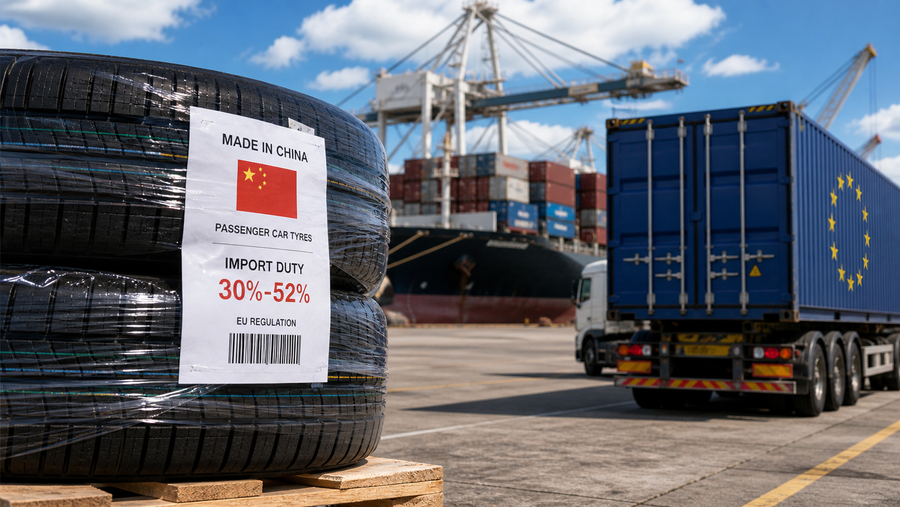

The European Commission has calculated provisional import duty levels on Chinese passenger car and light vehicle tyres, setting rates of 30% for cooperating companies and 52% for all other firms. Hankook was listed separately at 3.4%, indicating that it received an individual assessment rather than being folded into the residual China-wide rate.
The case marks a significant escalation in EU trade defence action against Chinese tyre imports. Brussels launched the investigation in May 2025 after a complaint from the tyre industry alleging that dumped Chinese imports were harming European producers, and the Commission said at the time that the market for passenger car and light lorry tyres in the EU was worth more than €18 billion in 2024.
The new duty range follows the Commission’s completion of its year-long probe into passenger car and light vehicle tyres from China. The case covers a segment central to wholesalers, retail networks, online tyre sellers and fleet suppliers, rather than only specialist or heavy-duty channels.
The immediate impact will be felt in landed costs. Importers handling affected Chinese-origin products may have to absorb higher costs, renegotiate supply terms or pass increases into retail and fleet pricing. That could narrow the gap between budget imports and European or non-Chinese alternatives.
For Chinese tyre brands, the duties could reduce one of their strongest competitive tools in Europe: price. Manufacturers may respond by adjusting product mix, increasing emphasis on higher-value fitments, or reviewing country-of-origin planning where they have production outside China.
For European manufacturers, the measure offers potential breathing space in a segment where price pressure has been persistent. The Commission’s launch notice said duties could follow if dumping and injury were established and if action was in the EU interest.
The strongest industry angle is that these duties may alter market behaviour. A 30% duty for cooperating companies is already material, while a 52% rate for others could force a sharper reassessment of sourcing, especially for importers exposed to lower-priced private-label or budget passenger tyres.
Tyre News previously reported the formal opening of the anti-dumping probe into Chinese passenger tyres in May 2025. That report noted the case was designated AD733 and linked the action to the Coalition Against Unfair Tyre Imports.
The new duty levels also sit alongside a separate EU anti-subsidy investigation into Chinese car and light truck tyres, opened in November 2025. The subsidy case complements the earlier anti-dumping action and adds another layer of risk for importers and exporters.
The development matters because Europe is one of the world’s largest tyre replacement markets. Duties at this level can influence pricing floors, distributor behaviour and the competitiveness of brands that have built share through aggressive pricing.
The case also signals that Brussels is prepared to extend robust trade defence beyond truck and bus tyres. The Commission noted in May 2025 that anti-dumping and anti-subsidy measures were already in force on Chinese bus and lorry tyres, and passenger car and light vehicle tyres now appear to be moving into the same policy arena.
Tagged with: Chinese tyre imports, EU anti-dumping duties, passenger car tyres, light vehicle tyres, tyre import duties, EU tyre market, tyre pricing, tyre wholesalers, budget tyres, Hankook, tyre trade defence
Editorial Standards & Disclaimer
Tyre News Media is an independent industry publication. Our reporting is based on information available at the time of publication, including company announcements, regulatory filings, official data, research and other sources considered reliable.
Articles may include independent analysis and editorial interpretation. Where appropriate, company statements and third-party claims are attributed to their source. Analysis, estimates and forward-looking observations should not be read as statements of established fact.
Tyre News Media takes reasonable steps to ensure accuracy but welcomes corrections, clarifications and responses from organisations or individuals covered in our reporting. If you believe information is inaccurate or requires clarification, please contact info@tyrenews.co.uk. Material errors will be corrected as appropriate.
Commercial relationships, advertising and sponsorship do not determine Tyre News Media's editorial coverage or conclusions.

_0%20(1).png)













%20(1).jpeg)