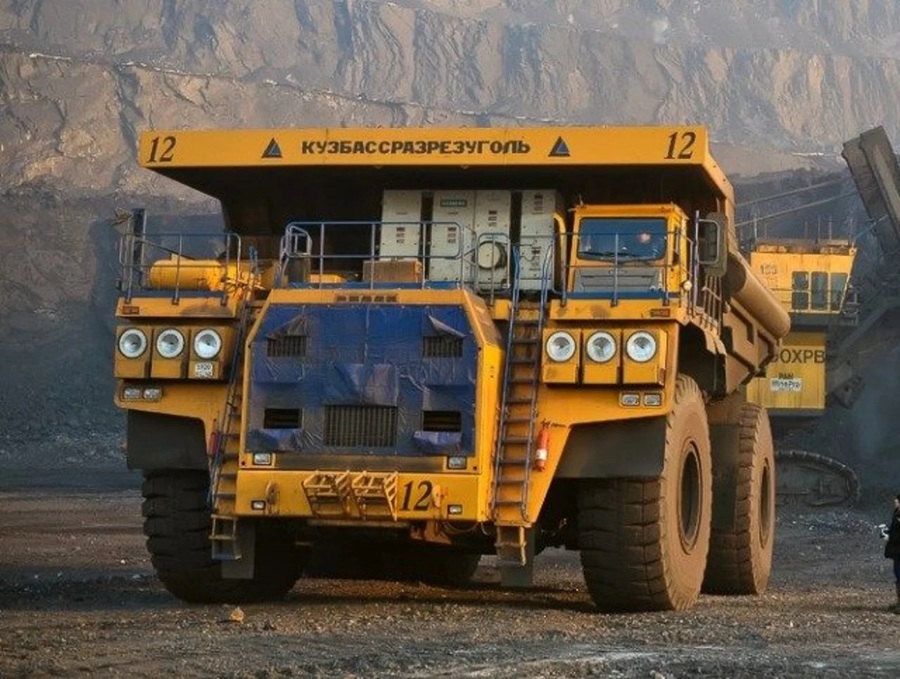

Russia has approved construction of its first dedicated large and ultra-large OTR tyre plant, a RUB60 billion investment designed to supply mining dump trucks and other heavy equipment. With planned capacity of about 10,500 tyres a year, the Omsk project is substantial enough to reshape domestic supply. The harder question is whether production capacity can translate into qualified, competitive tyres that Russian mines will use.
The planned factory in the Avangard Special Economic Zone in Omsk has moved from industrial proposal towards physical reality. Omsk governor Vitaly Khotsenko said this month that the project had received construction permission, with production expected to begin in late 2028 or early 2029. More than 600 jobs are planned and annual design capacity is around 10,500 large and ultra-large tyres for mining and other heavy equipment.
Those figures make this more than another tyre factory investment. Russia is attempting to establish domestic capability in one of the industry's most capital-intensive and technically demanding product categories, where tyre availability and performance can directly affect haul-truck utilisation and mine productivity.
There is also evidence that the scale and timetable of the investment have changed significantly. In July 2025, the project was valued at RUB41.5 billion, with production expected to begin in the first quarter of 2028 and capacity already set at 10,500 tyres annually. The latest RUB60 billion figure therefore represents an increase of about 45% while stated nameplate capacity has remained unchanged, alongside a later expected start date.
That does not establish why project costs have risen, and the reason should be put to the developer rather than inferred. It does, however, make the economics and intended product mix increasingly important to understanding what Russia is building.
The most interesting number in the project is its capacity.
One recent Russian industry analysis estimates domestic consumption of ultra-large tyres at 15,000 to 20,000 units annually. That estimate is not an official market statistic and should be treated cautiously, particularly because definitions of large and ultra-large tyres vary. On its figures alone, however, 10,500 units would equate to roughly 53% to 70% of annual Russian demand.
A separate bottom-up assessment produces another perspective. A recent analysis of the Russian and CIS mining haul-truck fleet puts Russia's population at approximately 8,967 machines, including about 6,808 BelAZ trucks, 1,120 Komatsu units and 887 Caterpillar machines. It identifies the 130-tonne and 220-tonne categories as particularly important within the Russian fleet.
Tyre News Media modelling of the large rigid-truck population suggests that annual replacement requirements for the tyre sizes potentially relevant to the Omsk project could be of broadly the same order of magnitude as the plant's 10,500-unit capacity. That calculation is highly sensitive to assumptions about which truck classes and tyre sizes qualify, fleet utilisation and actual tyre life, so it should not be presented as measured Russian consumption.
It nevertheless raises an important strategic question: has the factory effectively been sized around Russia's domestic requirement for the mining tyres it intends to manufacture?
There is some evidence that demand visibility has influenced the investment case. Earlier project reporting said a substantial part of output was already supported by orders, while another Russian report said approximately half of future production was expected to be consumed within the Ural Mining and Metallurgical Company, or UMMC, group. In July, Khotsenko told President Vladimir Putin that the project was being developed by UMMC and Chinese partners.
If around half of output ultimately has an internal customer, the commercial challenge facing the plant is materially different from that of a greenfield manufacturer trying to establish demand for its entire capacity.
Capacity, however, should not be confused with import substitution.
Giant mining tyres operate under high loads, heat build-up and repeated deformation, making casing integrity, compound performance and correct application critical. Mines ultimately buy operating performance rather than manufacturing nationality. Tyre life, unplanned failures, availability, TKPH capability and technical support all feed into cost per operating hour.
Competition is also advancing. Chinese manufacturers have increasingly moved into the large and ultra-large OTR segment, meaning Omsk will enter a market where the technical benchmark is already moving higher. Tyre News Media has previously reported on Linglong’s development of a 59/80R63 giant OTR tyre and Prinx Chengshan’s production of its first 30.00R51 giant mining tyre.
Performance development is extending beyond simply producing increasingly large tyres. Triangle’s EnsureX giant OTR technology, for example, targets delamination, casing durability and service life, illustrating how competition in mining tyres increasingly centres on operational economics rather than size alone. Triangle's reported performance improvements remain manufacturer claims, but the direction of competition is significant.
For Omsk, therefore, the decisive milestone will not necessarily be the first tyre leaving the production line. It will be successful validation of the relevant sizes under Russian mining conditions and acceptance by fleet operators.
The project's economics underline the scale of the commitment. RUB60 billion divided by 10,500 units of annual nameplate output represents approximately RUB5.7 million of investment for each unit of annual tyre capacity. That is not a measure of tyre production cost, but it illustrates the capital required to establish this type of domestic manufacturing capability.
It also increases the importance of utilisation. If domestic demand for the plant's specific size range proves materially below 10,500 tyres, Omsk would need to compete for replacement share, extend its product mix, supply OE requirements, export into neighbouring markets or operate below nameplate capacity. Earlier official reporting identified Kuzbass and Russia's Far East as target markets.
Conversely, if the factory's planned size mix maps closely onto domestic replacement demand, the investment becomes a much more direct attempt to remove a strategic supply dependency.
That distinction cannot yet be resolved from publicly available information. The missing piece is the production mix. Confirmation of planned volumes across 49-, 51-, 57- and 63-inch products, together with the intended truck applications, would allow the 10,500-unit capacity to be tested properly against Russia's installed mining fleet.
It would also clarify the competitive consequences. Russia's new domestic capacity will not enter the same market that existed before Western tyre suppliers reduced their exposure to the country. Chinese manufacturers have expanded their technical capabilities and market presence in giant OTR tyres in the intervening period. If Omsk succeeds, some of the market share it seeks to localise may therefore come from suppliers that benefited from the earlier disruption.
Russia has secured permission to build the factory. Establishing whether it can replace imported mining tyres requires a different test: how quickly Omsk can produce validated tyres at the required sizes, achieve competitive cost-per-hour performance and persuade mining fleets to rely on the resulting casings.
The answer will determine whether RUB60 billion has created another tyre factory, or a genuinely self-sufficient Russian supply base for one of mining's most critical consumables.
Tags: Russia OTR tyre factory, Omsk tyre plant, giant mining tyres, ultra-large OTR tyres, mining tyres, dump truck tyres, OTR manufacturing, Russian tyre industry, Avangard SEZ, mining tyre supply
Editorial Standards & Disclaimer
Tyre News Media is an independent industry publication. Our reporting is based on information available at the time of publication, including company announcements, regulatory filings, official data, research and other sources considered reliable.
Articles may include independent analysis and editorial interpretation. Where appropriate, company statements and third-party claims are attributed to their source. Analysis, estimates and forward-looking observations should not be read as statements of established fact.
Tyre News Media takes reasonable steps to ensure accuracy but welcomes corrections, clarifications and responses from organisations or individuals covered in our reporting. If you believe information is inaccurate or requires clarification, please contact info@tyrenews.co.uk. Material errors will be corrected as appropriate.
Commercial relationships, advertising and sponsorship do not determine Tyre News Media's editorial coverage or conclusions.



















%20(1).jpeg)