
Balkrishna Industries is moving into the execution phase of a growth programme intended to take annual revenue to around ₹23,000 crore by FY30, backed by approximately ₹6,800 crore of cumulative investment across its core off-highway tyre business, carbon black, infrastructure and new on-road tyre categories in India.
Balkrishna Industries’ route towards its FY30 revenue ambition is becoming clearer as capacity additions, new product launches and previously announced capital programmes move forward.
The tyre manufacturer closed FY26 with consolidated revenue from operations of approximately ₹10,823 crore. It then reported consolidated Q1 FY27 revenue of ₹3,455.27 crore, up 25.2% year on year, while profit for the period increased 56.4% to ₹450.77 crore. The stronger opening quarter gives BKT a firmer trading base as spending on its longer-term growth programme continues, although the new on-road categories remain too early in their development to attribute the current growth to them.
The broader objective is to reach around ₹23,000 crore in revenue by FY30. That ambition predates the latest results and is not based on a single expansion project. Instead, BKT is pursuing three main growth levers: further expansion of its established off-highway tyre franchise, greater integration through carbon black and power generation, and the creation of an Indian on-road tyre business.
Despite BKT’s move into mainstream automotive tyres, off-highway tyres remain fundamental to the growth programme.
The company has previously said its tyre manufacturing capacity of around 360,000 tonnes per year can be expanded to approximately 425,000 MTPA through announced additions and debottlenecking. Management has linked that capacity to an ambition of reaching around 8% of the global OHT market by FY30.
That distinction matters because BKT’s diversification does not represent a withdrawal from the specialist markets on which it built the business. Investment in agriculture, mining, construction and other OHT applications is continuing alongside the development of the newer product categories.
The company’s ₹6,800 crore cumulative capital programme reinforces the point. An initial ₹1,300 crore package announced in August 2024 related to OHT tyres. A further ₹3,500 crore announced in May 2025 covers on-highway tyres, rubber tracks, carbon black and power generation. BKT subsequently approved another ₹2,000 crore for capacity and infrastructure across OHT and on-highway tyres, AI-enabled automation in the on-highway business and sustainability initiatives.
The full investment figure should therefore not be read as spending on passenger-car or other on-road tyres alone.
The most visible diversification is BKT’s move into larger Indian automotive tyre categories.
BKT has introduced truck and bus radial and two-wheeler products and is preparing to add passenger-car radials. Earlier company presentations set out a modular approach, with the passenger-car radial pilot scheduled for Q3 FY27. Recent reporting has placed the launch in November, which falls within that quarter.
Management has positioned FY27 principally as a market-building period, with a more material contribution expected as distribution and volumes develop. The stated ambition is for the on-road business to generate around ₹5,000 crore of revenue by FY30.
“Our vision is ₹5,000 crore by 2030,” Satish Sharma, Senior President & Director – Business Development and Strategy at Balkrishna Industries, said in recent comments on the programme. BKT has previously said the new categories could represent around 20% of revenue by FY30.
The scale of that opportunity is substantial, but the commercial outcome remains to be demonstrated. BKT is entering passenger-car and commercial-vehicle replacement markets with established competitors, and its capacity and revenue objectives are targets rather than evidence that the required market share has already been secured.
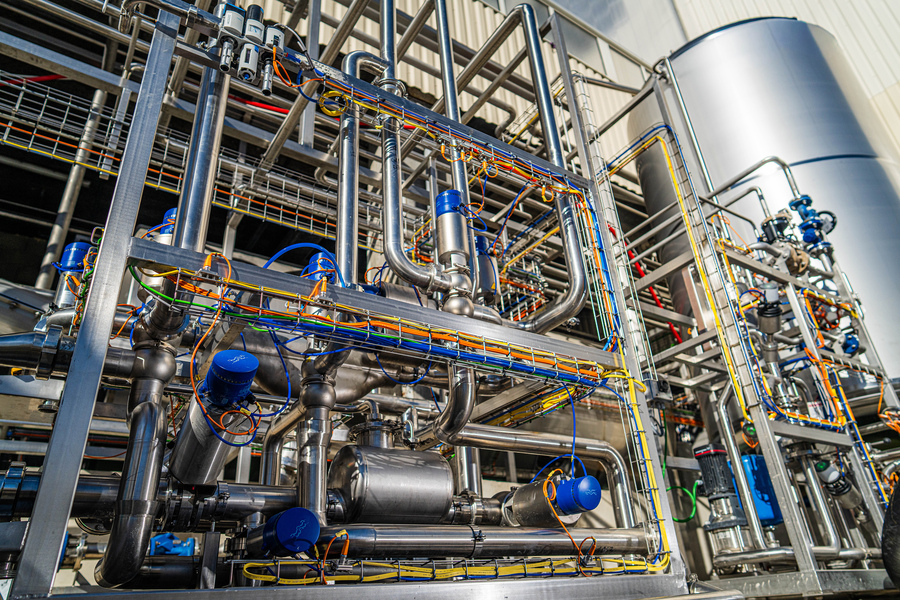
Alongside tyres, BKT is expanding its carbon black operation both as an external business and as part of a more integrated manufacturing platform.
Capacity reached approximately 265,000 MTPA following commissioning of a new line in December 2025, with BKT subsequently progressing towards total capacity of about 360,000 MTPA. The company has also increased captive power generation at Bhuj from 40MW to 64MW.
For BKT, this investment combines additional third-party carbon black sales with greater internal integration, including energy and raw-material synergies with tyre manufacturing.
Management has also maintained an ambition for blended EBITDA margins of around 23–25% once the enlarged businesses are fully commercialised. The company reiterated in its May 2026 earnings call that this was a group-level objective despite the expansion into on-highway tyres, while acknowledging that nearer-term raw-material pressures could affect margins.
Taken together, the FY30 programme is broader than a diversification into consumer tyres. BKT is simultaneously adding capacity to the specialist OHT franchise that remains its core business, expanding upstream integration and creating positions in much larger Indian automotive categories.
The ₹23,000 crore revenue ambition will ultimately depend on execution across all three. For now, the latest disclosures provide a clearer picture of where the capital is being deployed and how BKT expects each part of the business to contribute to its FY30 objective.
SEO Tags: Balkrishna Industries, BKT, BKT Vision 2030, off-highway tyres, OHT tyres, carbon black, passenger car tyres, truck tyres, tyre investment, tyre manufacturing
Editorial Standards & Disclaimer
Tyre News Media is an independent industry publication. Our reporting is based on information available at the time of publication, including company announcements, regulatory filings, official data, research and other sources considered reliable.
Articles may include independent analysis and editorial interpretation. Where appropriate, company statements and third-party claims are attributed to their source. Analysis, estimates and forward-looking observations should not be read as statements of established fact.
Tyre News Media takes reasonable steps to ensure accuracy but welcomes corrections, clarifications and responses from organisations or individuals covered in our reporting. If you believe information is inaccurate or requires clarification, please contact info@tyrenews.co.uk. Material errors will be corrected as appropriate.
Commercial relationships, advertising and sponsorship do not determine Tyre News Media's editorial coverage or conclusions.














%20(1)%20(1).png)


%20(1).jpeg)