.jpg)

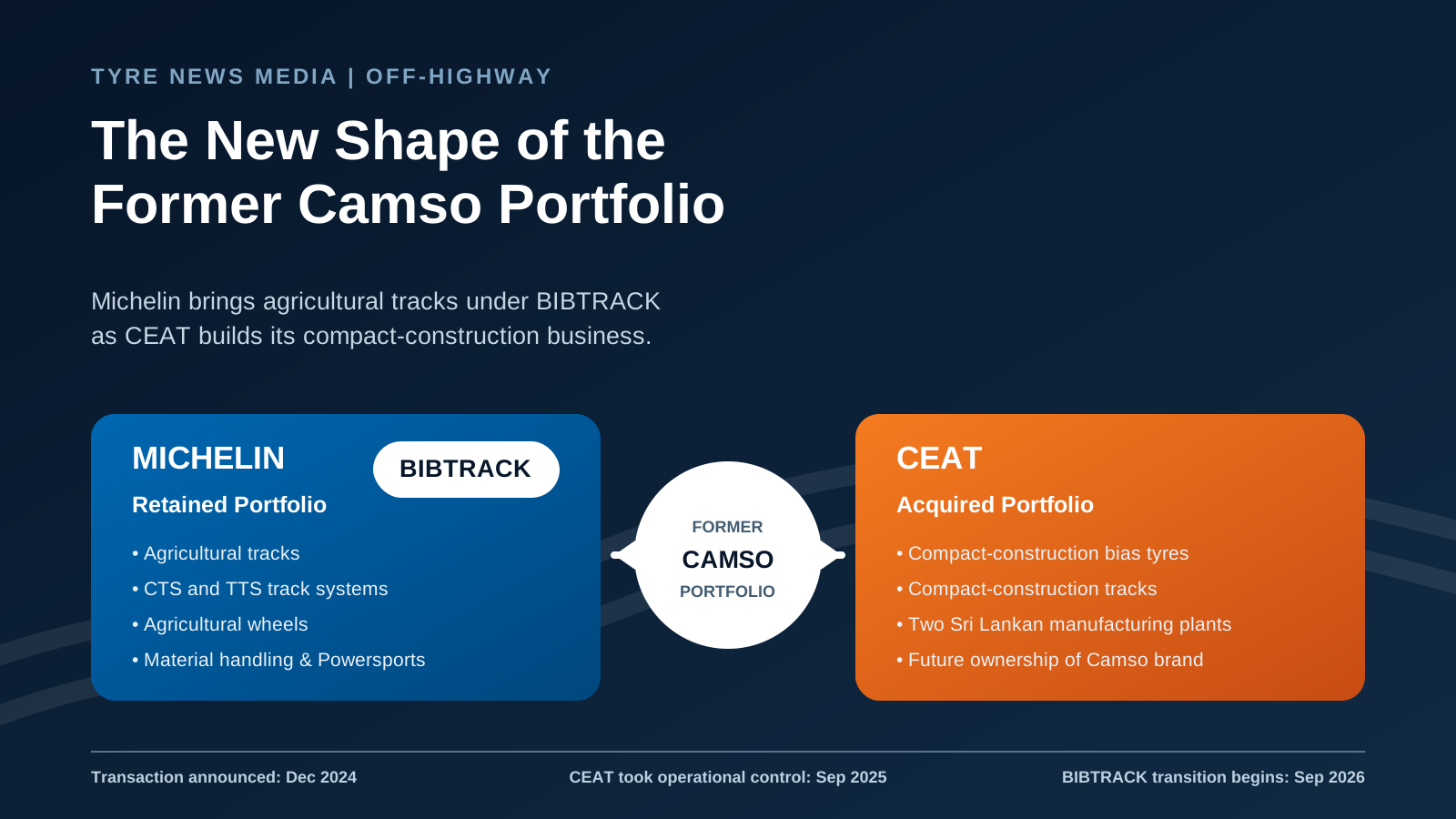
Michelin is moving its retained Camso agricultural track portfolio under the Michelin name, introducing MICHELIN BIBTRACK from September 2026. The rebranding does not change the underlying products, but it provides one of the clearest signs yet of how the former Camso business is being divided between Michelin and CEAT following their $225 million transaction.
Michelin’s introduction of BIBTRACK is primarily a branding change rather than a new-product launch. Agricultural tracks previously sold as Camso products will progressively adopt MICHELIN BIBTRACK names, while conversion track systems (CTS) and trailed track systems (TTS) will move to Michelin branding without changing their existing product names. Michelin says product performance, quality standards and manufacturing processes are unchanged, with the transition expected to run from September 2026 until the end of June 2027.
For customers and dealers, that means Camso- and Michelin-branded agricultural products will coexist during the transition. Existing Camso warranties will remain valid, according to Michelin, while sales, customer service and technical support teams remain in place. One example of the naming change is the Camso 3500 Positive, which becomes the MICHELIN BIBTRACK 150 POSITIVE.
The significance lies less in the product itself than in what the name change says about the restructuring of the former Camso portfolio.
The transition follows Michelin’s disposal of Camso’s compact-construction equipment bias tyre and track activities to CEAT. The transaction, announced in December 2024 at approximately $225 million, included a business generating around $213 million of revenue in 2023, two manufacturing facilities in Sri Lanka and the eventual global ownership of the Camso brand. CEAT took control of the acquired operations on 1 September 2025.
Michelin retained agricultural tracks and track systems, among other off-highway activities. The result is that products which previously shared the Camso identity are now moving in different directions: the compact-construction business is being integrated into CEAT, while Michelin is progressively removing Camso branding from agricultural products it retained.
That separation is commercially important because the Camso name itself forms part of the CEAT transaction. CEAT has said the brand will be permanently assigned to it across categories after a three-year licensing period, with a further payment of approximately $44 million associated with the formal brand transfer.
Tyre News Media has previously examined how CEAT is using the Camso acquisition to expand its off-highway tyre reach, including the importance of tracks, premium customers and developed markets to the Indian manufacturer’s international ambitions.
For Michelin, BIBTRACK brings the retained track operation into an agricultural naming architecture already established through ranges including AGRIBIB, AXIOBIB, YIELDBIB and EVOBIB. Michelin explicitly links the BIBTRACK designation to that agricultural heritage and says the change is intended to create a more consistent portfolio of tyres, tracks and systems.
That makes BIBTRACK better understood as portfolio consolidation than product development. Michelin already owns the agricultural track expertise and products concerned. What changes is the identity presented to farmers, equipment manufacturers and distribution channels.
There is a practical commercial benefit to that simplification. A customer encountering Michelin agricultural tyres and tracks can increasingly deal with a single master brand rather than navigating the relationship between Michelin and Camso. Michelin’s UK commercial operation is already presenting BIBTRACK alongside its wider agricultural track and system offer.
The transition therefore removes some of the brand complexity left by Michelin’s acquisition of Camso while also preparing for a future in which Michelin will no longer own the Camso name.
The transaction looks different from CEAT’s perspective. The company acquired not only manufacturing assets and existing compact-construction sales but access to more than 40 international OEM customers and premium off-highway distributors, alongside track technology and a recognised position in Europe and North America.
This complements CEAT’s broader effort to establish a stronger international off-highway business. Its expansion is also occurring alongside a more local European operating structure, which Tyre News Media examined in its coverage of CEAT’s growing presence across European markets.
The important distinction is that CEAT’s ambitions are not necessarily confined permanently to the compact-construction categories transferred by Michelin. In its December 2024 acquisition call, CEAT management specifically discussed opportunities in agricultural and harvester tracks after the Camso brand becomes available to it, while the original transaction announcement said Camso could expand into areas including agricultural tyres.
That does not establish that CEAT and Michelin will become direct competitors across agricultural tracks, nor does it reveal precisely how CEAT will deploy Camso once the licensing period ends. It does, however, make the eventual brand transfer strategically more significant than a straightforward change of ownership for the existing compact-construction range.
CEAT is acquiring a brand it believes can support expansion into additional off-highway categories. Michelin, meanwhile, is ensuring that agricultural track products remaining within its business become identified directly with Michelin before that transfer is completed.
For agricultural dealers and customers, the immediate consequences should be relatively modest. Michelin says the products, manufacturing processes and performance remain unchanged, and the transition is being phased rather than imposed at a single cut-off point. The main near-term requirement will be navigating equivalent product names and the temporary coexistence of Camso and Michelin branding.
The longer-term significance is clearer. Two businesses that previously operated beneath the Camso identity are developing increasingly distinct commercial identities and ownership structures.
Michelin is folding retained agricultural tracks into its core agricultural brand architecture. CEAT has taken control of the compact-construction operations and manufacturing assets while preparing for permanent ownership of the Camso brand, which it has already identified as a potential platform for broader off-highway expansion.
BIBTRACK is therefore not the beginning of Michelin’s agricultural track business. Nor, on the evidence currently available, should it be treated as a new technological generation. Its importance is as a visible marker of the post-transaction landscape: Michelin is putting its name firmly behind the track activities it retained, while Camso is moving towards a future under CEAT.
Tags: Michelin BIBTRACK, Michelin agricultural tracks, Camso, CEAT, off-highway tyres, agricultural tracks, OHT tyres, rubber tracks, Camso acquisition, agricultural tyres, CEAT Camso
Editorial Standards & Disclaimer
Tyre News Media is an independent industry publication. Our reporting is based on information available at the time of publication, including company announcements, regulatory filings, official data, research and other sources considered reliable.
Articles may include independent analysis and editorial interpretation. Where appropriate, company statements and third-party claims are attributed to their source. Analysis, estimates and forward-looking observations should not be read as statements of established fact.
Tyre News Media takes reasonable steps to ensure accuracy but welcomes corrections, clarifications and responses from organisations or individuals covered in our reporting. If you believe information is inaccurate or requires clarification, please contact info@tyrenews.co.uk. Material errors will be corrected as appropriate.
Commercial relationships, advertising and sponsorship do not determine Tyre News Media's editorial coverage or conclusions.
















.png)


%20(1).png)


%20(1).jpeg)