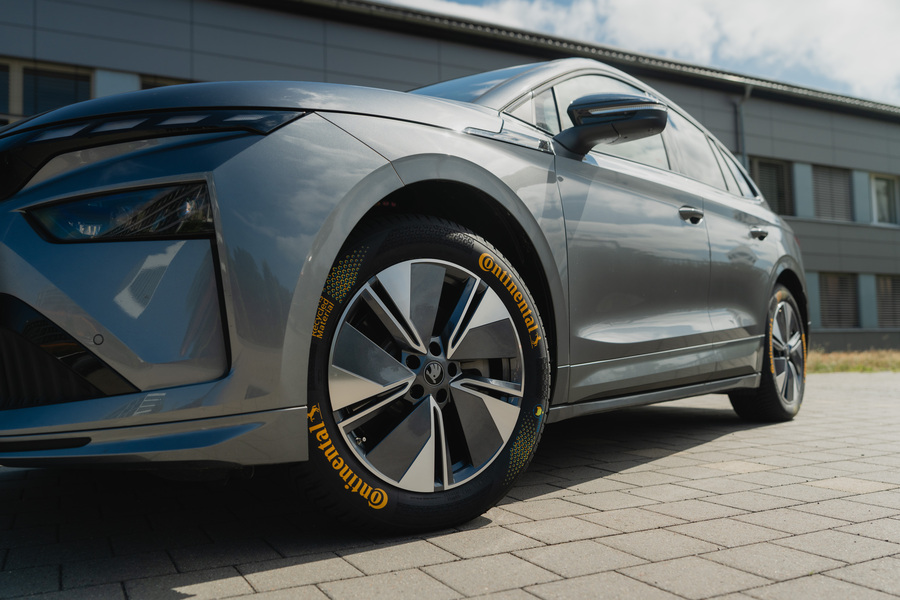

Continental has built a passenger tyre containing around 43% physically recycled materials while achieving the highest EU tyre-label rating for rolling resistance. The technical achievement is significant, but Continental’s own assessment of what comes next points beyond tyre development. Making such material use routine will depend on recycling capacity, consistent tyre-grade outputs, regulation and supply chains capable of operating at industrial scale.
Continental’s ZEvRA concept tyre provides evidence that substantial quantities of physically recycled material can be incorporated into a passenger tyre without automatically sacrificing a critical performance requirement.
Developed through the EU-funded Zero Emission Electric Vehicles Enabled by Harmonized Circularity project, the concept contains around 43% recycled materials. These include recycled steel and tall oil, rubber from end-of-life tyres, polyester fibres made from recycled PET bottles and materials recovered through processes including tyre pyrolysis. Continental says the tyre achieved the highest EU label rating for rolling resistance.
That combination matters. A tyre is a safety-critical composite in which material substitutions still have to meet tightly defined mechanical and performance requirements. But Continental is not presenting the concept as proof that a 43%-recycled tyre is ready for commercial mass production.
Instead, its description of the next stage concentrates on industrial availability and processing of recycled materials, manufacturing scale-up, regulatory definitions, recycling infrastructure, resilient supply chains and the allocation of material flows.
.jpg)
The distinction is becoming increasingly important. The tyre industry is accumulating evidence that more circular materials can work technically. The industrial system capable of supplying those materials consistently and economically is developing more slowly.
Europe does not lack end-of-life tyres. Tyres Europe data published in 2025, based on Astutus Research, estimated that almost 4.5 million tonnes of used tyres were generated across the EU27, UK, Norway and Switzerland in 2024. Around 600,000 tonnes were reused or retreaded, leaving approximately 3.9 million tonnes classified as end-of-life tyres. Passenger car and light truck tyres accounted for 64% of used-tyre tonnage.
That makes the industrial challenge more complicated than simply finding sufficient waste feedstock.
End-of-life tyres already have competing destinations. Historical European data shows substantial volumes going into material recycling and energy recovery, while recycled rubber has served markets including sports surfaces, flooring, construction and civil engineering. Moving towards tyre-to-tyre circularity therefore requires not only collecting ELTs, but converting their constituent materials into outputs of sufficient quality and consistency for new tyre manufacturing.
Recovered carbon black illustrates the problem particularly clearly.
Pyrolysis can convert end-of-life tyres into products including tyre pyrolysis oil and a carbon-rich solid which, following further processing, can become recovered carbon black. But the existence of pyrolysis technology does not mean every tonne of resulting material is interchangeable with the virgin carbon blacks used for different functions in a passenger tyre.
Bridgestone, for example, is working with Tokai Carbon and Japanese universities on secondary processing intended to give recovered carbon black reinforcing properties equivalent to virgin carbon black. The fact that further material development is required is itself significant: producing carbonaceous material from an old tyre and producing a consistent reinforcing material qualified for demanding new-tyre applications are different industrial problems.
Continental already uses recovered carbon black at its Korbach plant in newly produced solid tyres, principally for forklift applications. Moving recycled material further into passenger tyres expands the performance and consistency requirements involved.
The emerging pyrolysis industry also demonstrates the gap between technological capability, announced capacity and stable commercial output.
Figures presented to the Bureau of International Recycling in 2024 put global production of milled and pelletised recovered carbon black at about 180,000 tonnes annually, from 4.5 million tonnes of tyre feedstock processed by pyrolysis. The same assessment put European ELT pyrolysis capacity at only 62,400 tonnes of tyres a year at that point, although substantial expansion was expected.
Projects now under development show that investment is moving towards larger facilities.
The Michelin-backed joint venture with Antin Infrastructure Partners and Scandinavian Enviro Systems has been developing an end-of-life tyre recycling plant at Uddevalla in Sweden with stated capacity to process around 35,000 tonnes annually. Michelin described it as the first plant in a planned European expansion.
Pyrum, meanwhile, plans a new facility at Perl-Besch in Germany with capacity above 22,000 tonnes of used tyres annually and expected commissioning in 2027. Yet experience at its existing Dillingen operation shows why nameplate capacity alone is an incomplete measure of industrial readiness. During the commissioning of expanded recovered-carbon-black grinding and pelletising equipment in 2025, Pyrum reported meeting customer quality standards at an 800kg-per-hour throughput but also encountered material-handling constraints between grinding and pelletising.
These are ordinary industrialisation problems rather than evidence against the technology. They nevertheless demonstrate why announced recycling capacity cannot automatically be counted as available tyre-grade material.
Bridgestone provides another indication of the development stage. Its planned precise-pyrolysis demonstration plant in Japan is expected to process approximately 7,500 tonnes of end-of-life tyres annually when operations begin in 2027. The purpose is explicitly to demonstrate and optimise technology for recovering tyre-derived oil and carbon black before wider implementation.
Continental also argues that industrialisation requires common European definitions of recycled materials and clear criteria determining when processed substances qualify as recycled raw materials.
This is not merely a question of sustainability terminology.
Under the EU Waste Framework Directive, recovered materials can cease to be legally classified as waste when specified conditions are satisfied. The European Commission’s Joint Research Centre says a lack of clear rules for high-quality waste-derived materials can impede their use in the internal market, which is why EU-wide end-of-waste criteria are intended to support markets for secondary raw materials.
Rubber recovered from end-of-life tyres has previously been identified by the JRC as a priority stream for possible EU-wide end-of-waste criteria.
For an industrial circular supply chain, legal status affects more than vocabulary. Harmonised criteria can influence how recovered material is traded across borders, what quality assurance is required and whether a secondary material can circulate under a predictable regulatory framework comparable with conventional raw materials.
Continental is also calling for internationally coordinated approaches to material-flow allocation. That becomes increasingly relevant as tyre manufacturers use several different routes towards lower-virgin-material products, including physically recycled materials, renewable feedstocks and materials attributed through certified mass-balance systems. Those categories cannot simply be combined when assessing how much physical material has actually been recovered and returned to a tyre.
There are signs that the industry is beginning to construct the relationships needed to move beyond isolated material trials.
Pirelli began a North American closed-loop programme with Bolder Industries in 2026 in which scrap tyres from manufacturing are pyrolysed and recovered carbon black is returned to Pirelli tyre production. In Europe, Pirelli is also working with Pyrum, Synthos and BASF on a chain in which recovered carbon black goes directly back into tyre production while pyrolysis oil is used upstream in the production of chemical materials that can return as inputs for synthetic rubber.
Those arrangements point towards what industrial tyre circularity is likely to require: recyclers capable of producing specified outputs, tyre manufacturers prepared to qualify those materials, chemical companies able to process recovered feedstocks, traceability through the chain and sufficient commercial demand to justify investment in larger plants.
They also show why comparing headline percentages between tyres can be misleading. Pirelli has already put into production a P Zero for JLR containing more than 70% bio-based and recycled materials, but that figure includes several material categories and circular routes. Continental’s ZEvRA figure is specifically around 43% physically recycled material. They answer different questions about circularity and should not be treated as equivalent measures.
The ZEvRA tyre therefore marks progress without resolving the industrial question.
There appears to be enough end-of-life tyre material in Europe for feedstock availability alone to be an inadequate explanation of the current constraint. The more immediate gap lies between ELTs existing and those tyres being converted, at sufficient scale, into consistent materials that manufacturers can qualify for particular functions in new high-performance tyres.
Recovered carbon black makes that gap visible. Commercial production exists, manufacturers are using the material and larger plants are being developed. At the same time, producers and tyre companies are still investing in upgrading material properties, commissioning processing equipment, demonstrating larger pyrolysis systems and building dedicated closed-loop supply arrangements.
Regulation forms another part of that industrial system. Common definitions and clearer end-of-waste conditions cannot create tyre-grade material, but they can make investment, trade and qualification of secondary raw materials more predictable.
Continental’s 43% concept therefore shifts the practical question. The challenge is becoming less about whether recycled materials can enter a technically capable passenger tyre and more about whether the recycling and manufacturing chain can repeatedly supply the right materials, at the right specifications and volumes, under rules sufficiently clear to support investment.
That is a considerably larger industrial project than making the concept tyre itself.
Tags: recycled tyre materials, tyre recycling, recovered carbon black, tyre pyrolysis, end-of-life tyres, circular tyres, tyre manufacturing, recycled rubber, tyre-to-tyre recycling, Continental ZEvRA, secondary raw materials, circular economy
Editorial Standards & Disclaimer
Tyre News Media is an independent industry publication. Our reporting is based on information available at the time of publication, including company announcements, regulatory filings, official data, research and other sources considered reliable.
Articles may include independent analysis and editorial interpretation. Where appropriate, company statements and third-party claims are attributed to their source. Analysis, estimates and forward-looking observations should not be read as statements of established fact.
Tyre News Media takes reasonable steps to ensure accuracy but welcomes corrections, clarifications and responses from organisations or individuals covered in our reporting. If you believe information is inaccurate or requires clarification, please contact info@tyrenews.co.uk. Material errors will be corrected as appropriate.
Commercial relationships, advertising and sponsorship do not determine Tyre News Media's editorial coverage or conclusions.

















%20(1)%20(1).png)



%20(1).jpeg)