
Euro 7 is bringing tyre abrasion into the type-approval equation. As C1 regulation moves towards implementation and work advances on C2 and C3, TNM examines what changes for tyre development, and why regulating wear is not the same as measuring tyre life.
Tyre abrasion has spent years moving through test-method development, market assessment and regulatory negotiation. Following the September meeting of UNECE's Working Party on Noise and Tyres (GRBP), the Task Force on Tyre Abrasion is reporting the conclusion of its work on the C1 regulation, while work continues on C2 and looks ahead to C3.
For the European Union, Euro 7 gives that work a commercial deadline. From 1 July 2028, authorities will grant component or separate technical unit EU type approval only to new C1 tyre types complying with the regulation. New C2 tyre types follow from 1 April 2030 and C3 from 1 April 2032.
The practical change for tyre manufacturers is straightforward. Abrasion is becoming another performance that future tyres will have to satisfy for regulatory approval.
That does not mean Euro 7 can simply be described as a requirement to make tyres last longer.
UNECE's tyre-abrasion programme makes an important distinction between the amount of material a tyre loses during a defined test and the mileage that tyre might ultimately deliver in service.
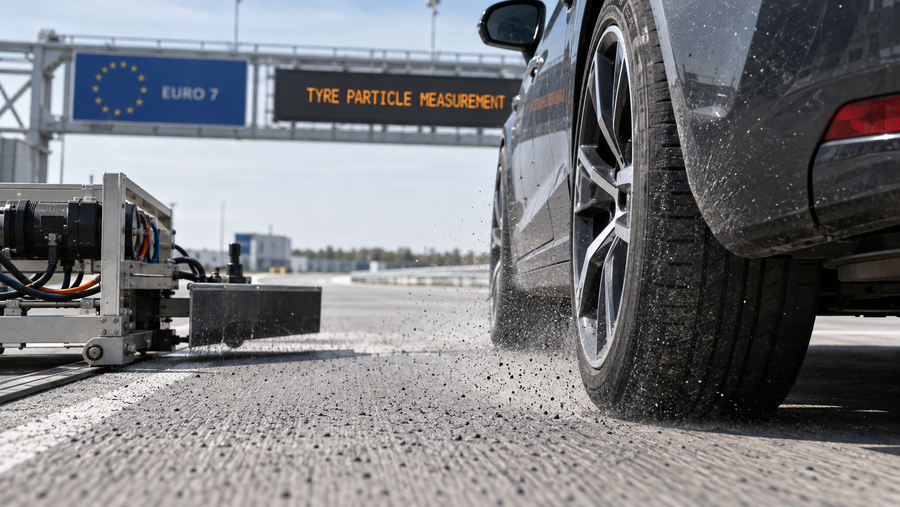
The regulatory work has developed methodologies for measuring abrasion, including an on-road vehicle convoy method and an indoor drum method for C1 tyres. The European Commission says the on-road method covers 8,000km on public roads. The objective is to create a repeatable basis on which abrasion performance can be assessed and minimum requirements applied.
Mileage potential is a different problem.
UNECE's Task Force terms of reference separately require it to evaluate the feasibility of characterising tyres by a "relative mileage potential calculated performance", potentially through an abrasion-based index. Subsequent technical work has considered using tread-depth measurements alongside abrasion-test data as part of that effort.
The distinction is commercially important. A tyre's measured abrasion performance under a prescribed regulatory procedure and the distance it can cover before reaching the end of its usable life are related questions, but regulators have not treated them as interchangeable.
Indeed, the European Commission said in its 2026 review of the Tyre Labelling Regulation that work so far had concentrated on abrasion minimum requirements and that it had urged the Task Force to develop a metric linked to tyre wear for assessing mileage potential.
For manufacturers, therefore, the immediate regulatory requirement is not simply "make tyres last longer". It is to demonstrate acceptable abrasion performance under the prescribed methodology while continuing to satisfy the other demands placed on the product.
Modern tyre development already involves balancing a large number of requirements. Wet grip, rolling resistance, noise, handling, durability, structural performance, application requirements and cost all have to coexist in one product.
Abrasion now joins that optimisation exercise as a regulated parameter.
That potentially reaches across several areas of tyre development. Compound formulation influences wear behaviour, but tread geometry, footprint behaviour, load distribution and tyre construction can also contribute to how a tyre wears. Regulatory testing also creates requirements around measurement, validation and repeatability that manufacturers have to incorporate into development programmes.
It would be premature, however, to assume that improved abrasion performance necessarily requires sacrificing wet grip, rolling resistance or another specific characteristic. Tyre engineering has always involved optimisation across interacting performances, but the nature and scale of any compromises associated specifically with the new abrasion limits will depend on product design and the technologies available to manufacturers.
The difference is that abrasion will no longer simply be another characteristic a manufacturer might choose to optimise. For new C1 tyre types in the EU from July 2028, a regulatory threshold will sit behind it.
Tyre wear already carries an obvious economic value.
For motorists, a tyre capable of covering more usable kilometres can reduce replacement frequency and potentially improve cost over its service life. For fleets, tyre life forms part of a wider calculation involving cost per kilometre, vehicle utilisation, maintenance and tyre management.
Manufacturers already have commercial reasons to develop durable products. They must do so while preserving safety, efficiency, performance and a viable cost structure.
Euro 7 adds something different.
Once abrasion is subject to a regulatory limit, excessive wear under the prescribed test can become a type-approval problem. For new C1 tyre types, the consequence from July 2028 is therefore more fundamental than adding another marketing claim: abrasion performance becomes part of whether a product meets the regulatory requirements for approval.
This does not establish that replacement cycles will lengthen, tyre sales volumes will decline or that manufacturers will compete primarily on longevity. None of those outcomes follows automatically from an abrasion threshold.
It does, however, give tyre wear a new regulatory status.
That may also make the relationship between abrasion and durability more commercially interesting. The current EU tyre label gives buyers standardised information covering fuel efficiency through rolling resistance, wet grip and external rolling noise, with additional snow and ice information where applicable. It does not provide a directly comparable tyre-mileage rating.
A robust mileage-potential metric would therefore do something different from the initial abrasion regulation. It could potentially provide a more standardised way of comparing a characteristic that already matters economically to consumers and fleets.
UNECE work has contemplated that possibility, but it remains work in progress rather than a new tyre-label requirement.
Passenger-car tyres are only the first stage.
UNECE's programme has been structured around separate C1, C2 and C3 development from the outset. Its work programme envisaged determining whether the C1 methodology could be applied or adapted for C2 tyres, while C3 work followed on a later timetable.
The September 2026 GRBP meeting marks the transition from completed Task Force work on the C1 regulation towards the subsequent stages. Separately, the European Commission reported this year that conclusions for C2 tyres are expected in 2027, with C3 work taking longer.
The commercial-vehicle question is particularly important because real-world tyre operation becomes highly varied.
Truck tyres operate across different vehicle loads, duty cycles and axle positions. Long-haul, regional and other applications impose different operating conditions. Inflation and tyre management affect performance, while casing value and retreading introduce considerations that are much more commercially prominent than they are in most passenger-car tyre purchasing.
Those factors should not be presented as the proven reason that C3 regulation is on a later timetable. They do, however, illustrate the technical challenge: how can a repeatable regulatory test represent abrasion performance across tyres used under very different commercial operating conditions?
That question matters beyond laboratory methodology. Commercial tyres are frequently evaluated through whole-life economics rather than initial purchase price alone. Mileage, retreadability, casing value, fuel efficiency and operational reliability can all contribute to the cost calculation.
A future abrasion requirement therefore has to sit within an already sophisticated approach to tyre life and utilisation.
Euro 7 nevertheless establishes the regulatory dates. New C2 tyre types enter its compliance timetable from 1 April 2030 and new C3 types from 1 April 2032. The technical and regulatory work now has to support those requirements.
The next stage of the discussion may ultimately be more interesting commercially than the first.
A regulatory abrasion threshold answers a relatively narrow question: does a tyre satisfy the minimum performance required for approval?
Mileage potential asks something broader: can the regulatory measurement infrastructure also help establish how much useful tyre life a product offers?
UNECE has been considering exactly that possibility. Its programme explicitly includes work on a relative mileage-potential calculation, while the European Commission has called for a metric linked to tyre wear that could be used to assess mileage potential.
If a sufficiently robust and representative methodology eventually emerges, its commercial relevance could extend beyond compliance. Standardised mileage information could give consumers, fleets, tyre manufacturers and distributors another basis for comparing products and evaluating lifetime value.
There are substantial qualifications. Regulatory abrasion performance would still need to be related reliably to tyre life, while real mileage varies with vehicle, load, road, maintenance, driving behaviour and operating conditions. The fact that mileage potential is being investigated separately from abrasion itself is evidence that the conversion is not straightforward.
For now, the clearer change is closer at hand.
From 1 July 2028, abrasion becomes part of the EU type-approval equation for new C1 tyre types. Manufacturers will have to optimise it alongside the other performances their products are expected to deliver.
C2 and C3 follow, with more regulatory and technical work still required.
The longer-term question is whether the measurement system being built to regulate how much material tyres lose can eventually provide something the tyre market has never had in the same standardised form: a meaningful basis for comparing how much usable life they deliver.
Tags: tyre abrasion regulation, Euro 7 tyres, tyre wear, UNECE tyre abrasion, C1 tyres, C2 tyres, C3 tyres, tyre durability, tyre mileage, tyre development, tyre type approval, tyre technology
Editorial Standards & Disclaimer
Tyre News Media is an independent industry publication. Our reporting is based on information available at the time of publication, including company announcements, regulatory filings, official data, research and other sources considered reliable.
Articles may include independent analysis and editorial interpretation. Where appropriate, company statements and third-party claims are attributed to their source. Analysis, estimates and forward-looking observations should not be read as statements of established fact.
Tyre News Media takes reasonable steps to ensure accuracy but welcomes corrections, clarifications and responses from organisations or individuals covered in our reporting. If you believe information is inaccurate or requires clarification, please contact info@tyrenews.co.uk. Material errors will be corrected as appropriate.
Commercial relationships, advertising and sponsorship do not determine Tyre News Media's editorial coverage or conclusions.















%20(1)%20(1).png)


%20(1).jpeg)