
Yokohama Rubber has begun using generative AI to search its own technical documents during tyre development. The deployment raises a wider industry question: as AI technology becomes more accessible, could decades of proprietary engineering knowledge become the real competitive differentiator?
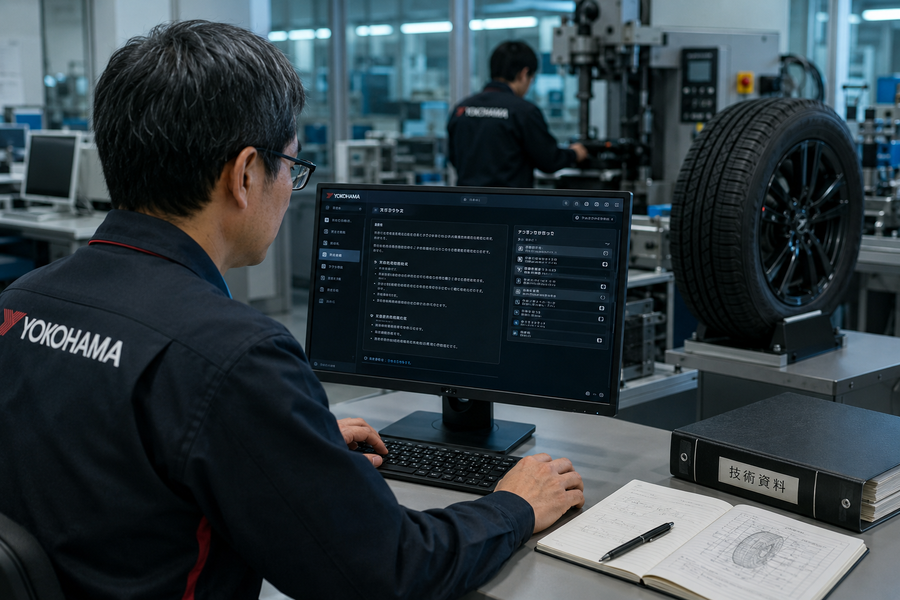
Yokohama Rubber's latest artificial intelligence development is, on the surface, another digital tool for its engineers. Announced in August, the system uses retrieval-augmented generation, or RAG, to search technical information accumulated within the company and generate answers based on those documents. Yokohama says full-scale operation began during August 2026.
The more significant question for the tyre industry is what happens when generative AI is connected not simply to publicly available information, but to proprietary technical knowledge that competitors cannot readily reproduce.
Yokohama says essential domain knowledge used in tyre development is distributed across regulatory documents, procedure manuals, technical reports and case studies. Finding the right information for a particular development objective or situation can therefore be difficult, even when the knowledge already exists somewhere within the organisation.
Its new system is intended to make that information easier for engineers to interrogate.
The distinction matters because Yokohama has not simply given engineers access to a conventional generative AI chatbot.
When an engineer asks a question, the system retrieves information from Yokohama's internal technical documents before generating its response. According to the company, an AI agent interprets the intention behind the question and repeatedly conducts search planning, retrieval and evaluation to improve the relevance of the information returned.
Importantly, the system also provides links to the source documents used to generate the answer. Engineers can therefore inspect the underlying material and make their own judgement about whether the response is technically valid.
That is particularly relevant in tyre development, where information is rarely useful without context. Materials, manufacturing processes, regulations and product requirements change, meaning an engineering archive is not necessarily a collection of permanently applicable conclusions. Older documents could relate to superseded specifications, previous regulatory requirements or development conditions that no longer apply.
Making corporate knowledge searchable is therefore one challenge. Making sure the information retrieved is authoritative, current and relevant to the engineering problem in front of the user is another.
Yokohama's source-linking approach does not eliminate that problem, but it gives engineers an opportunity to interrogate the evidence behind an AI-generated answer rather than treating the output itself as the authority.
This begins to shift the discussion about competitive advantage.
General-purpose generative AI capabilities are becoming widely accessible to industrial companies. Proprietary technical knowledge is not. A tyre manufacturer can procure AI technology, but it cannot quickly reproduce another manufacturer's accumulated technical documentation, development experience and organisational knowledge.
RAG potentially provides a new way to extract value from that information by reducing the friction involved in finding it.
The qualification is important: AI does not automatically make decades of R&D knowledge valuable.
A retrieval system can only exploit knowledge that has been captured, retained and made sufficiently searchable in the first place. Poorly structured archives, inconsistent terminology, missing documentation and knowledge that exists primarily in the experience of individual engineers remain knowledge-management problems, regardless of the sophistication of the AI placed on top of them.
In that sense, generative AI could expose weaknesses in corporate knowledge management as readily as it creates new capabilities.
The RAG deployment also sits within several years of Yokohama experimenting with AI through its HAICoLab framework, established in 2020 around collaboration between human engineers and artificial intelligence.
Earlier applications concentrated more directly on prediction and design. In 2022, Yokohama introduced an AI system capable of generating rubber compound candidates against specified physical-property targets. The company said the system had learned from tens of thousands of rubber compounds and could generate formulations using more than 100 types of compounding agents.
In April 2026, Yokohama announced an AI-assisted tyre mould design system combining finite element simulation with AI modelling. That application examines relationships between mould-design factors and tyre characteristics, while explainable-AI techniques are intended to help engineers understand how individual design factors influence predicted results.
HAICoLab has also been applied within tyre development programmes, including Yokohama's BluEarth-4S AW21 all-season tyre.
Taken together, the projects show Yokohama applying AI to a widening range of R&D tasks, from predicting characteristics and generating compounds to assisting design and now retrieving technical knowledge.
The latest application is different because the principal resource being exploited is information Yokohama already possesses.
That distinction could have wider significance for an industry in which accumulated specialist knowledge matters.
Tyre engineers must balance interacting requirements involving areas such as grip, wear, rolling resistance, durability, noise, load capability and manufacturability. Experience developed through previous programmes can consequently be valuable, but the existence of that experience does not guarantee that it is readily available to the engineer who needs it years later.
People retire or change roles. Teams reorganise. Terminology evolves. Reports accumulate across different systems and projects.
RAG offers a potential mechanism for reducing the dependence on knowing who possesses a particular piece of information or precisely where a relevant document was filed. Engineers could instead interrogate a wider body of internal knowledge around the problem they are trying to solve.
That does not necessarily diminish the importance of engineering expertise. It could change where that expertise is applied.
If AI becomes better at locating relevant material, engineers still need to formulate useful questions, recognise the significance of what has been retrieved and determine whether previous conclusions remain applicable to the current problem. Source evaluation becomes particularly important where technical knowledge has accumulated over decades and may contain conflicting or superseded information.
The quality of an industrial RAG system may therefore depend on more than the underlying AI model. Information governance, document quality, classification, access controls and the ability to identify obsolete material could all influence whether retrieved knowledge is genuinely useful.
For other tyre manufacturers, the strategic question is consequently broader than which generative AI platform to adopt.
Companies may need to assess what proprietary technical knowledge they possess, how consistently it has been documented and whether engineers can retrieve it with enough context to distinguish current knowledge from material that has been superseded. Protecting commercially sensitive information and controlling who can retrieve it will be another consideration as internal technical archives become easier to interrogate.
This could give manufacturers with substantial R&D histories an advantage, but longevity by itself guarantees little. A large archive that is fragmented, poorly classified or difficult to validate may have less practical value than a smaller but better governed knowledge base.
The potential differentiator is therefore not simply possession of proprietary information. It is the combination of relevant proprietary knowledge, effective retrieval, information governance and engineering judgement.
Whether that translates into measurable R&D productivity remains an open question.
Yokohama says its system is intended to contribute to faster and more advanced tyre development, but it has not disclosed quantified evidence demonstrating shorter overall development cycles, fewer physical prototypes, lower testing expenditure or reduced staffing requirements.
Those distinctions matter when assessing the commercial significance of industrial AI.
Evidence that engineers can find relevant information faster would demonstrate an improvement in knowledge retrieval. Evidence that this subsequently reduces duplicated investigation, improves development decisions or shortens an entire tyre-development programme would be a much larger claim and would require different evidence.
That is what the industry should now watch.
The interesting question is becoming less whether tyre manufacturers will use generative AI. As access to the underlying technology broadens, attention may increasingly turn to what manufacturers can connect it to.
The companies with the largest archives will not necessarily have the advantage. It may belong to those that have captured the most useful proprietary knowledge, maintained it effectively and made it accessible without stripping away the context engineers need to judge whether it can still be trusted.
Tags: Yokohama Rubber, generative AI, RAG, tyre R&D, HAICoLab, tyre engineering, AI tyre development, technical knowledge, knowledge management, tyre manufacturing
Editorial Standards & Disclaimer
Tyre News Media is an independent industry publication. Our reporting is based on information available at the time of publication, including company announcements, regulatory filings, official data, research and other sources considered reliable.
Articles may include independent analysis and editorial interpretation. Where appropriate, company statements and third-party claims are attributed to their source. Analysis, estimates and forward-looking observations should not be read as statements of established fact.
Tyre News Media takes reasonable steps to ensure accuracy but welcomes corrections, clarifications and responses from organisations or individuals covered in our reporting. If you believe information is inaccurate or requires clarification, please contact info@tyrenews.co.uk. Material errors will be corrected as appropriate.
Commercial relationships, advertising and sponsorship do not determine Tyre News Media's editorial coverage or conclusions.















.png)


%20(1).png)


%20(1).jpeg)