
Natural rubber traceability, digital workshop inspections and carbon black supply shaped tyre industry developments during the week ending 2 August 2026. New market data also exposed weaker UK replacement demand, while BKT reported record off-highway tyre volumes. Together, the stories showed how compliance, technology and material control are becoming closely linked across the tyre value chain.
Natural rubber traceability moved closer to becoming an operational procurement requirement during the week.
Tyre supply chains often extend through smallholders, village collectors, processors and international traders. Information about the original farm has not always travelled with each shipment.
That structure creates a growing commercial risk as businesses prepare for the EU Deforestation Regulation. Its main requirements are scheduled to apply from 30 December 2026, with a later date for micro and small operators.
Companies handling covered products may need plot-level geolocation data and supporting due-diligence records. The difficulty lies in obtaining reliable information several stages beyond a manufacturer’s direct suppliers.
In practice, procurement teams may need to assess more than price, quality and delivery. Data completeness, sourcing controls and regulatory evidence could also affect supplier approval.
Tyres Europe has described natural rubber as having a “complex, highly fragmented supply chain”. That fragmentation means compliant material may still become commercially difficult to use when supporting records are incomplete.
The change could also influence original equipment contracts. Vehicle manufacturers increasingly expect suppliers to document responsible sourcing, extending traceability beyond basic regulatory compliance.
Read more about natural rubber traceability becoming a tyre procurement risk.
Workshop technology also advanced as Anyline updated its TireBuddy mobile inspection platform.
Version 1.8 automatically captures a tyre sidewall image once the software confirms that positioning, sharpness, viewing angle and distance meet its requirements. The system therefore decides when an acceptable image has been obtained.
This could reduce variation between technicians and locations. Multi-site retailers often need inspection records to remain consistent across branches, shifts and different experience levels.
“A shop is only as consistent as its least experienced inspector,” said Lukas Kinigadner, Anyline’s chief revenue officer.
The update also introduces tyre-size mismatch alerts and combines sidewall information with tread measurements. Results can be sent automatically to back-office systems.
These features move mobile scanning towards a more complete digital inspection record. However, Anyline did not publish independent figures showing how much time the automated process saves.
For retailers, the commercial test will be whether standardised records improve inspection speed, replacement recommendations and customer approval rates.
Read more about Anyline’s automated tyre sidewall capture update.
Carbon black developments provided two connected views of tyre-industry circularity.
Longxing Technology Group began supplying nearly 10,000 tonnes of sustainable carbon black to an unnamed European tyre manufacturer. The producer did not disclose the contract value, delivery timetable or intended tyre applications.
The order nevertheless indicates that lower-carbon material is moving through established industrial qualification processes. Reliable supply volumes will be important if tyre manufacturers are to increase their use of alternative raw materials.
At the same time, recovered carbon black continues to attract investment. It is produced during tyre pyrolysis and can replace a proportion of virgin carbon black in selected rubber compounds.
Market forecasts indicate strong percentage growth from a relatively small base. Commercial adoption still depends on consistent grades, stable capacity and approval for demanding tyre applications.
This distinction matters. Market growth estimates do not guarantee immediate use in safety-critical compounds. Manufacturers must confirm that material performance remains repeatable across production batches.
Initial adoption is therefore likely to involve partial substitution. Producers can increase recovered content as technical evidence, availability and commercial terms improve.
Read more about Longxing’s sustainable carbon black supply to Europe and the growth of closed-loop recovered carbon black.
UK market data added a more difficult commercial context.
All-season tyre sell-out volumes fell by 9.8% during the first eight months of 2025, according to NielsenIQ and GfK figures. The wider car tyre market declined by 9.3%.
Summer tyre volumes also fell by 9.3%, while winter tyres declined by 8.4%. The figures point to broad replacement-market weakness rather than a simple movement between seasonal categories.
This creates a stock-management challenge. Manufacturers continue to expand all-season ranges across premium, mid-market and value positions, while total consumer demand remains under pressure.
Wholesalers and retailers may therefore need to match stock more closely with local vehicle parc, climate and customer requirements.
The data does not remove the longer-term case for all-season tyres. However, it shows that category growth cannot fully offset delayed replacement purchases or weaker consumer spending.
Read more about the 9.8% fall in UK all-season tyre volumes.
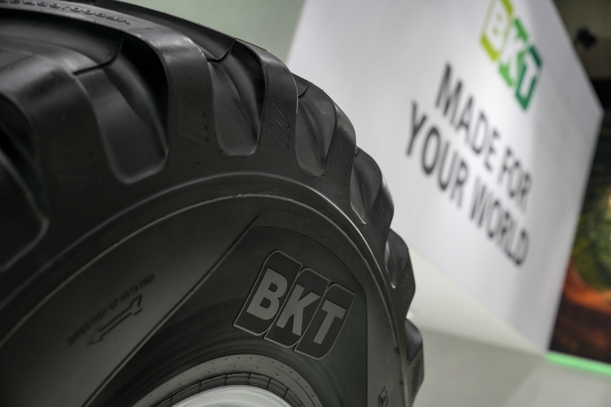
BKT provided one of the week’s clearest examples of manufacturers pursuing growth while managing cost and supply risks.
The company sold a record 93,770 tonnes of off-highway tyres during its first FY27 quarter. Volume increased by 16% year on year, while standalone revenue rose by 24% to INR 34.09 billion.
India accounted for around 40% of sales and became BKT’s largest volume market. Agricultural tyres remained its leading product category.
Rajiv Poddar, BKT’s joint managing director, said the record was achieved despite difficult international markets and global supply-chain conditions.
Higher raw-material and freight costs limited the margin benefit. BKT introduced average price increases of about 5%, but it also expects raw-material costs to rise by a similar amount.
The manufacturer is responding partly through vertical integration. Its expanded Bhuj carbon black operation now has annual capacity of 360,000 tonnes.
BKT has also started commercial truck and bus radial tyre supplies in India. That move could broaden revenue, although on-highway products bring different distribution and pricing pressures.
Read more about BKT’s record off-highway tyre quarter and capacity programme.
The week’s developments show that tyre-industry competitiveness increasingly depends on control of both materials and information.
Natural rubber must be accompanied by credible origin data. Digital inspections need consistent records. Recovered and alternative carbon black require stable specifications, while manufacturers are investing in captive capacity to reduce supply exposure.
Demand conditions remain equally important. New products and technologies must enter markets where consumers and fleets continue to scrutinise replacement spending.
The common issue is therefore not innovation in isolation. It is whether companies can connect sourcing, production, inspection, distribution and compliance without adding excessive cost or complexity.
For the tyre trade, that makes data quality and material assurance increasingly commercial concerns rather than separate sustainability or technology projects.
Tagged with: natural rubber traceability, tyre supply chain, EUDR, digital tyre inspection, sustainable carbon black, recovered carbon black, tyre recycling, UK tyre market, off-highway tyres, workshop technology, circular economy, tyre manufacturing
Editorial Standards & Disclaimer
Tyre News Media is an independent industry publication. Our reporting is based on information available at the time of publication, including company announcements, regulatory filings, official data, research and other sources considered reliable.
Articles may include independent analysis and editorial interpretation. Where appropriate, company statements and third-party claims are attributed to their source. Analysis, estimates and forward-looking observations should not be read as statements of established fact.
Tyre News Media takes reasonable steps to ensure accuracy but welcomes corrections, clarifications and responses from organisations or individuals covered in our reporting. If you believe information is inaccurate or requires clarification, please contact info@tyrenews.co.uk. Material errors will be corrected as appropriate.
Commercial relationships, advertising and sponsorship do not determine Tyre News Media's editorial coverage or conclusions.

_0%20(1).png)













%20(1).jpeg)