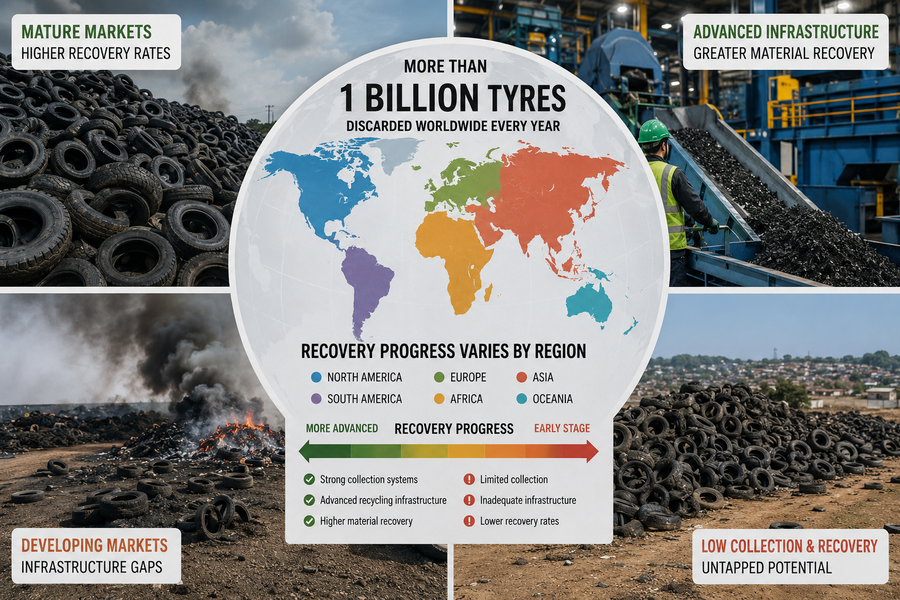

More than one billion tyres reach the end of their useful lives worldwide each year, yet their treatment varies sharply by region. New country-level data is improving visibility across the sector. However, it also shows that high collection rates do not always translate into circular material outcomes for tyre manufacturers, recyclers or fleet supply chains.
The global end-of-life tyre market is moving beyond a simple question of whether discarded tyres are collected.
Regulators, producers and recyclers are increasingly examining what happens after collection. The distinction matters because reported recovery figures can combine several very different treatment routes.
These include material recycling, retreading, reuse, civil engineering applications and energy recovery. Pyrolysis and devulcanisation are also expanding, although commercial scale and output quality vary between facilities.
A tyre used as fuel may count as recovered. However, its rubber and carbon content are removed permanently from the manufacturing loop.
By contrast, mechanical recycling, devulcanisation and pyrolysis can produce materials for further industrial use. The quality, consistency and market acceptance of those outputs determine their circular value.
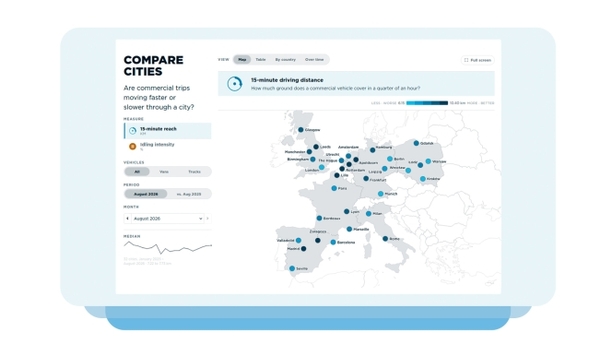
The Tire Industry Project has responded to the data challenge with an interactive end-of-life tyre map. The platform brings together information on national ELT volumes, treatment routes, system maturity and data quality.
Its development signals that transparency and comparable reporting are becoming priorities across the global tyre sector.
Europe remains the most mature regional ELT management market. European collection and treatment rates are commonly reported at about 95%, supported by landfill restrictions and established producer-responsibility systems.
However, national figures show that similar collection performance can produce very different material outcomes.
Swedish Tyre Recycling collected 94,060 tonnes of end-of-life tyres during 2025. This was 8.2% higher than the 86,927 tonnes collected in 2024.
The organisation recycled and delivered 103,990 tonnes during the year. Its material recycling share reached 75%, compared with just over 30% in 2022.
Swedish Tyre Recycling attributes the change to improved sorting and greater industrial processing capacity. Its figures illustrate how an established collection system can move progressively towards higher-value uses.
Further capacity is being developed through Bon Orbit, a joint venture between the Swedish and Norwegian tyre recovery organisations.
Sweden and Norway generate about 150,000 tonnes of ELTs annually. Bon Orbit’s planned Trollhättan facility is expected to process up to 100,000 tonnes each year and be commissioned in autumn 2026.
Initial production activity reported at the site during July 2026 suggests that commissioning work may already be under way. However, the published timetable continues to identify autumn 2026 as the formal commissioning period.
Belgium reported an even stronger material-recovery outcome through Recytyre.
The producer-responsibility organisation collected 93,685 tonnes of used tyres during 2025. Its network covered 5,043 collection points and completed 39,741 collections.
Recytyre reported that 90,188 tonnes were valorised through 60 pre-treatment and treatment companies. It recorded no energy recovery for the valorised volume.
Granulate represented 88.57% of total valorisation, making it the dominant recovery route within the system.
That outcome differs markedly from Spain, where energy recovery continues to handle a substantial proportion of collected tyres.
SIGNUS Ecovalor managed 230,901 tonnes of end-of-life tyres in Spain during 2025. The volume was equivalent to more than 28 million passenger car tyres.
Of the tyres sent for final treatment and valorisation, 51.1% went to material recovery. A further 12.2% entered reuse or retreading routes, while 36.7% went to energy recovery.
Spain’s other major producer-responsibility scheme, Tratamiento Neumáticos Usados, managed 98,933 tonnes during 2025. That represented a 7.4% annual increase.
TNU directed 42.91% of its managed volume to material recovery and 47.15% to energy recovery. Reuse accounted for the remaining 9.94%.
The comparison does not mean the Spanish systems are failing to recover tyres. Both handle substantial national volumes through regulated collection and treatment networks.
It does show why collection or recovery percentages cannot be viewed in isolation.
Belgium’s reported zero-energy-recovery result represents a different circular outcome from a system where more than one-third of the material becomes fuel.
The United States generates roughly 280 million scrap tyres annually. Recovery exceeded 3.8 million US tons during 2023, according to industry sustainability data.
State-level programmes have created established markets for tyre-derived aggregate, rubber-modified asphalt, moulded products and tyre-derived fuel.
Infrastructure spending can also provide demand for recovered tyre material in road and civil engineering projects.
However, as in Europe, the definition of recovery remains important. A market with high consumption of tyre-derived fuel may divert tyres from landfill without returning their materials to tyre production.
Recent consolidation also shows how commercial conditions influence processing capacity.
Tyre News recently reported that Genan sold its Houston recycling plant to Liberty Tire Recycling, allowing the Danish group to concentrate investment in Europe.
The transaction illustrates that recovery infrastructure is shaped by feedstock access, transport costs and regional demand for recycled outputs.
Asia-Pacific is a major driver of global ELT generation. Vehicle ownership, replacement tyre demand and automotive production continue to expand across several large economies.
China, India, Japan and South Korea are central to the region’s tyre recovery market.
Japan has a mature treatment system and views material recovery partly through the lens of resource security. South Korea is investing in larger-scale facilities for recovered carbon black and tyre-derived oil.
Tyre News has previously covered South Korea’s expanding ELT resource-circulation capacity, including investment in pyrolysis outputs for reuse in manufacturing.
Across much of Asia-Pacific, however, country-level ELT data remains less consistent than in Europe. Definitions, reporting periods and treatment classifications can vary.
That makes comparisons difficult and can obscure the role of informal collection and processing markets.
The lack of standardised reporting is significant because the region’s tyre volumes are expected to grow. Without consistent data, it becomes harder to measure whether new capacity is improving circularity or simply increasing disposal throughput.
Passenger, van and truck tyres dominate most ELT statistics, but off-highway tyres create a separate recovery problem.
Mining tyres are considerably larger and heavier. Their removal, transport and processing require specialist equipment and viable access to industrial facilities.
In Australia, the Australian Tyre Recyclers Association estimates that only about 2% of mining tyres are recovered. Many are still buried within mining sites.
In-pit burial avoids long-distance transport costs, but it removes valuable rubber, steel and carbon resources from potential recovery markets.
The figure also demonstrates why national tyre recovery averages may not describe every segment accurately. A country can have an established passenger tyre system while retaining major gaps in off-highway recovery.
The next phase of ELT development will depend on whether recovered outputs can meet industrial requirements.
Mechanical processing already produces rubber granulate, steel and textile fibre. Devulcanisation aims to create rubber that can replace a proportion of virgin compound material.
Pyrolysis can produce recovered carbon black, tyre-derived oil and gas. However, product consistency, certification and upgrading requirements remain important commercial considerations.
Tyre News analysis has shown how Europe’s recycling market is moving towards higher-value recovered materials, including recovered rubber, carbon black and oil.
Manufacturers require dependable specifications, stable volumes and traceable supply. Without those conditions, recovered materials may remain confined to lower-value applications.
Investment announcements therefore need to be judged by more than stated plant capacity. Yield, output quality, operating reliability and confirmed end markets are equally important.
Better traceability could also change how ELT performance is measured.
Digital systems can record collection points, carriers, treatment locations and final outputs. This creates a clearer audit trail than a collection certificate alone.
Tyre News previously reported on Big Atom’s digital ELT tracking system, which was designed to follow tyres from collection to final treatment.
Such systems could help producers and regulators distinguish between material recycling, export, energy use and other treatment routes.
They could also support environmental reporting by showing where material leaves the circular supply chain.
Commercial estimates of the global tyre recycling market differ according to the technologies and applications included.
One forecast values the market at USD 7.66 billion in 2025 and projects growth to USD 9.49 billion by 2031. Another places the broader market at USD 8.1 billion in 2026, rising to USD 16.7 billion by 2035.
These forecasts should be treated cautiously because they may include different combinations of collection, mechanical recycling, pyrolysis, devulcanisation and downstream product sales.
Nevertheless, the direction is clear. More capital is moving into ELT processing and recovered-material supply.
The retread market adds another circular route by extending tyre casing life before recycling becomes necessary. It is commercially distinct from waste treatment but remains important for truck, bus and fleet operators.
The global ELT challenge is changing.
Stockpiles, illegal disposal and tyre fires remain serious problems in countries with limited collection infrastructure. Mature markets face a different question: how much recovered material returns to productive use?
Sweden’s movement towards a 75% material recycling share shows that treatment patterns can change when processing capacity and sorting improve.
Belgium’s reported material-recovery performance shows what a system can achieve when outlets exist for recovered products.
Spain demonstrates that even well-established producer-responsibility schemes may continue to depend heavily on energy recovery.
For the tyre industry, future comparisons will need to look beyond tonnes collected. The more useful measures will include material yields, verified destinations, recovered-material quality and substitution of virgin resources.
The Tire Industry Project’s data map reflects that transition. As global vehicle fleets expand, the dividing line between regional systems will increasingly concern not whether an ELT was collected, but what happened to its materials afterwards.

Tagged with: end-of-life tyres, ELT recycling, tyre recovery rates, material recycling, energy recovery, recovered carbon black, tyre pyrolysis, devulcanisation, circular economy, producer responsibility, mining tyres, tyre traceability
Editorial Standards & Disclaimer
Tyre News Media is an independent industry publication. Our reporting is based on information available at the time of publication, including company announcements, regulatory filings, official data, research and other sources considered reliable.
Articles may include independent analysis and editorial interpretation. Where appropriate, company statements and third-party claims are attributed to their source. Analysis, estimates and forward-looking observations should not be read as statements of established fact.
Tyre News Media takes reasonable steps to ensure accuracy but welcomes corrections, clarifications and responses from organisations or individuals covered in our reporting. If you believe information is inaccurate or requires clarification, please contact info@tyrenews.co.uk. Material errors will be corrected as appropriate.
Commercial relationships, advertising and sponsorship do not determine Tyre News Media's editorial coverage or conclusions.


_0%20(1).png)













%20(1).jpeg)

.jpg)

%20(1).jpeg)