

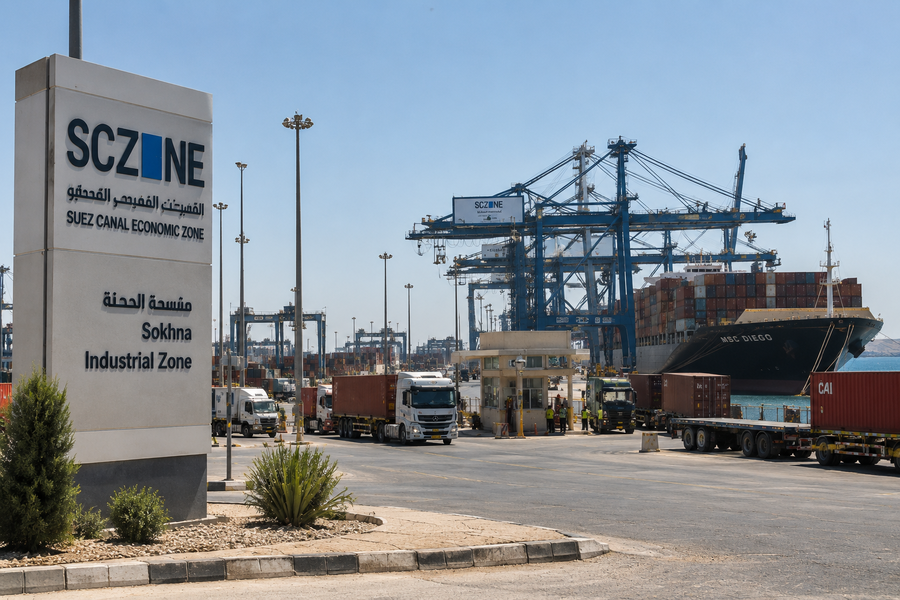

ZC Rubber is studying a $500 million tyre manufacturing complex in Egypt’s Suez Canal Economic Zone, with 95% of planned output intended for export. On its own, the letter of intent is preliminary. Set against Sailun Group’s rapidly expanding Egyptian investment, however, it raises a more significant industry question: whether Egypt is developing into a major new export manufacturing base for Chinese tyre producers.
ZC Rubber’s proposed development is still at the study stage. The Chinese manufacturer has signed a letter of intent with the Suez Canal Economic Zone, or SCZONE, to examine an integrated tyre manufacturing complex at Sokhna covering roughly 600,000 square metres. Estimated investment is around $500 million, with the project envisaged in three phases and approximately 95% of passenger car and truck tyre production targeted at export markets including the Middle East, Africa and Europe.
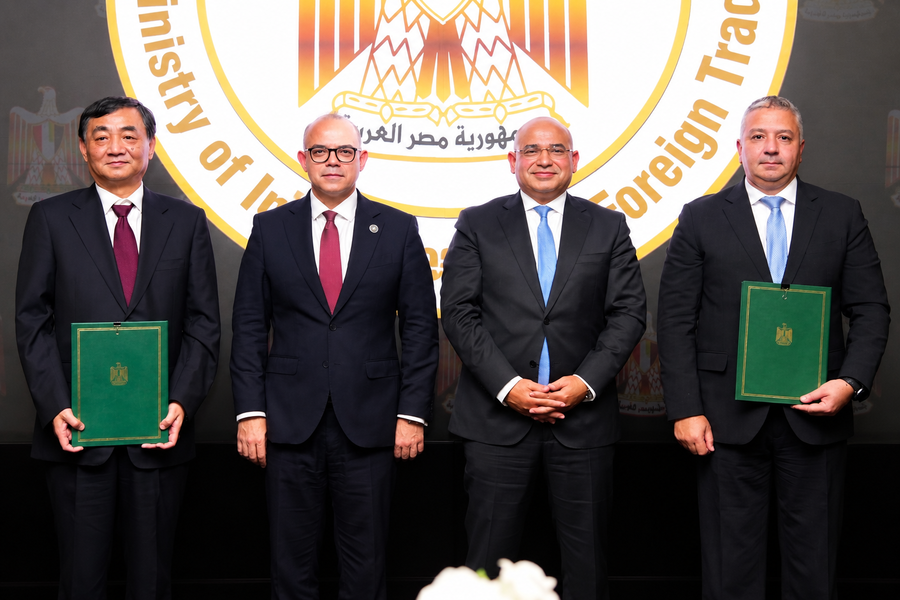
That distinction matters. No $500 million ZC Rubber factory should yet be treated as committed construction, and the next steps include further technical and investment studies, site selection and regulatory procedures. What makes the announcement more important than another prospective factory agreement is where it is being considered and what has happened there over the previous 12 months.
Sailun broke ground at Sokhna in September 2025 and has since enlarged its Egyptian manufacturing plans substantially. Its original corporate announcement put the first project at $291 million for annual capacity of three million passenger car radial tyres and 600,000 truck and bus radial tyres. In April 2026, the company disclosed another roughly $285 million investment to increase the site to nine million passenger tyres and 1.65 million truck and bus tyres annually.
The much bigger move came in June. As Tyre News Media reported on Sailun’s $1.14bn Egypt capacity expansion, Sailun proposed a further $1.141 billion project which, combined with previously disclosed capacity, would give its Egyptian operations annual production capability of 36 million semi-steel radial tyres, 3.3 million all-steel radials and 20,000 tonnes of OTR tyres. That latest project remains subject to approvals and implementation risks.
Using Sailun’s individual corporate project disclosures, the three announced investment rounds amount to approximately $1.72 billion. That figure is also reported by Japan External Trade Organization, although Egyptian government material has previously described Sailun’s original three-phase scheme as a $1 billion project. The difference illustrates why capacity and investment figures need to be tied to specific disclosures rather than treated as interchangeable headline numbers.
For the wider tyre industry, the planned output is more significant than the accounting distinction. Sailun is not positioning Egypt simply as a plant serving Egyptian replacement demand. Its June investment documentation explicitly identifies Egypt, Europe and North America among the markets to be served and says the location should improve regional order response, logistics and global manufacturing flexibility.
The common factor behind Sailun and ZC Rubber is the Sokhna area of SCZONE, including the China-Egypt TEDA industrial development. Its proposition combines an industrial platform developed specifically for export-oriented investment with proximity to one of the world’s major shipping corridors.
SCZONE advertises access to six seaports and two airports, while its location around the Suez Canal links Asian supply routes with Europe, North Africa and the Middle East. It also offers customs and VAT advantages for materials entering the economic zone, alongside investment incentives that can permit deductions equivalent to 50% of investment costs from taxable profits within defined limits and periods.
For tyre production, the logistics argument is particularly relevant because manufacturing combines internationally sourced raw materials with a bulky finished product where freight time and cost materially affect delivered economics. Sailun itself has said Egypt could optimise both raw-material procurement and finished-product export routes. At The Tire Cologne this year, the company also said its Egyptian plant should be capable of reaching several European freight hubs within five working days, a claim that could become commercially important for wholesalers managing availability and working capital if the promised service levels are achieved. Tyre News Media’s earlier coverage of Sailun’s European supply plans
There is a second attraction: trade access. Egypt has an association agreement with the EU that removes tariffs on qualifying industrial products, while it also participates in arrangements including COMESA, the Greater Arab Free Trade Area, the Agadir Agreement and the African Continental Free Trade Area. SCZONE says qualifying goods can receive Egyptian certificates of origin and gain preferential access under agreements to which Egypt is a party.
That does not mean tyres made by a Chinese-owned factory automatically enter every market tariff-free. Preferential access depends on the applicable agreement and product-specific rules of origin, including the level of local transformation or value added. SCZONE guidance says industrial products normally require at least 30% local manufacturing for its certificate of origin, while individual trade agreements can impose their own rules. For manufacturers and importers, origin qualification will therefore be as important as factory location when assessing the eventual delivered-cost advantage.
There is unusually clear evidence that trade policy is part of the manufacturing decision. Sailun’s investment documentation says overseas production can improve its ability to deal with international trade barriers, language already used when the original Egyptian project was announced in August 2025. Its June 2026 material went further, saying the expanded Egyptian manufacturing network would help the group avoid existing and potential international trade barriers and reduce the associated operating risks.
That does not establish the same motivation for ZC Rubber. Its Egyptian announcement emphasises exports, logistics, infrastructure and access to the Middle East, Africa and Europe rather than explicitly identifying tariffs as the reason for studying Sokhna. The evidence therefore supports a distinction: tariff and trade-barrier mitigation is a stated element of Sailun’s overseas manufacturing rationale, while applying that motive to ZC Rubber would currently be inference rather than confirmed strategy.
The result nevertheless matters for global tyre supply. Chinese manufacturers have spent years increasing production outside mainland China, but an Egyptian base offers a different geographical proposition from established Southeast Asian manufacturing. It places capacity much closer to European and Middle Eastern customers while opening African markets from within an African trade framework.
There are other indications that interest extends beyond these two businesses. Tyre News Media reported in May that Linglong was discussing a possible $2bn export-focused Egyptian tyre complex, although that project was also at proposal rather than committed-construction stage. Taken together, the projects are evidence of sustained manufacturer interest, but they do not yet justify treating every announced dollar of Egyptian tyre investment as capacity that will reach the market.
The strongest evidence that Egypt is becoming important comes from Sailun because construction has started and the company has repeatedly expanded its planned capacity. ZC Rubber adds another significant data point, particularly because 95% of its proposed output would be exported, but its project still has important development gates to pass.
If both manufacturers ultimately build at the planned scale, Sokhna would become more than another overseas production location. It could develop into a sizeable tyre manufacturing cluster positioned between Asian raw-material supply and European, Middle Eastern and African demand, supported by port infrastructure, investment incentives and Egypt’s network of trade agreements.
For tyre wholesalers and distributors, the next questions are therefore practical rather than rhetorical: which capacity is approved and completed, which products are allocated to which markets, whether Egyptian-made tyres meet the relevant rules of origin, and how freight times and landed costs compare with Chinese and Southeast Asian supply.
Egypt is not yet a Chinese tyre manufacturing hub simply because several large numbers have been announced. But Sailun’s construction programme, its proposed multi-billion-dollar-scale footprint and now ZC Rubber’s export-oriented study mean the country has moved well beyond being a speculative location. It is becoming one of the manufacturing markets the global tyre trade needs to watch.
This approach follows Tyre News Media’s editorial principle that significant investment should be assessed for its wider market relevance rather than treated as company promotion.
Tags: ZC Rubber, Sailun Group, Egypt tyre manufacturing, SCZONE, Suez Canal, Chinese tyre manufacturers, tyre exports, TEDA Egypt, tyre supply chain, trade barriers, tyre production
Editorial Standards & Disclaimer
Tyre News Media is an independent industry publication. Our reporting is based on information available at the time of publication, including company announcements, regulatory filings, official data, research and other sources considered reliable.
Articles may include independent analysis and editorial interpretation. Where appropriate, company statements and third-party claims are attributed to their source. Analysis, estimates and forward-looking observations should not be read as statements of established fact.
Tyre News Media takes reasonable steps to ensure accuracy but welcomes corrections, clarifications and responses from organisations or individuals covered in our reporting. If you believe information is inaccurate or requires clarification, please contact info@tyrenews.co.uk. Material errors will be corrected as appropriate.
Commercial relationships, advertising and sponsorship do not determine Tyre News Media's editorial coverage or conclusions.

_0%20(1).png)














.jpg)
%20(1).jpg)
%20(1)%20(1).jpg)

%20(1).jpg)
%20(1).jpg)