

Nearly one million MOT failures were recorded for insufficient tyre tread during 2025, according to eBay’s analysis of DVSA data. Now the marketplace has connected MOT histories with its My Garage platform, creating a potentially important new link between identifying a vehicle defect and buying the parts to rectify it. For tyre retailers, the question is who captures that replacement demand first.
Tyres accounted for some of the largest individual defect totals in MOT failure data analysed by eBay for 2025. The company says 935,605 failures involved tread depth below the statutory 1.6mm requirement, while 545,690 involved cuts deep enough to reach the ply or cords and another 523,944 involved exposed ply or cords. The figures came from DVSA information obtained by eBay through a Freedom of Information request and cover failures recorded between 1 January and 31 December 2025.
Those numbers should be handled carefully. They are failure records, not evidence of an equivalent number of individual motorists, tyres sold or replacement transactions. DVSA itself notes that a failed MOT can contain multiple failure items, an important distinction when interpreting defect statistics commercially.
What makes eBay’s new MOT Hub more interesting to the tyre industry is therefore not simply the scale of the failure data. It is what happens when information about vehicle condition moves closer to the point of sale.
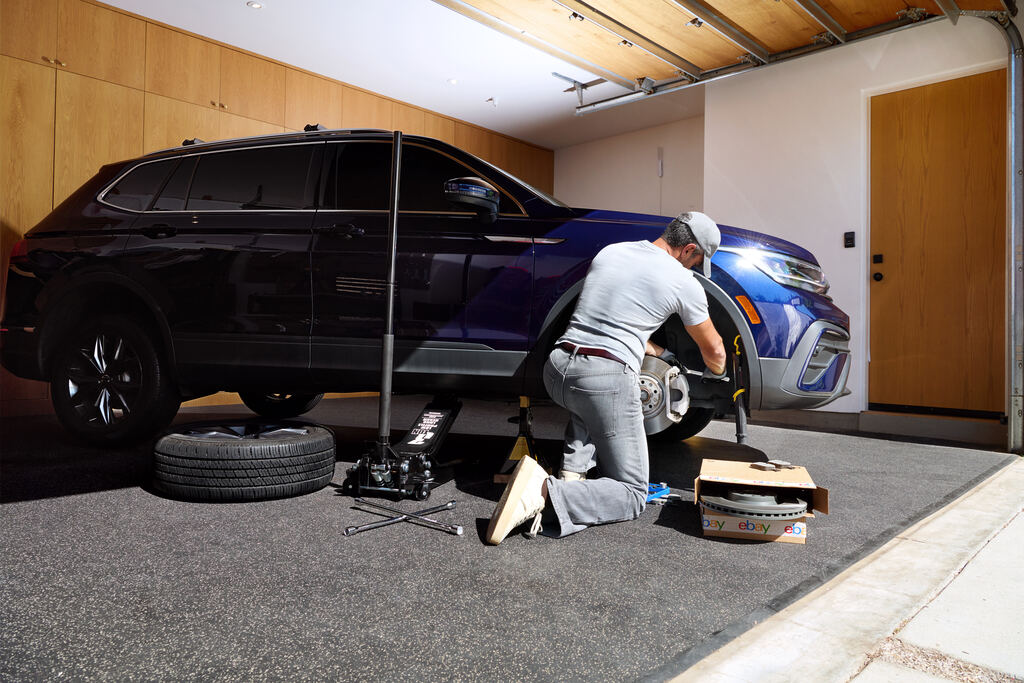
MOT Hub sits inside eBay’s My Garage service. A motorist adds a vehicle registration number, after which eBay combines that vehicle information with DVSA MOT results to display test dates, previous defects and advisories. The platform can then use those records to recommend relevant parts, while notifications remind motorists about previous issues as another MOT approaches.
The example provided by eBay is straightforward: where an MOT previously identified worn wiper blades, the system can remind the motorist about that defect and show compatible blade listings. Following a failed test, MOT Hub can also display defects and help users source parts before a retest. That turns an MOT record from a passive piece of vehicle history into a potential ecommerce trigger.
There is, however, an important gap between that proposition and its implications for tyres. eBay has not established in its published launch material whether a tyre defect or advisory currently triggers recommendations for specific replacement tyres, how any such tyres would be matched and fitted, or whether the platform can determine that a previously recorded tyre problem has subsequently been rectified. Those questions matter because tyres are materially different from many of the DIY components around which the MOT Hub proposition is easiest to demonstrate.
A worn wiper can be ordered and replaced on a driveway. A tyre normally requires physical inspection, removal, fitting and balancing, meaning the workshop remains part of the transaction even when discovery and purchasing move online.
That distinction fits the broader development of Britain’s online tyre market. As Tyre News Media has previously examined in its coverage of how the UK online tyre market is moving into the mainstream, digital platforms increasingly influence research, product selection and booking, but physical fitting capacity remains integral to the customer journey.
For a tyre retailer or garage, an MOT advisory can represent more than a technical observation. A tyre that remains legal but is approaching replacement may create a future commercial opportunity for the business that inspected the vehicle.
Traditionally, the advantage has rested partly with that business. It identifies the condition, explains it to the customer and has an opportunity either to replace the tyre immediately or retain the relationship until replacement becomes necessary.
MOT Hub demonstrates how that sequence could become less linear. If a digital platform can retrieve a recorded advisory, remind the vehicle keeper later and connect the issue with suitable products, another business potentially gains an opportunity to influence the purchase before the customer returns to the original workshop.
That does not mean eBay is seeking to bypass tyre retailers, and its announcement provides no evidence for such a conclusion. Nor does an MOT record reveal the current condition of a tyre months after the inspection. What the technology does demonstrate is that vehicle-condition information can be incorporated into the digital customer journey rather than remaining solely a record of what happened at the testing station.
The commercial question for tyre businesses is consequently broader than eBay. How effectively are retailers themselves using information they already collect about tread depth, advisories, mileage, service intervals and anticipated replacement dates?
For businesses with established customer databases, an MOT advisory could potentially become a timed follow-up rather than a recommendation that disappears once the vehicle leaves the workshop. That possibility deserves particular attention as tyre purchasing becomes increasingly omnichannel, combining digital research and ordering with local fitting.
Online tyre retail has traditionally depended heavily on motorists recognising a need. A driver decides that tyres require replacement, begins searching by registration or size, compares products and prices, and chooses a supplier and fitting option.
Vehicle-condition data potentially moves competition further upstream. Instead of waiting for the customer to begin searching, a platform can use an existing vehicle record to identify a previous maintenance issue and bring it back to the motorist’s attention.
That distinction could prove commercially important if platforms can demonstrate that such prompts convert into purchases. At present, eBay has not published the evidence needed to establish that for tyres. Data showing what proportion of motorists presented with a tyre-related MOT recommendation subsequently search for, view or buy tyres would provide a much stronger indication of whether MOT Hub represents a meaningful new source of replacement demand rather than simply a more sophisticated recommendation function.
The scale of the underlying MOT system nevertheless makes the question worth pursuing. DVSA publishes anonymised test and failure-item data covering test outcomes, make and model, odometer readings and reasons for failure, providing scope for considerably deeper analysis of tyre defects than headline national totals alone.
That could eventually allow the industry to examine replacement indicators by vehicle age, mileage and model. It does not mean every recorded defect is a sales opportunity, but it illustrates why vehicle-condition information is becoming commercially interesting to businesses far beyond the MOT testing station.
MOT Hub should not yet be interpreted as evidence of a fundamental shift in who sells Britain’s tyres. There is no published conversion evidence to support that conclusion, and tyre fitting, inspection and professional advice give physical retailers a role that an ecommerce recommendation alone cannot replace.
But the launch illustrates an important change in where competition for the customer can begin. Marketplaces and online retailers no longer necessarily have to wait until a motorist types “new tyres” into a search engine. Vehicle records can potentially provide an earlier indication of a maintenance requirement.
The next stage extends well beyond MOT histories. Connected vehicles, TPMS information, mileage, digital service records and tyre-condition monitoring could all make maintenance requirements increasingly visible before a conventional replacement search begins. These technologies should not be read as part of eBay’s strategy unless the company says so, but they point towards a wider aftermarket in which identifying demand may become almost as important as fulfilling it.
For tyre retailers, that makes customer data a competitive issue rather than merely an administrative one. Tyre News Media has previously reported on digital tools being developed for independent tyre retailers and garages, and the arrival of MOT-linked ecommerce gives that digitisation another dimension.
The unresolved question is whether motorists will respond to a digital prompt by purchasing tyres online, or still return to the workshop that originally identified the problem. Answering it requires conversion data from eBay and evidence from tyre retailers about what currently happens to an advisory after the customer drives away.
Until those numbers emerge, MOT Hub is better viewed as an indicator of where competition could be heading than proof that the market has already changed. The competitive advantage in replacement tyre retail may increasingly depend not only on price, availability and search visibility, but on which business identifies the replacement need first.
According to eBay’s analysis of DVSA data obtained through an FOI request, covering MOT failures between 1 January and 31 December 2025:
DVSA’s anonymised dataset contains test outcomes and individual reasons for failure and can support further analysis by characteristics including vehicle make, model and odometer reading.
Authoritative external reference: DVSA anonymised MOT testing data
Tags: eBay MOT Hub, MOT tyre failure, MOT tyre advisory, tyre tread MOT, MOT tyre tread depth, replacement tyres, online tyre retail, DVSA MOT data, tyre retail technology, vehicle data
Editorial Standards & Disclaimer
Tyre News Media is an independent industry publication. Our reporting is based on information available at the time of publication, including company announcements, regulatory filings, official data, research and other sources considered reliable.
Articles may include independent analysis and editorial interpretation. Where appropriate, company statements and third-party claims are attributed to their source. Analysis, estimates and forward-looking observations should not be read as statements of established fact.
Tyre News Media takes reasonable steps to ensure accuracy but welcomes corrections, clarifications and responses from organisations or individuals covered in our reporting. If you believe information is inaccurate or requires clarification, please contact info@tyrenews.co.uk. Material errors will be corrected as appropriate.
Commercial relationships, advertising and sponsorship do not determine Tyre News Media's editorial coverage or conclusions.















.png)


%20(1).png)



%20(1).jpeg)