
The UK online tyre market now plays a significant role in how motorists research, compare and purchase replacement tyres. Digital platforms increasingly shape product choice, pricing expectations and appointment decisions. However, most transactions still depend on garages for fitting, balancing and inspection.
The result is an omnichannel market connecting online convenience with local workshop capacity.
The main change is not simply that more tyres are sold through websites. Online research now influences much of the buying process, from the first search to final fitment.
Drivers can search by registration number, tyre size or vehicle model within seconds. They can then compare brands, review EU tyre-label information and check fitting availability before contacting a garage.
This visibility has made digital channels a routine part of tyre shopping. They are no longer limited to confident enthusiasts or motorists seeking the lowest possible price.
However, the transaction often ends on a workshop ramp. Installation, balancing, inspection and final handover remain physical services. Fitting networks therefore continue to provide the infrastructure behind online tyre retail.
This hybrid model is becoming increasingly visible across the sector. Tyre News recently examined how scale, data and mobility are reshaping tyre retail, with digital booking and mobile fitting becoming part of a broader service ecosystem.
Estimates of the online tyre channel’s precise market share vary significantly. Definitions can include home delivery, mobile fitting, garage collection and complete click-and-fit transactions.
Tyre News previously cited industry estimates indicating that online sales represented more than 21% of UK tyre volume. The figure demonstrates commercial relevance, although it should not be treated as a definitive measure of every digital transaction.
Wider automotive e-commerce data also shows the scale of online purchasing. ECDB estimates the UK vehicle-parts e-commerce market generated US$2.98 billion in revenue during 2025. It forecasts further growth during 2026, although tyres represent only one part of that category.
The data therefore provides useful directional context rather than a standalone valuation of the online tyre market.
This distinction matters because consumer tyre demand has faced pressure. British Tyre Manufacturers’ Association data showed member replacement volumes for consumer tyres fell 16% during the first half of 2025. A growing digital channel does not necessarily mean that the overall replacement market is expanding at the same rate.
Recent business launches suggest experienced tyre retailers still see opportunities in the online channel. Tyre News reported in May 2026 that Blackcircles founder Michael Welch OBE plans to introduce Rolo Tires across six European markets, including the UK.
The new business is expected to begin with a direct-to-consumer model covering passenger, ultra-high-performance, 4x4 and light commercial tyres. Products will initially be shipped directly to customers rather than distributed through a conventional wholesale-led route.
Read the original Tyre News report: Michael Welch Plans European Launch for Rolo Tires.
The planned launch provides a current test of the online market’s maturity. It shows how a new tyre brand can use digital retail to establish pricing, product visibility and customer relationships from the outset.
It also highlights the practical questions facing direct-to-consumer operators. Competitive pricing must be supported by reliable fulfilment, clear technical information and convenient access to fitting. Rolo’s progress may therefore offer a useful indicator of how far factory-direct tyre models can develop within the UK and wider European replacement markets.
Consumer search behaviour helps explain why physical fitting remains central to the model.
Research published by tyre-data specialist Lizeo found that 24% of UK online tyre searches included a location or proximity element. Lizeo said these users were “looking for a place or solution close to home”.
That finding challenges the idea that online tyre customers want a completely remote transaction. Many motorists use digital tools to locate a nearby service rather than replace the garage.
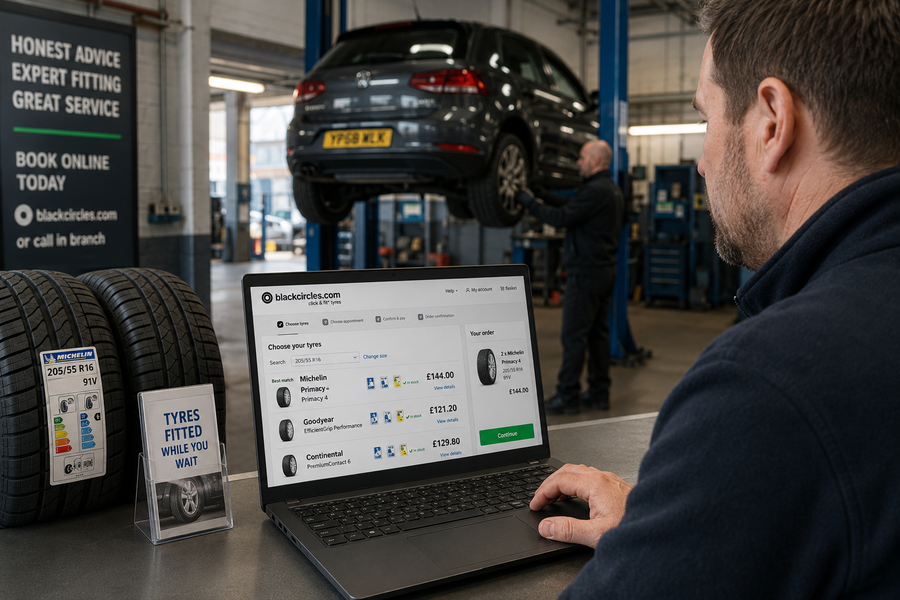
Online platforms have responded by combining product catalogues, appointment systems and fitting networks. Blackcircles says its network includes more than 2,200 UK garages, allowing motorists to select tyres online before arranging local installation.
Physical retailers are also strengthening their digital capabilities. Tyre News reported that Elite Garages supports online reservations alongside same-day fitting, illustrating how workshop groups can connect digital demand with local capacity.
Price remains important, but it is only one part of the online buying decision.
Consumers can compare premium, mid-range and budget tyres on the same screen. Product descriptions, customer reviews, stock availability, fitting charges and appointment times can all influence which product reaches the basket.
Clear technical information is particularly important because consumer tyre knowledge remains uneven. Motorists who do not understand tyre labels, load ratings or original equipment markings often depend on retailers and fitters for guidance.
This gives tyre businesses an opportunity to influence the decision earlier. Accurate product data can explain differences in wet grip, efficiency, noise and vehicle suitability before price becomes the only deciding factor.
Poor information creates the opposite effect. Hidden fitting charges, uncertain stock positions and unclear appointment availability can cause customers to leave before completing a purchase.
Retailers must also ensure that search results do not encourage unsuitable substitutions. Registration and vehicle-lookup tools improve convenience, but final checks remain essential where vehicles have non-standard wheels or staggered fitments.
For tyre manufacturers, digital presentation increasingly determines whether a product enters the customer’s consideration set.
Search-friendly product information, reliable imagery, recognised reviews and accurate availability data can support visibility across retailer websites. Weak or inconsistent data can leave a product overlooked even when it is available through the wholesale network.
The change also increases transparency. Consumers can compare similar tyres across multiple sellers within minutes. This places greater pressure on pricing consistency, availability and the quality of product explanations.
For retailers, the priority is to connect research, payment and fitting without unnecessary friction. A competitive price may attract attention, but convenient appointments and confidence in the fitter often secure the booking.
Garages should not assume that online growth automatically means lost business. Digital platforms can deliver pre-qualified and scheduled work, reducing the time spent handling initial enquiries.
However, participation comes with commercial trade-offs. Fitting fees, platform conditions, customer ownership and opportunities for additional workshop sales must all be considered.
The strongest future model is unlikely to be entirely digital or entirely physical.
Online platforms make tyres easier to find and compare. Workshops provide technical checks, installation and personal reassurance. Each side addresses a different part of the customer journey.
That makes workshop capacity a strategic part of digital tyre retail rather than a legacy cost. Recent consolidation across the UK fast-fit sector further demonstrates the value of local fitting coverage. Tyre News reported that Elite Garages’ acquisition of former ATS branches preserved workshop capacity and experienced teams.
The businesses most likely to benefit will connect clear online information with dependable local service. Consumers may start with a search box, but the quality of the fitting experience will still shape trust, repeat business and reputation.
Tagged with: UK online tyre market, online tyre sales, tyre e-commerce, replacement tyres, tyre fitting networks, digital tyre retail, local tyre fitting, click and fit tyres, tyre pricing, tyre product data, omnichannel retail, UK tyre trade
Editorial Standards & Disclaimer
Tyre News Media is an independent industry publication. Our reporting is based on information available at the time of publication, including company announcements, regulatory filings, official data, research and other sources considered reliable.
Articles may include independent analysis and editorial interpretation. Where appropriate, company statements and third-party claims are attributed to their source. Analysis, estimates and forward-looking observations should not be read as statements of established fact.
Tyre News Media takes reasonable steps to ensure accuracy but welcomes corrections, clarifications and responses from organisations or individuals covered in our reporting. If you believe information is inaccurate or requires clarification, please contact info@tyrenews.co.uk. Material errors will be corrected as appropriate.
Commercial relationships, advertising and sponsorship do not determine Tyre News Media's editorial coverage or conclusions.

















%20(1)%20(1).png)