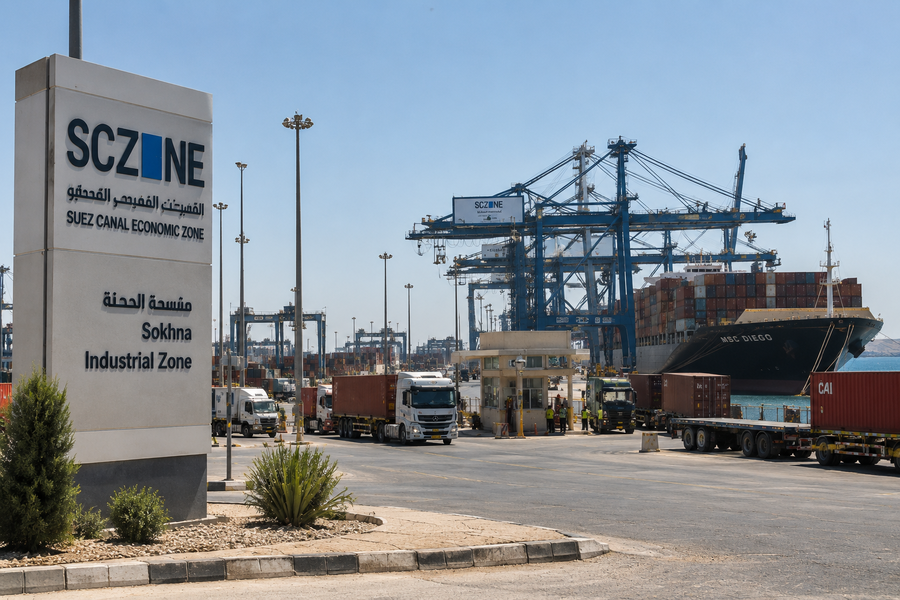

ZC Rubber is studying a $500 million tyre manufacturing complex in Egypt’s Suez Canal Economic Zone, with approximately 95% of its proposed production intended for export. The project remains at letter-of-intent stage, but its location is significant: Sailun is already building and substantially expanding its own manufacturing presence in the same economic zone.
Zhongce Rubber Group has signed a letter of intent with Egypt’s Suez Canal Economic Zone (SCZONE) concerning the possible establishment of an integrated tyre manufacturing complex in Sokhna.
The proposed development would involve estimated investment of around $500 million and initially occupy approximately 600,000 square metres. Around 95% of production is expected to be exported, with the complex planned to include car and truck tyre manufacturing alongside related industrial, service and logistics activities.
For now, however, this is a proposal rather than a confirmed $500 million factory investment. The agreement establishes a framework for studying and evaluating the project and its requirements. No construction timetable has been disclosed.
What makes the proposal particularly relevant to the tyre industry is what has already happened nearby.
Sailun broke ground on its Egyptian tyre plant in September 2025. The initial $291 million development provided for annual capacity of three million passenger car tyres and 600,000 truck and bus tyres. Sailun said at the time that the plant would improve global supply-chain efficiency and responsiveness to customers in Africa, the Middle East and Europe.
The scale of its Egyptian plans has since increased sharply.
In April 2026, Sailun disclosed a further $285.43 million investment covering another six million passenger car radial tyres and 1.05 million truck and bus radial tyres annually. It said that, once the projects then under development were completed, its Egyptian capacity would reach nine million passenger car tyres and 1.65 million truck and bus tyres a year.
Two months later, Sailun announced a separate $1.141 billion Egypt tyre capacity-enhancement project. This envisages another 27 million passenger car radial tyres, 1.65 million truck and bus radial tyres and 20,000 tonnes of OTR tyre capacity annually.
If the announced projects proceed, Sailun’s planned Egyptian footprint would therefore reach approximately 36 million passenger car tyres, 3.3 million truck and bus tyres and 20,000 tonnes of OTR tyres annually. These are planned capacities rather than current production.
Investment figures require more caution. SCZONE described the development at the September 2025 groundbreaking as part of a $1 billion, three-phase project, while Sailun’s subsequent corporate investment decisions have expanded the programme further. The headline figures should therefore not simply be added together without establishing how the projects and expenditure overlap.
The common location is easier to understand when Sokhna is considered as an export manufacturing platform rather than simply an Egyptian production site.
ZC Rubber has identified the area’s logistics and infrastructure as supporting its expansion into the Middle East, Africa and Europe. Its intention to export around 95% of the proposed plant’s output reinforces that international focus.
Sailun has made similar points. In its April expansion disclosure, the company identified Egypt’s position at the intersection of Asia, Africa and Europe and the logistics advantages of the Suez Canal. It said local manufacturing could optimise raw-material procurement and transport routes, reducing costs and improving supply-chain efficiency.
The economics of operating inside SCZONE add another layer. The zone promotes 0% customs duty on project materials and equipment imported for qualifying activities and re-export, and 0% VAT on manufacturing and production inputs entering the zone. Eligible projects can also receive an investment incentive through deductions from taxable profits.
Manufacturing in Egypt can also potentially provide preferential access to markets covered by the country’s trade agreements. The EU-Egypt Association Agreement, for example, established a free-trade area for industrial products. Preferential treatment is not automatic, however: products must satisfy the applicable rules of origin and other requirements.
That distinction matters when considering tyres produced largely from internationally sourced materials. Location alone does not guarantee duty-free entry into a particular export market.
For Sailun, the case for overseas production extends beyond transport.
Material relating to its Egyptian investments has explicitly connected localised manufacturing with the company’s ability to respond to international trade barriers, while its June capacity expansion was presented as part of strengthening its international production footprint.
That provides evidence for placing Sailun’s Egyptian expansion within the wider relationship between tyre manufacturing geography and trade policy. It does not establish that tariff avoidance is the sole or even dominant reason for the investment.
Nor should Sailun’s stated rationale automatically be applied to ZC Rubber. The material available on ZC Rubber’s proposed complex emphasises Egypt’s location, infrastructure, investment environment and access to regional and international markets. It has not explicitly attributed the Sokhna proposal to tariffs or trade barriers.
The two manufacturers have chosen similar geography. That does not mean their calculations are identical.
Two Chinese manufacturers are not enough to demonstrate an industry-wide relocation towards Egypt, and ZC Rubber’s letter of intent is still some distance from a completed factory.
Sailun’s repeated expansion decisions nevertheless make the comparison more substantial than two unrelated investment announcements.
One major Chinese tyre manufacturer is constructing and repeatedly enlarging an Egyptian production base whose announced capacity now runs into tens of millions of tyres. Another is studying a $500 million integrated complex in the same economic zone, with approximately 95% of production intended for export.
For European, Middle Eastern and African distributors, that scale of production could eventually mean new sourcing options, routes and lead-time considerations. For tyre industry suppliers, the development of significant capacity around Sokhna could create opportunities in materials, machinery, logistics and other supporting services.
Much depends on projects that remain under construction, proposed or subject to further approvals. Egypt cannot yet reasonably be described as an established global tyre manufacturing hub.
But ZC Rubber’s proposal arrives in a markedly different context from the one in which Sailun broke ground less than a year ago.
The proposed $500 million ZC Rubber complex still requires further study and subsequent investment decisions. Yet Sailun’s rapidly enlarged production plans mean another overwhelmingly export-oriented Chinese tyre project in Sokhna deserves attention beyond the value of the investment alone.
Egypt, and particularly the Suez Canal Economic Zone, has moved from an interesting new tyre manufacturing location to one that competitors, suppliers and distributors should watch closely.
Tags: ZC Rubber, Sailun, Egypt tyre manufacturing, Suez Canal Economic Zone, Sokhna, Chinese tyre manufacturers, tyre production, tyre investment, tyre exports, SCZONE, tyre supply chain
Editorial Standards & Disclaimer
Tyre News Media is an independent industry publication. Our reporting is based on information available at the time of publication, including company announcements, regulatory filings, official data, research and other sources considered reliable.
Articles may include independent analysis and editorial interpretation. Where appropriate, company statements and third-party claims are attributed to their source. Analysis, estimates and forward-looking observations should not be read as statements of established fact.
Tyre News Media takes reasonable steps to ensure accuracy but welcomes corrections, clarifications and responses from organisations or individuals covered in our reporting. If you believe information is inaccurate or requires clarification, please contact info@tyrenews.co.uk. Material errors will be corrected as appropriate.
Commercial relationships, advertising and sponsorship do not determine Tyre News Media's editorial coverage or conclusions.













.png)


%20(1).png)
%20(1).jpeg)