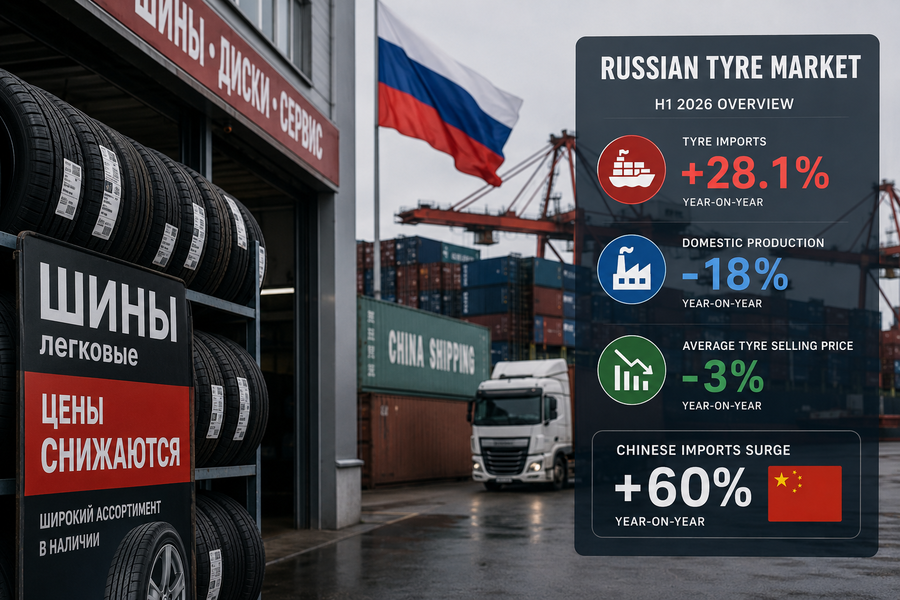

Russia’s passenger tyre market is showing growing supply pressure after imports rose 28.1% in the first half of 2026 while domestic production fell 18%. With Chinese shipments accelerating and the average tyre selling price down 3%, the figures point to intensifying competition even as replacement-market demand remains comparatively resilient.
Passenger tyre imports into Russia reached 16.4 million units during the first half of 2026, while domestic factories produced 13.2 million tyres, according to data reported by RBC. The contrasting movements extended a shift already evident during the first quarter, when imports were rising as Russian manufacturers reduced output. The average price of tyres sold during the half-year fell 3% year on year to RUB6,873, adding evidence that the changing supply position is translating into greater price pressure.
The figures need careful interpretation. Imports exceeding domestic production by 3.2 million tyres does not mean that inventories increased by the same amount, because exports, opening stocks and movements through different parts of the supply chain also affect market availability. Nevertheless, imports increasing 28.1% while domestic production fell 18% represents a significant change in the competitive composition of supply.
This is not entirely new. Russian passenger tyre production fell 20% to 28.1 million units in 2025, while imported passenger tyres totalled 25.4 million, according to CRPT figures previously reported by RBC. Russian products' overall share of the tyre market fell to 51.5%, with manufacturers already pointing to Asian imports and low factory utilisation as important competitive pressures.
The H1 figures suggest that process has continued into 2026. Earlier this year, Tyre News Media reported how Ikon Tyres was restructuring its passenger tyre portfolio to compete more directly with Chinese imports, including a new budget proposition and broader fitment coverage. The strategy reflected a Russian market in which domestic manufacturers increasingly have to compete not only against imported brands on price, but against a changing vehicle parc that requires a broader range of tyre sizes.
Chinese supply is central to the latest shift. Chinese customs figures reported in July put passenger tyre shipments to Russia at 12.7 million units during the first half, up 60% year on year, with their declared value increasing 40% to $322 million. June shipments alone reached 2.99 million tyres, reportedly the highest monthly level in the available data since 2015.
The difference between the 60% increase in volume and 40% increase in value is commercially significant. Based on those reported totals, the implied customs value per tyre fell from approximately $29 in H1 2025 to about $25.40 this year, a decline of roughly 12.5%.
That calculation should not be interpreted as evidence of a like-for-like 12.5% reduction in Chinese tyre prices. Changes in tyre dimensions, brand mix, seasonality and product positioning can materially affect average customs values. However, when viewed alongside the reported 3% decline in Russia's average selling price, it strengthens the case for watching whether greater imported supply is changing price points across the replacement market.
The international backdrop may also matter. Chinese tyre exporters face greater trade barriers in some other major markets. The EU, for example, introduced anti-dumping duties ranging from 4.3% to 45.3% on certain Chinese passenger car and light commercial vehicle tyres in July. As Tyre News Media has examined in relation to possible diversion of Chinese tyre exports, restrictions in one large market can create incentives for exporters to seek volume elsewhere, although there is not yet sufficient evidence to attribute Russia's H1 increase directly to trade diversion.
Demand data make the Russian picture less straightforward than the production and import numbers alone suggest. CRPT data reported by RBC put H1 passenger tyre sales at 12.8 million units worth RUB88.2 billion, with unit sales up 19.4% and value increasing 16.4%. Separately, Cordiant has estimated retail sell-out growth at 11%, while Pirelli's estimate is 15%.
Those measures should not be treated as interchangeable. Cordiant's broader sell-out assessment, incorporating retail, original equipment and corporate purchases, reportedly increased by only 1%. The substantial gap between replacement retail growth and the broader measure therefore points to much weaker conditions outside retail, although the available figures do not allow the effect to be attributed solely to OE demand.
For wholesalers and retailers, that distinction matters. Stronger replacement demand can support throughput even while the wider market struggles, but rapidly increasing imports add more suppliers and products competing for that demand. If incoming supply continues to expand faster than overall market absorption, stock management, purchasing terms and supplier discipline are likely to become increasingly important.
Domestic manufacturers face a different calculation. Russian factories entered 2026 with substantial unused capacity, while manufacturers had already been adjusting production to avoid repeating the stock accumulation experienced in 2025. Cordiant told Autonews earlier this year that restrained production aligned with actual consumer demand would continue, while Ikon Tyres said utilisation at its Russian plant was above 50%.
This means falling Russian output should not automatically be read as market share lost directly to imports. Some reduction appears to reflect deliberate production management in response to demand and inventory conditions. Even so, persistent import growth makes raising factory utilisation harder unless domestic producers can regain replacement-market share, expand exports or compete more effectively in the sizes demanded by Russia's changing car parc.
There is already evidence of that product-mix challenge. RBC reported earlier in 2026 that 32.4% of Chinese cars sold in Russia required R18 or larger tyres, while Russian factories historically concentrated more heavily on mainstream sizes up to R17. Imports may therefore be addressing fitment gaps as well as competing on price.
The next test will be whether the H1 supply pattern persists into the second half. Inventory data would provide the clearest evidence of whether higher imports are producing genuine market-wide overstocking, while price movements by brand, size and tier would show whether the decline in average selling prices represents broad compression or changes in product mix.
For now, the evidence supports a more measured conclusion than declaring a price war. Russia has a passenger tyre market in which imports are rising rapidly, domestic factories are producing less and average selling prices have fallen. Replacement demand remains comparatively strong, but the combination leaves manufacturers and distributors competing within an increasingly import-heavy supply structure.
If Chinese shipments remain elevated while domestic producers seek higher utilisation, price and inventory discipline could become the defining commercial issues for the Russian tyre market during the remainder of 2026.
Tags: Russian tyre market, Chinese tyre imports, Russia tyre prices, passenger car tyres, tyre imports, tyre manufacturing, Cordiant, Ikon Tyres, tyre wholesale, Chinese tyres
Editorial Standards & Disclaimer
Tyre News Media is an independent industry publication. Our reporting is based on information available at the time of publication, including company announcements, regulatory filings, official data, research and other sources considered reliable.
Articles may include independent analysis and editorial interpretation. Where appropriate, company statements and third-party claims are attributed to their source. Analysis, estimates and forward-looking observations should not be read as statements of established fact.
Tyre News Media takes reasonable steps to ensure accuracy but welcomes corrections, clarifications and responses from organisations or individuals covered in our reporting. If you believe information is inaccurate or requires clarification, please contact info@tyrenews.co.uk. Material errors will be corrected as appropriate.
Commercial relationships, advertising and sponsorship do not determine Tyre News Media's editorial coverage or conclusions.



















%20(1).jpeg)