Point S International has called for greater emphasis on tyre performance as tread depth decreases, following independent testing of its 4 Seasons 3 all-season tyre against selected Tier 2 and Tier 3 competitors.
The tests, carried out by TÜV SÜD Product Service in February and March 2026, assessed performance when new and with tread reduced to 2mm, with Point S reporting advantages in wet grip, braking and other performance measures.
The testing commissioned by Point S International examined the Point S 4 Seasons 3 alongside a selection of competing all-season tyres in size 205/55 R16 94V XL.
Testing was conducted using an Audi A3 and Volkswagen Golf VIII, with results covering wet braking, aquaplaning, lateral grip, snow performance and rolling resistance.
With tyres reduced to 2mm of remaining tread, the Point S 4 Seasons 3 achieved a wet grip index of 100, compared with an average of 85 for the selected Tier 2 tyres and 83 for the Tier 3 group.
The figures are relative performance indices, with the Point S tyre used as the reference. They do not represent absolute braking distances or performance across the wider tyre market.
The 2mm test depth is close to the 1.6mm legal minimum for passenger car tyres in the UK and much of Europe, making performance at this stage relevant to workshops advising customers on tyre replacement.
Fabien Bouquet, CEO of Point S International, said:
“We tested at 2mm because that is the tyre a customer is really driving on when the weather turns. If a tyre only performs when it is new, the driver finds that out at the worst possible moment.”
The Point S 4 Seasons 3 also recorded the strongest results among the tyres tested in several assessments conducted when new.
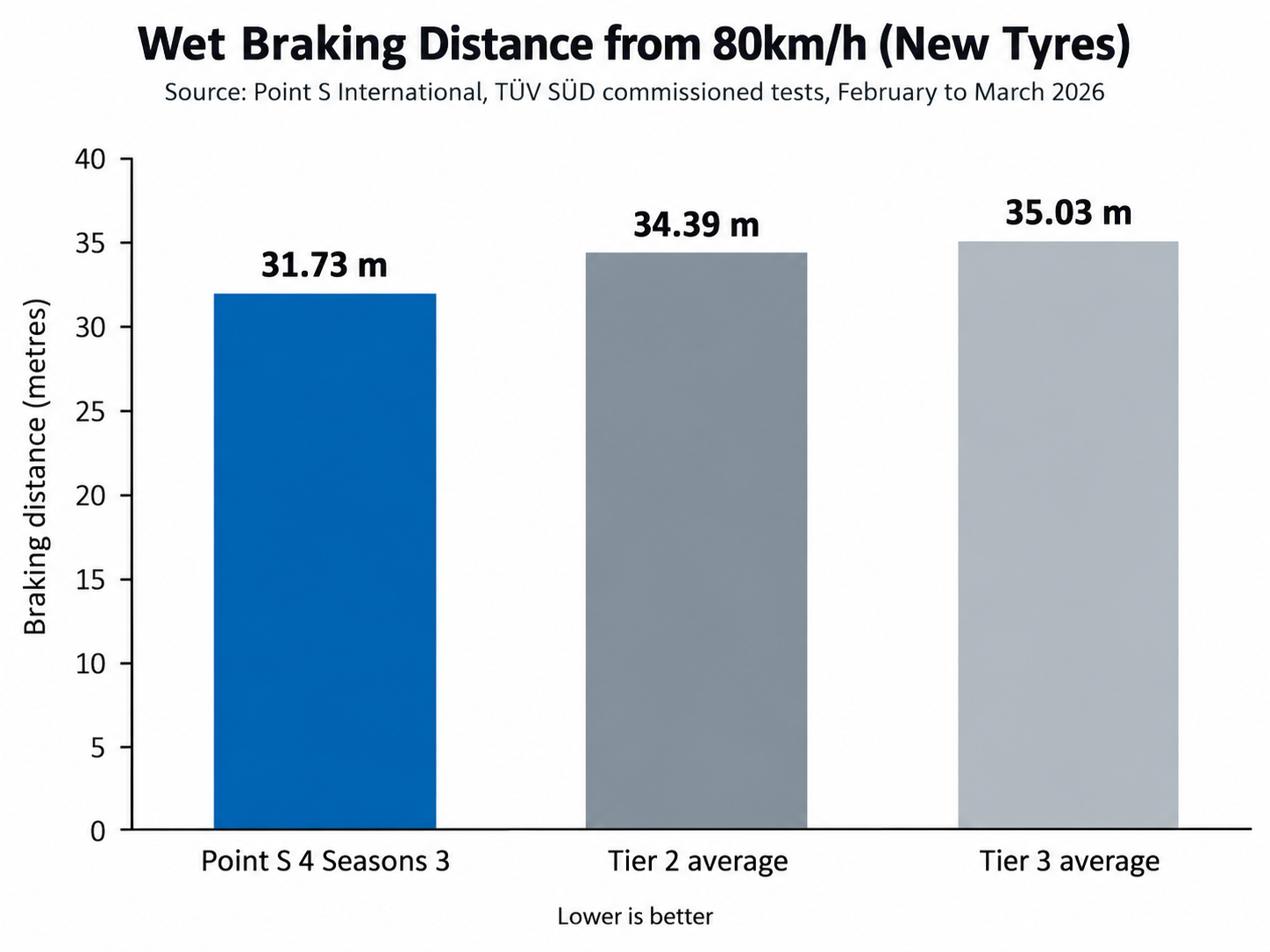
In wet braking tests from 80km/h, the tyre stopped in 31.73 metres, compared with averages of 34.39 metres for the Tier 2 selection and 35.03 metres for the Tier 3 group.
Wet braking distance from 80km/h, new tyres
In snow braking tests from 40km/h, the Point S tyre stopped in 17.3 metres, against 17.7 metres and 19.0 metres for the respective competitor groups.
Point S also reported favourable results for aquaplaning resistance, lateral wet grip and snow acceleration.
In rolling resistance testing, the company recorded an index of 100 for its tyre, compared with 90 and 86 for the Tier 2 and Tier 3 selections respectively. Lower rolling resistance can contribute to reduced energy consumption, although actual fuel economy and electric vehicle range depend on driving and vehicle conditions.
The findings come ahead of the winter equipment season in parts of Europe.
In France, designated mountainous areas across 34 départements require vehicles to carry suitable snow chains or socks, or use qualifying winter tyres, between 1 November and 31 March.
Since November 2024, tyres must carry the Three-Peak Mountain Snowflake (3PMSF) symbol to qualify as winter equipment in place of chains under these rules. Tyres marked only M+S no longer meet that requirement.
Germany also requires 3PMSF-marked tyres during specified winter road conditions, including snow, ice and slush. Unlike France's seasonal requirements, Germany's obligation is determined by road conditions rather than fixed dates.
The Point S 4 Seasons 3 carries 3PMSF certification.
Worn tyre performance is also receiving greater attention through international type-approval requirements.
UN Regulation No. 117 includes wet adhesion requirements for passenger car tyres in a worn state, supplementing the existing assessments of new tyres.
For manufacturers, this introduces an additional performance consideration during tyre development. For retailers and workshops, it also reinforces the importance of considering how tyres behave throughout their service life rather than relying solely on new-tyre performance figures.
Emilie Faure, International Private Labels Product Manager at Point S International, said:
“We gave 4 Seasons 3 an improved tread and a more flexible compound so it performs across a wider temperature range, and it is fully compatible with electric vehicles, which is still unusual among all-season tyres.”
The company said the tyre was developed and manufactured in Europe, with testing intended to demonstrate its performance against products competing in the same market segments.
The results relate to the specific tyres, size and conditions tested. They provide comparative evidence for the selected products rather than a ranking of all Tier 2 and Tier 3 all-season tyres.
🏢 Company Information
Find out more about Point S UK Ltd, including company details and contact information, in the Tyre News Business Directory.
View Point S UK Ltd in the Business Directory
Tags: Point S International, Point S 4 Seasons 3, TÜV SÜD, worn tyre performance, all-season tyres, wet grip testing, tyre braking distances, winter tyre regulations, 3PMSF certification, tyre safety
Editorial Standards & Disclaimer
Tyre News Media is an independent industry publication. Our reporting is based on information available at the time of publication, including company announcements, regulatory filings, official data, research and other sources considered reliable.
Articles may include independent analysis and editorial interpretation. Where appropriate, company statements and third-party claims are attributed to their source. Analysis, estimates and forward-looking observations should not be read as statements of established fact.
Tyre News Media takes reasonable steps to ensure accuracy but welcomes corrections, clarifications and responses from organisations or individuals covered in our reporting. If you believe information is inaccurate or requires clarification, please contact info@tyrenews.co.uk. Material errors will be corrected as appropriate.
Commercial relationships, advertising and sponsorship do not determine Tyre News Media's editorial coverage or conclusions.