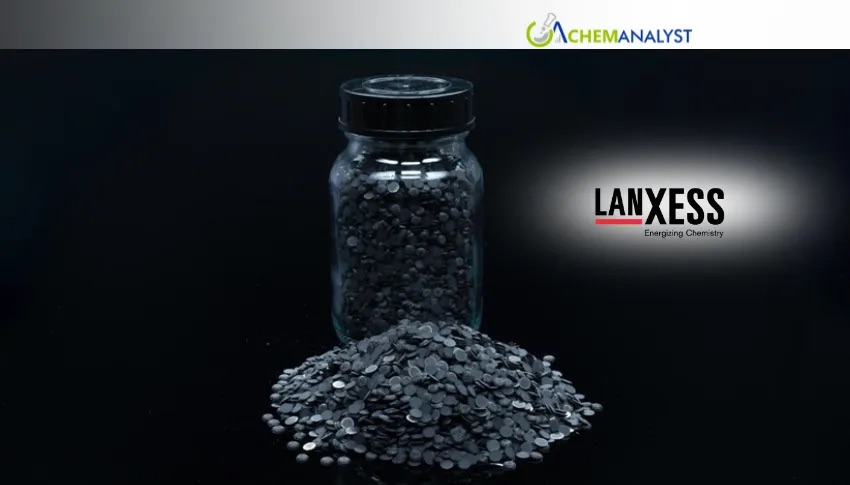

LANXESS is preparing to begin initial commercial production of its Vulkanox 4060 tyre antidegradant in the fourth quarter of 2026, moving one potential alternative to 6PPD closer to practical tyre-industry use. The CCPD-based additive is intended to provide antioxidant and antiozonant protection while, according to LANXESS, offering an improved environmental profile.
LANXESS plans to start initial commercial production of Vulkanox 4060 in Q4 2026, with the company reporting particular customer interest in Europe and the United States. The product contains CCPD, N,N’-dicyclohexyl-p-phenylenediamine, and has been developed as a potential substitute for 6PPD, the widely used tyre antidegradant that protects rubber against deterioration caused by oxygen and ozone.
According to LANXESS, testing conducted by the company and customers has shown CCPD delivering technical performance comparable with 6PPD. The company also claims a significantly improved environmental profile and says testing of CCPD-quinone, a transformation product formed from CCPD, produced no observed acute effects in coho salmon up to the material’s solubility limit. These remain company-generated performance and environmental claims rather than evidence that CCPD has been established as a universal replacement for 6PPD.
The search for alternatives matters because 6PPD performs an important durability function in tyres. When exposed to ozone, however, 6PPD forms 6PPD-quinone, which US Environmental Protection Agency material identifies as acutely toxic to coho salmon and some other fish species. EPA is among the bodies examining both 6PPD and possible replacement chemicals.
That makes substitution more complex than finding a material with a preferable environmental profile. Any candidate also has to meet tyre manufacturers’ requirements for ageing protection, manufacturing compatibility, regulatory compliance, commercial supply and cost before it can be adopted at production scale.
The Q4 production target represents a further step from Vulkanox 4060’s position earlier this year.
At Tire Technology Expo in Hannover in March, LANXESS was presenting CCPD as a potential 6PPD alternative and said laboratory and application testing had shown comparable protection against oxidative ageing. At that stage, the company said it was preparing EU REACH registration for volumes exceeding 1,000 tonnes and expected production of commercial quantities around the middle of 2026.
LANXESS’s product information has meanwhile continued to describe Vulkanox 4060 as being in development and produced at pre-commercial scale, with further safety studies accompanying its planned production ramp-up.
In its September update, LANXESS reported completion of EU REACH registration under Annex VII and shifted the stated initial commercial-production timetable to Q4. Annex VII corresponds to the standard REACH information requirements for the 1–10 tonnes-per-year band. Higher tonnage bands require progressively more information, meaning the announcement should not be read as confirmation that all registration requirements associated with the higher production volumes previously discussed by LANXESS have been completed.
Practical manufacturing compatibility could also help determine how readily tyre producers can evaluate the material. LANXESS says Vulkanox 4060 can be manufactured at commercial scale in existing company plants and is supplied as a solid product that can be dosed in a similar way to 6PPD. It also says major raw materials are available at scale from multiple suppliers.
Commercial production would therefore move Vulkanox 4060 beyond the pre-commercial supply stage and make larger-scale tyre-industry evaluation more practical. Broader adoption, however, will depend on manufacturer validation, further environmental and toxicological evidence, cost, available supply volumes and regulatory requirements in major tyre markets.
Tags: LANXESS, Vulkanox 4060, 6PPD alternative, CCPD, tyre antidegradants, tyre chemicals, 6PPD-quinone, tyre manufacturing, EU REACH, rubber additives
Editorial Standards & Disclaimer
Tyre News Media is an independent industry publication. Our reporting is based on information available at the time of publication, including company announcements, regulatory filings, official data, research and other sources considered reliable.
Articles may include independent analysis and editorial interpretation. Where appropriate, company statements and third-party claims are attributed to their source. Analysis, estimates and forward-looking observations should not be read as statements of established fact.
Tyre News Media takes reasonable steps to ensure accuracy but welcomes corrections, clarifications and responses from organisations or individuals covered in our reporting. If you believe information is inaccurate or requires clarification, please contact info@tyrenews.co.uk. Material errors will be corrected as appropriate.
Commercial relationships, advertising and sponsorship do not determine Tyre News Media's editorial coverage or conclusions.















%20(1)%20(1).png)



%20(1).jpeg)