


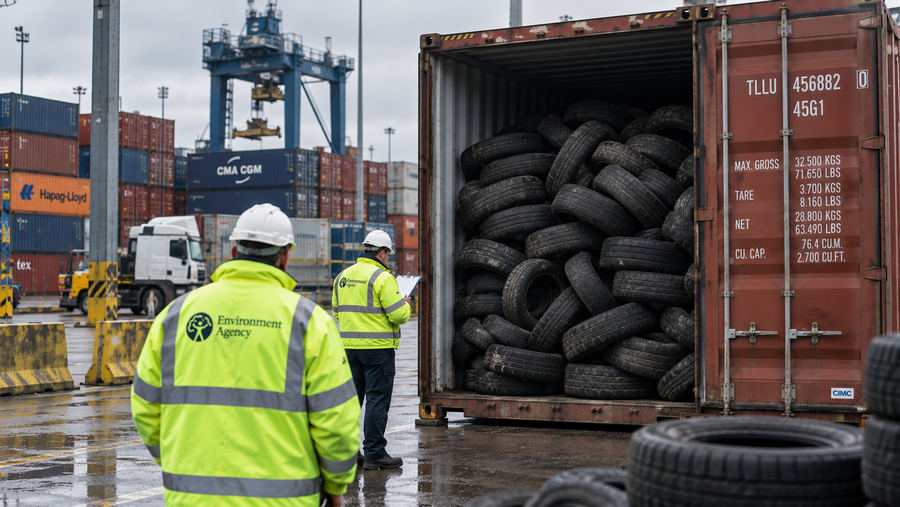

Defra is finalising legislation to withdraw the T8 waste exemption, while new parliamentary figures show the Environment Agency has served 50 prohibition notices on waste tyre exporters and restricted exports to 31 destination facilities. The developments come as the regulator moves from blanket enhanced export checks towards a more targeted, risk-based compliance regime.
The UK Government is finalising legislation to withdraw the T8 waste exemption for end-of-life tyres, although it has stopped short of setting a timetable for bringing the change before Parliament.
In a written parliamentary answer on 7 September, Defra minister Emma Hardy said drafting was being finalised and the legislation would be laid before Parliament "when parliamentary time allows". There is therefore still no confirmed implementation date for the withdrawal.
The update comes alongside fresh figures showing that Environment Agency enforcement against waste tyre exporters has progressed considerably since its last published report.
According to a separate parliamentary answer, the EA has now served 50 prohibition notices on exporters of waste tyres from England. It has also restricted exports to 31 destination facilities where exporters were unable to provide satisfactory return-tracking evidence, including required geotagged proof of arrival.
Between October 2025 and July 2026, the regulator carried out enhanced checks on more than 10,000 waste tyre shipments.
Those figures represent a later enforcement position than the EA's 13 August progress report. That update, presenting the position as at 3 August, recorded details of 10,822 shipments and said 26 prohibition notices had been served to prevent further exports. Five fixed penalty notices had also been issued, with another 39 under consideration.
The increase from 26 to 50 prohibition notices shows that enforcement continued to develop after the figures contained in the August report. The parliamentary answer does not, however, establish that the 50 notices relate to 50 individual exporters.
The latest enforcement figures come alongside an important change in how the EA is policing waste tyre exports.
From 1 August, exporters moved onto an interim compliance approach intended to maintain proportionate checks while concentrating regulatory resources on higher-risk activity ahead of digital waste tracking in 2027.
Exporters must provide monthly Annex VII shipment information, while details of new destination treatment facilities in India must be submitted for review before those facilities are used. The EA is also continuing to track shipments made up to 31 July for which return evidence remains outstanding.
This differs from the enhanced checking programme introduced in October 2025, under which exporters subject to information notices faced additional evidence requirements intended to establish where tyres were sent and whether they reached their stated recovery facilities.
The change should not simply be characterised as either a tightening or relaxation of export controls. The EA says it has built a substantial evidence base on exporter performance and is now focusing resources on operators with consistently poor compliance. It retains options including requirements for pre-shipment information and return-tracking evidence, further prohibition notices and other regulatory action.
Significantly, Defra told Parliament that the enhanced checks did not identify evidence of widespread exports to batch-pyrolysis facilities. It said those findings led the EA to revise its approach to provide proportionate assurance across the sector while targeting operators presenting the greatest risk of non-compliance.
That provides important context to the headline enforcement figures. The programme has resulted in substantial regulatory action against particular exports and destinations, but the evidence gathered did not persuade the regulator that blanket enhanced requirements remained proportionate across the sector.
T8 currently allows operators meeting its conditions to undertake activities including baling, shredding, peeling, shaving and granulating relatively small quantities of end-of-life tyres without an environmental permit.
The Government has decided to remove the exemption, citing fire risks associated with tyre storage and evidence of operators exceeding exemption limits. Businesses relying on T8 would ultimately need to operate under an appropriate environmental permit or cease the activities covered by the exemption.
Previously announced policy provides for a three-month transition period associated with the withdrawal, but that should not be confused with a commencement date. Defra's latest parliamentary answer confirms only that legislation is being finalised and will be laid when parliamentary time permits.
Together, the developments mean regulatory change is advancing on two fronts for England's end-of-life tyre sector. The domestic T8 permitting reform remains in legislative preparation, while the EA's export intervention is already resulting in restrictions and prohibition notices.
At the same time, the regulator's shift towards risk-based controls suggests the next phase of export enforcement will be more targeted, concentrating additional scrutiny and regulatory action where evidence indicates greater or persistent compliance risks.
Environment Agency August 2026 Progress Update
Tags: T8 waste exemption, end-of-life tyres, tyre recycling, waste tyre exports, Environment Agency, Defra, tyre recovery, tyre export controls, waste regulation, environmental permits
Editorial Standards & Disclaimer
Tyre News Media is an independent industry publication. Our reporting is based on information available at the time of publication, including company announcements, regulatory filings, official data, research and other sources considered reliable.
Articles may include independent analysis and editorial interpretation. Where appropriate, company statements and third-party claims are attributed to their source. Analysis, estimates and forward-looking observations should not be read as statements of established fact.
Tyre News Media takes reasonable steps to ensure accuracy but welcomes corrections, clarifications and responses from organisations or individuals covered in our reporting. If you believe information is inaccurate or requires clarification, please contact info@tyrenews.co.uk. Material errors will be corrected as appropriate.
Commercial relationships, advertising and sponsorship do not determine Tyre News Media's editorial coverage or conclusions.
















%20(1)%20(1).png)





%20(1).jpeg)