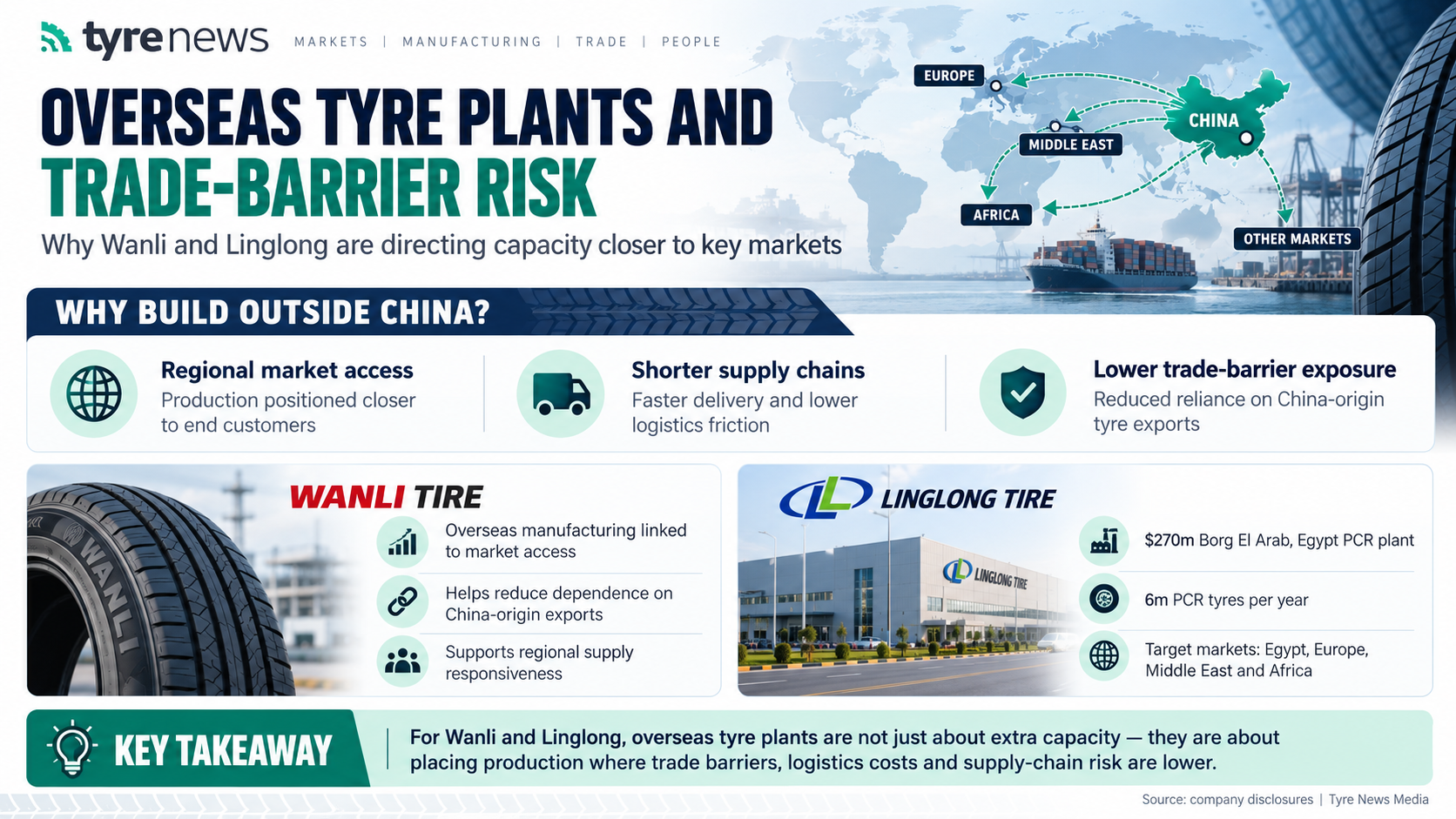

Wanli Tire and Linglong Tire have each put fresh numbers behind overseas manufacturing projects, but their disclosures say more than where the next factories will be built. Both manufacturers explicitly connect production outside China with regional market access, shorter supply chains and reduced exposure to trade measures affecting China-origin tyre exports.
Wanli Tire’s latest Shenzhen IPO prospectus and Linglong Tire’s newly approved Egyptian investment provide two current examples of Chinese tyre manufacturers changing the geography from which they intend to serve overseas markets.
Wanli plans to raise RMB2 billion through its proposed Shenzhen listing. Of that, RMB930 million is earmarked for its Malaysian high-performance green tyre manufacturing project, against total planned investment of RMB2.237 billion. The project will be implemented through a subsidiary in which Wanli expects to hold 70%, although the prospectus says the Malaysian operation remains in preparation and the funded project has not yet started.
The financing matters because the prospectus is unusually explicit about why overseas production is being expanded. Wanli says more than half its tyres were exported in 2025 and identifies Europe, North America and Brazil among markets to be served by its Cambodia and Malaysia projects. It describes an operating model built around “China R&D + Southeast Asia manufacturing + global sales”.
More significantly, Wanli directly links those projects with its exposure to anti-dumping and countervailing measures. The company says local production in Cambodia and Malaysia is intended to reduce tariff risk affecting Chinese-origin products and support a transition from China-centred manufacturing exports towards more localised global production. Those are Wanli’s claims about the expected trade treatment of its overseas output, rather than an independent determination of customs origin.
TNM previously reported the establishment of Wanli’s Malaysian joint venture with Berjaya Property, including the 70:30 ownership structure and planned manufacturing site in Selangor. TNM’s July report on Wanli’s Malaysia project The IPO filing now adds a clearer funding route and places the investment within Wanli’s broader overseas-production case.
Linglong’s latest disclosure provides a parallel development in a different region.
Its board approved a US$270 million investment on 23 September for a plant at Borg El Arab in Alexandria, Egypt. The project is planned to produce six million semi-steel radial tyres annually, with construction estimated at two years. Linglong intends to establish a wholly owned Egyptian company for the investment, which remains subject to regulatory approvals in China and Egypt.
The company says the plant will serve Egypt and markets across Europe, the Middle East and Africa. It points to shorter logistics routes, improved regional fulfilment and greater supply-chain resilience, while also saying the overseas capacity should help offset uncertainty from existing and potential international trade barriers.
That makes the latest announcement materially more concrete than the wider Egyptian framework TNM covered on 11 September. The earlier memorandum concerned a proposed integrated industrial complex with investment of around US$2 billion and remained at an early planning stage. TNM’s earlier report on Linglong’s Egypt MoU
The US$270 million project does not turn the whole US$2 billion concept into an approved investment programme. What it does provide is a defined listed-company project with a location, capacity, construction period and capital requirement.
The common point between Wanli and Linglong is therefore not simply that both are adding factories overseas. Their own disclosures put trade exposure alongside logistics, customer access and supply-chain resilience when explaining the location of new production.
That is particularly relevant in Europe. In July, the European Commission imposed definitive anti-dumping duties ranging from 4.3% to 45.3% on passenger-car and light-lorry tyres originating in China. The measures apply according to origin, not simply the country from which goods are shipped.
European Commission: definitive tyre anti-dumping measures
This distinction matters when manufacturers describe overseas plants as a means of reducing tariff exposure. Under EU non-preferential origin rules, goods involving production in more than one country generally take their origin from the country where the last substantial and economically justified processing or working takes place. The Commission also states that processing intended to avoid certain tariff measures may not be regarded as economically justified. Preferential tariff treatment is governed by separate, agreement-specific origin rules.
A factory in Malaysia or Egypt therefore does not, by its location alone, establish the customs treatment its tyres will receive in every destination market. The manufacturing process, material sourcing and applicable rules of origin remain relevant. That is why Wanli’s statements about third-country origin and tariff mitigation are best reported as the company’s intended outcome rather than as a guarantee that duties will not apply.
For tyre importers, distributors and OE customers, the direction is nevertheless important. Where production is located affects delivery routes, lead times, sourcing flexibility and potential exposure to country-specific trade measures. Overseas capacity can also give manufacturers another source from which to allocate production when particular markets or factories face disruption.
Two manufacturers do not establish that every Chinese tyre producer will adopt the same model. But Wanli and Linglong now provide unusually direct documentary evidence of how overseas investment is being justified. In both cases, international production is being presented not only as additional capacity, but as part of the infrastructure needed to serve regional markets from outside a China-centred export model.
Tags: Wanli Tire, Linglong Tire, China tyre manufacturing, overseas tyre production, Malaysia tyre plant, Egypt tyre plant, tyre trade barriers, tyre tariffs, tyre supply chain, tyre manufacturing investment
Editorial Standards & Disclaimer
Tyre News Media is an independent industry publication. Our reporting is based on information available at the time of publication, including company announcements, regulatory filings, official data, research and other sources considered reliable.
Articles may include independent analysis and editorial interpretation. Where appropriate, company statements and third-party claims are attributed to their source. Analysis, estimates and forward-looking observations should not be read as statements of established fact.
Tyre News Media takes reasonable steps to ensure accuracy but welcomes corrections, clarifications and responses from organisations or individuals covered in our reporting. If you believe information is inaccurate or requires clarification, please contact info@tyrenews.co.uk. Material errors will be corrected as appropriate.
Commercial relationships, advertising and sponsorship do not determine Tyre News Media's editorial coverage or conclusions.














%20(1).png)





%20(1).jpeg)