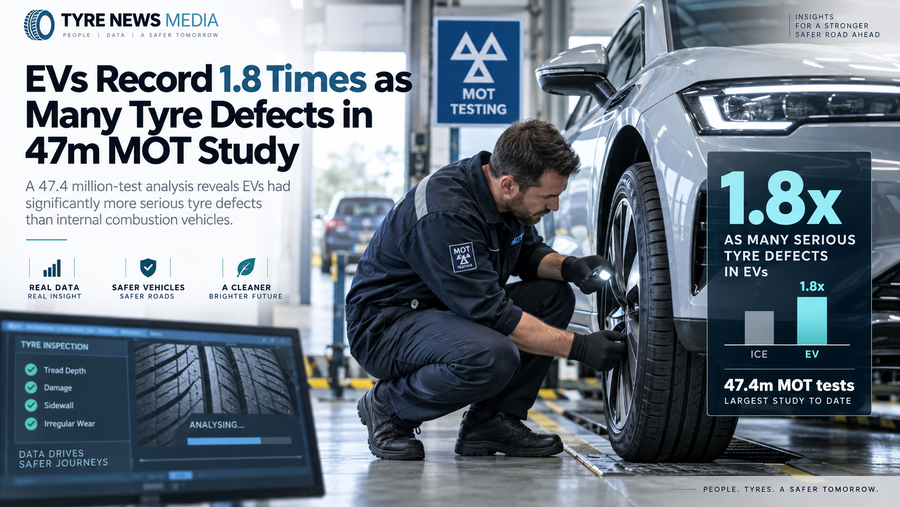

Electric vehicles recorded around 1.8 times as many serious tyre defects as petrol cars in a 47.4 million-test MOT analysis commissioned by the BVRLA. But the same data showed lower EV suspension defect rates and a wide variation between vehicle platforms, making the result a more specific engineering question than a simple story about EV weight.
Electric vehicles recorded substantially more tyre defects than petrol cars in a major analysis of Great Britain’s MOT data, even as they performed better in several other roadworthiness categories at higher mileages.
The study, commissioned by the British Vehicle Rental and Leasing Association (BVRLA) and carried out by New AutoMotive, analysed 47.4 million MOT tests. Its component-level comparison of vehicles aged three to eight found BEVs consistently recording around 1.8 times the tyre defects of petrol vehicles across the mileage bands examined.
Between 20,000 and 40,000 miles, BEVs recorded 5.8 tyre defects per 100 tests against 3.2 for petrol cars. The respective figures were 7.2 and 4.1 at 40,000 to 60,000 miles, 8.6 and 4.9 at 60,000 to 90,000 miles, and 9.4 and 5.4 beyond 90,000 miles.
The 1.8-times figure should not be interpreted as evidence that EV tyres wear 1.8 times faster or last little more than half as long.
The research counted only MOT defects classified as Major or Dangerous, while Minor defects and advisory items were excluded. Under DVSA rules, tyre failures in these categories can include insufficient tread depth, serious cuts or structural damage, incorrect fitment and other roadworthiness issues. The dataset therefore measures the incidence of serious defects found at MOT, not tread consumption per mile, tyre replacement frequency or service life.
That distinction matters because the tyre result sits alongside a different pattern elsewhere on the vehicle. At 60,000 to 90,000 miles, BEVs recorded 4.7 suspension defects per 100 tests compared with 6.1 for petrol cars. Brake defects were also lower, at 2.1 against 5.8 per 100 tests.
The higher tyre-defect rate therefore coexists with lower defect rates in other major component groups. In the wider age-and-mileage-controlled analysis, overall BEV MOT failure rates levelled at around 16% beyond 60,000 miles while petrol failure rates continued rising.
For the tyre industry, the study’s model-level comparisons are particularly relevant because the size of the tyre-defect gap was far from uniform.
In the report’s platform grouping, the Nissan e-NV200 recorded 6.99 additional tyre defects per 100 tests compared with its diesel counterpart, while the Volkswagen e-Golf recorded 4.97 more than the petrol Golf and the Hyundai Kona Electric 4.17 more than the petrol version. The corresponding excesses were considerably smaller for the BMW i3, Kia Niro EV and Hyundai Ioniq Electric, at between 1.33 and 1.93 defects per 100 tests.
The report attributes the broader EV tyre difference to factors including battery mass, torque and vehicle architecture. However, the MOT dataset does not independently isolate those variables or measure tyre wear directly. The platform comparison is therefore stronger evidence that the defect gap varies with vehicle design than proof of any single cause.
That leaves a more useful question for tyre manufacturers, vehicle engineers and fleets: why do some electric vehicle configurations produce a much larger excess of serious tyre defects than others?
The evidence does not establish whether tyre specification, suspension geometry, vehicle loading, torque characteristics, maintenance or other factors account for those differences. It does, however, make a simple assumption that EV mass alone determines component deterioration difficult to sustain, particularly when the same dataset shows lower suspension defect rates for BEVs across every mileage band examined.
Read the full BVRLA durability report
Tags: EV tyre defects, electric vehicle tyres, MOT tyre defects, BVRLA, New AutoMotive, DVSA MOT data, EV tyre study, vehicle platform design, tyre roadworthiness, EV tyre specification, electric car durability
Editorial Standards & Disclaimer
Tyre News Media is an independent industry publication. Our reporting is based on information available at the time of publication, including company announcements, regulatory filings, official data, research and other sources considered reliable.
Articles may include independent analysis and editorial interpretation. Where appropriate, company statements and third-party claims are attributed to their source. Analysis, estimates and forward-looking observations should not be read as statements of established fact.
Tyre News Media takes reasonable steps to ensure accuracy but welcomes corrections, clarifications and responses from organisations or individuals covered in our reporting. If you believe information is inaccurate or requires clarification, please contact info@tyrenews.co.uk. Material errors will be corrected as appropriate.
Commercial relationships, advertising and sponsorship do not determine Tyre News Media's editorial coverage or conclusions.


















%20(1).jpeg)