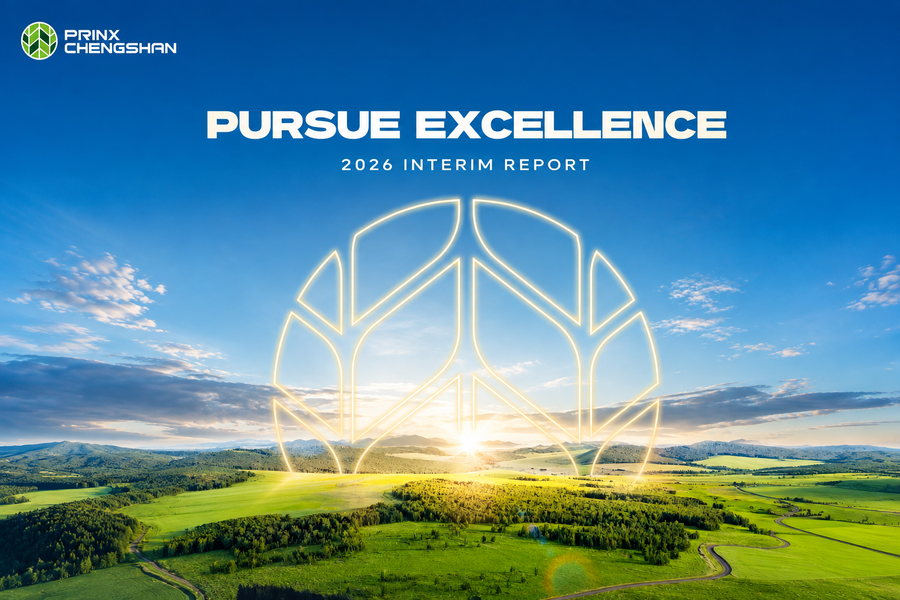

Prinx Chengshan sold more tyres and increased revenue in the first half of 2026, despite an 18.5% fall in attributable profit. Behind those headline figures, however, a widening gap between volume and revenue growth, stronger domestic and OEM sales and weaker international dealer revenue provides a more revealing picture of how the Chinese manufacturer’s growth is changing.
Prinx Chengshan Holdings sold approximately 14.8 million tyres during the first six months of 2026, an increase of 4.4% year on year, while revenue rose by a more modest 1.4% to RMB5.786 billion.
The difference between those two growth rates is commercially significant. At a simple group level, revenue per tyre was around 2.9% lower than in the corresponding period, although the published figures alone do not establish whether this resulted from pricing, product mix, geography, customer mix or a combination of those factors. What they do show is that additional volume did not translate proportionately into additional turnover.
That distinction matters because the headline profit decline could otherwise suggest a more pronounced deterioration in the underlying tyre operation. Gross profit actually increased 2.9% to RMB975 million, while gross margin improved from 16.6% to 16.9%. Profit attributable to shareholders nevertheless fell 18.5%, from RMB507.6 million to RMB413.7 million, with exchange-rate movements and higher tax expenses cited among the factors affecting earnings.
For tyre manufacturers, distributors and investors, that creates two different stories within the same set of accounts. The bottom line weakened substantially, but the combination of higher volumes, higher gross profit and a slightly stronger gross margin indicates that the operating picture was more resilient than the attributable profit number alone suggests.
More revealing is where Prinx Chengshan generated its revenue.
Domestic dealer revenue increased 18.1% to approximately RMB1.202 billion, while direct sales to vehicle manufacturers rose 25.8% to RMB995.7 million. International dealer revenue, still by far the largest of the three channels at RMB3.587 billion, fell 7.9%.
The movement deserves attention because Prinx Chengshan entered 2026 from a very different international position. In its 2025 interim report, the group said overseas sales volume and revenue had both increased, while it added 21 overseas distributors and secured further OE business in Thailand. Its Thai operation won projects involving SAIC MG and Changan Automobile during that period.
A single half-year does not establish a permanent change in distribution strategy, and weaker international dealer revenue should not automatically be interpreted as withdrawal from overseas replacement markets. However, the latest figures show that the strongest growth in the first half came from domestic distribution and direct OE business rather than the international dealer channel.
That matters to wholesalers and importers because Chinese manufacturers have historically built much of their international presence through export-led replacement tyre distribution. As those manufacturers become larger, secure more OE programmes and establish production outside China, the balance between export distributors, regional production and direct vehicle-manufacturer relationships has the potential to change.
Product mix provides another piece of the picture. All-steel radial tyre revenue increased 5.1% to RMB3.320 billion and represented 57.3% of tyre revenue, while semi-steel radial revenue declined 4.4% to RMB2.350 billion. Bias and OTR tyre revenue, although much smaller at around RMB110 million, increased 30.8%.
The stronger all-steel performance is particularly relevant as Prinx Chengshan continues to broaden its commercial vehicle activities internationally. Tyre News Media recently reported on the company’s launch of its Xelera truck tyre family for the European market, covering long-haul, regional and mixed applications.
The decline in international dealer revenue is also notable because it comes while Prinx Chengshan is investing further in manufacturing outside China.
The company began construction of its Malaysian production base at Kedah Rubber City in November 2025. Phase I is planned to provide annual capacity for six million semi-steel radial tyres and 600,000 all-steel radial tyres, adding a second major Southeast Asian manufacturing location alongside Thailand.
Tyre News Media’s coverage of the Kedah Rubber City factory highlighted the site's proximity to both the Thai border and Penang Port, giving the operation potential logistical relevance beyond simply adding production capacity.
That investment should therefore be viewed alongside, rather than contradicted by, the decline in international dealer sales. Prinx Chengshan is continuing to commit capital to international manufacturing even as its current revenue growth is being driven more strongly by other channels.
The wider question is whether this combination points towards the next stage in the internationalisation of larger Chinese tyre manufacturers.
The traditional model of producing tyres in China and exporting them through overseas distributors is increasingly being supplemented by manufacturing investments elsewhere in Asia, deeper regional distribution structures and attempts to win OE fitments. Prinx Chengshan is not alone in pursuing overseas capacity, making its changing sales mix relevant beyond the company's own accounts.
Tyre News Media has previously examined how the term “Chinese tyre” is becoming less useful as a simple description of market positioning, with manufacturers differing increasingly in international production, technology, scale and distribution strategy. That analysis of the changing position of Chinese tyre manufacturers identified overseas manufacturing as one of the forces making traditional assumptions about the sector less reliable.
Prinx Chengshan's first-half figures add another dimension to that discussion. They do not prove that the company is deliberately moving away from international distributors, nor do they establish that overseas manufacturing will necessarily lead to greater OE penetration. They do show, however, that the sources and geography of growth are becoming more complicated than export volumes alone can explain.
That makes the development of the Malaysian factory an important indicator to watch.
Prinx Chengshan's 2025 interim reporting said the Malaysian operation would eventually add six million semi-steel and 600,000 all-steel tyres of annual capacity, with capacity expected to be progressively released during 2027 and 2028. The plant adds to substantial existing manufacturing capacity in Shandong and Thailand.
The commercial test will be how that capacity is ultimately absorbed. If overseas manufacturing is accompanied by additional regional OE contracts, stronger local distribution and a broader mix of products manufactured closer to destination markets, Prinx Chengshan would increasingly resemble a multinational tyre producer with Chinese ownership rather than principally a China-based exporter.
For now, its first-half numbers show a business selling more tyres without equivalent revenue growth, generating stronger domestic and OE sales while international dealer turnover contracts, and continuing to invest in overseas production.
The 18.5% decline in attributable profit remains material. But for the tyre trade, the more consequential question is what is happening beneath it: where Prinx Chengshan's next increment of growth will come from, which channels will capture it and how its expanding Southeast Asian manufacturing footprint changes the answer.
Tags: Prinx Chengshan, Prinx Chengshan results 2026, Chinese tyre manufacturers, tyre manufacturing, Malaysia tyre factory, Chinese tyre exports, tyre OEM sales, tyre distribution, Prinx tyres, Austone tyres, Southeast Asia tyre manufacturing
Editorial Standards & Disclaimer
Tyre News Media is an independent industry publication. Our reporting is based on information available at the time of publication, including company announcements, regulatory filings, official data, research and other sources considered reliable.
Articles may include independent analysis and editorial interpretation. Where appropriate, company statements and third-party claims are attributed to their source. Analysis, estimates and forward-looking observations should not be read as statements of established fact.
Tyre News Media takes reasonable steps to ensure accuracy but welcomes corrections, clarifications and responses from organisations or individuals covered in our reporting. If you believe information is inaccurate or requires clarification, please contact info@tyrenews.co.uk. Material errors will be corrected as appropriate.
Commercial relationships, advertising and sponsorship do not determine Tyre News Media's editorial coverage or conclusions.