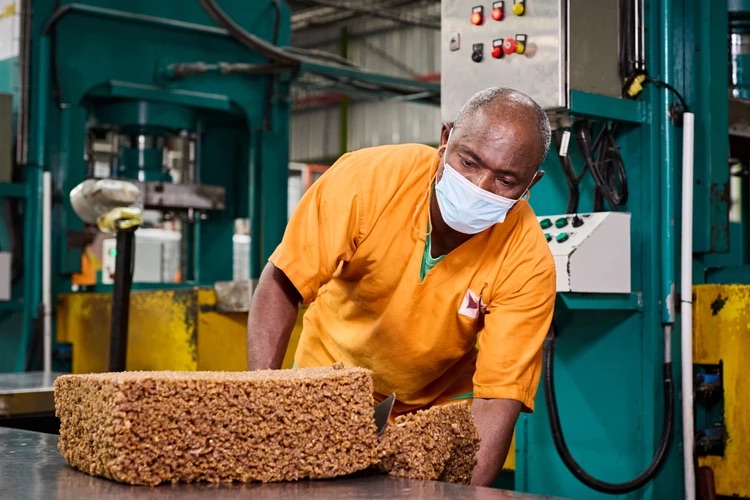

Olam Agri has completed its acquisition of Côte d’Ivoire natural rubber processor ASAF, adding a reported 176,000 tonnes of annual processing capacity. The deal materially expands its position in one of the tyre industry’s important rubber origins, but its significance goes beyond volume as traceability, sourcing control and regulatory compliance become increasingly important to global tyre manufacturers.
The acquisition of Asia Africa Rubber Industry S.A. (ASAF), completed through Olam Agri subsidiary Panasia International FZCO, gives Olam control of another natural rubber processing operation in Côte d’Ivoire. The ECOWAS Regional Competition Authority (ERCA) previously identified ASAF as a processor of solid natural rubber operating a single Ivorian plant, with its production exported outside the ECOWAS common market.
The transaction adds a reported 176,000 tonnes of annual processing capacity, according to the material supplied to Tyre News Media. That represents a potentially substantial increase alongside Olam Agri’s existing Ivorian operations. The company currently states that its Aniassué and Dibobli plants together have annual capacity of 198,000 tonnes, comprising 110,000 tonnes at Aniassué and 88,000 tonnes at Dibobli.
On those figures, adding ASAF’s reported 176,000 tonnes would imply theoretical combined capacity of approximately 374,000 tonnes a year, an increase of almost 89% against the 198,000-tonne figure currently stated by Olam Agri. Tyre News Media has not independently confirmed that the figures are directly comparable, however, and Olam Agri’s Côte d’Ivoire location page separately describes both existing plants as having 88,000 tonnes of annual capacity. The precise post-acquisition installed capacity therefore warrants clarification rather than treating the calculated 374,000-tonne figure as confirmed.
For tyre manufacturers, the more consequential aspect of the transaction may be what additional processing scale can support upstream.
Natural rubber supply is fragmented across large numbers of growers, making the connection between individual plots, raw material movements, processing and eventual industrial customers increasingly important. Olam Agri says it already sources rubber from more than 40,000 smallholders in Côte d’Ivoire. Its existing processing model combines this sourcing network with automation, digitalisation and traceability infrastructure.
ASAF therefore adds capacity at a strategically important point in the chain: where dispersed agricultural production is aggregated and converted into an industrial raw material for export markets. Greater scale could potentially allow Olam Agri to spread sourcing, traceability, quality-control and logistics infrastructure across larger volumes, although the commercial savings and integration benefits have not been independently quantified.
That distinction matters. Processing capacity has traditionally been assessed primarily in terms of throughput, utilisation, quality and cost. Increasingly, however, processors supplying international tyre manufacturers are also being asked to demonstrate where rubber originated and provide the information required for customers’ responsible-sourcing and regulatory systems.
Recent developments elsewhere in the tyre industry reinforce that direction. Tyre News Media has reported on Linglong’s traceability model for natural rubber in Yunnan, where collection infrastructure is being combined with weighing, data and traceability systems. Continental’s sustainable natural rubber programme in Indonesia similarly connects smallholder engagement with digital traceability from production towards the factory.
The regulatory backdrop makes that capability particularly relevant in 2026.
Natural rubber and specified derived products fall within the EU Deforestation Regulation. Following amendments adopted in December 2025, the principal EUDR obligations apply from 30 December 2026 for large and medium enterprises, while most micro and small operators follow from 30 June 2027.
The revised regime has simplified some downstream requirements, including concentrating responsibility for submitting due diligence statements on the first operator placing relevant products on the EU market or exporting them. It has not, however, removed the underlying requirement to establish that relevant commodities meet the regulation’s deforestation and legality conditions.
For the tyre supply chain, that makes reliable upstream information commercially relevant even where a particular company is not itself responsible for every regulatory submission. The industry has already spent several years building systems around geolocation, supplier information and chain-of-custody data. Tyre News Media’s previous coverage of the tyre industry’s push for workable EUDR simplification showed that the debate has increasingly shifted from whether traceability is necessary towards how the information can move efficiently through complex supply chains.
Olam Agri says its existing Côte d’Ivoire operations use digital traceability tools, while its wider rubber business has endorsed the Global Platform for Sustainable Natural Rubber Assurance System. Integrating another sizeable processor into that infrastructure could consequently prove more significant than simply adding factory tonnage.
The ASAF transaction also raises a broader question for the natural rubber sector: whether growing data, traceability and customer requirements will gradually favour processors able to operate at greater scale.
That should not be confused with evidence that wholesale consolidation is already under way. One acquisition does not establish an industry-wide trend, and Tyre News Media has not identified sufficient market concentration data to conclude that smaller processors are being structurally displaced.
There is nevertheless an economic question worth watching. Mapping growers, maintaining chain-of-custody systems, monitoring sourcing risks and satisfying increasingly sophisticated tyre manufacturers all require capabilities beyond the physical processing of rubber. Larger processors may be better positioned to spread some of those fixed investments across greater tonnage and multiple international customers.
For tyre procurement teams, greater processing scale can offer advantages if it translates into more consistent supply, quality and documentation. Concentration can also create different forms of dependency, however, particularly where manufacturers rely on a smaller group of processors for large volumes from a particular origin. Supply resilience therefore depends not only on the size of individual suppliers but also on diversification across processors, regions and sourcing networks.
The farmer dimension deserves similar scrutiny. Olam Agri’s existing scale already connects it with tens of thousands of Ivorian smallholders. A larger processing network could extend access to formalised sourcing, traceability and export markets, but the implications for grower relationships, procurement competition and pricing cannot be determined from the acquisition announcement alone.
The immediate issue is integration. Olam Agri will need to establish how ASAF’s plant, sourcing relationships and customer base fit alongside its existing Aniassué and Dibobli operations. Confirmation of combined installed capacity, utilisation and the extent to which ASAF will be incorporated into Olam Agri’s existing traceability systems would provide a clearer measure of the deal’s commercial impact.
The transaction also comes during a broader change in Olam Agri’s ownership. Saudi Agricultural and Livestock Investment Company (SALIC) completed the purchase of a further 44.58% interest in April 2026, taking its controlling stake at that point to 80.01%. Subsequent corporate changes following Olam Agri’s acquisition of Continental Farmers Group have altered the precise ownership percentages, but SALIC remains the controlling shareholder.
For the tyre industry, however, ASAF is principally a raw-material supply-chain story. The reported 176,000 tonnes of additional processing capacity is significant in itself. More important over the longer term will be whether Olam Agri can combine that capacity with its farmer network, traceability infrastructure and international customer relationships in a way that demonstrates an emerging competitive advantage from scale.
With the revised EUDR application date approaching at the end of 2026, the answer should become increasingly visible. If processors able to connect large-scale production with verified origin data win a greater share of international tyre business, ASAF may prove to be part of a wider shift in the economics of natural rubber processing rather than simply another capacity acquisition.
Tags: Olam Agri, ASAF, natural rubber, Côte d’Ivoire rubber, tyre raw materials, rubber processing, EUDR, rubber traceability, sustainable rubber, tyre supply chain, rubber sourcing
Editorial Standards & Disclaimer
Tyre News Media is an independent industry publication. Our reporting is based on information available at the time of publication, including company announcements, regulatory filings, official data, research and other sources considered reliable.
Articles may include independent analysis and editorial interpretation. Where appropriate, company statements and third-party claims are attributed to their source. Analysis, estimates and forward-looking observations should not be read as statements of established fact.
Tyre News Media takes reasonable steps to ensure accuracy but welcomes corrections, clarifications and responses from organisations or individuals covered in our reporting. If you believe information is inaccurate or requires clarification, please contact info@tyrenews.co.uk. Material errors will be corrected as appropriate.
Commercial relationships, advertising and sponsorship do not determine Tyre News Media's editorial coverage or conclusions.

















%20(1).jpeg)