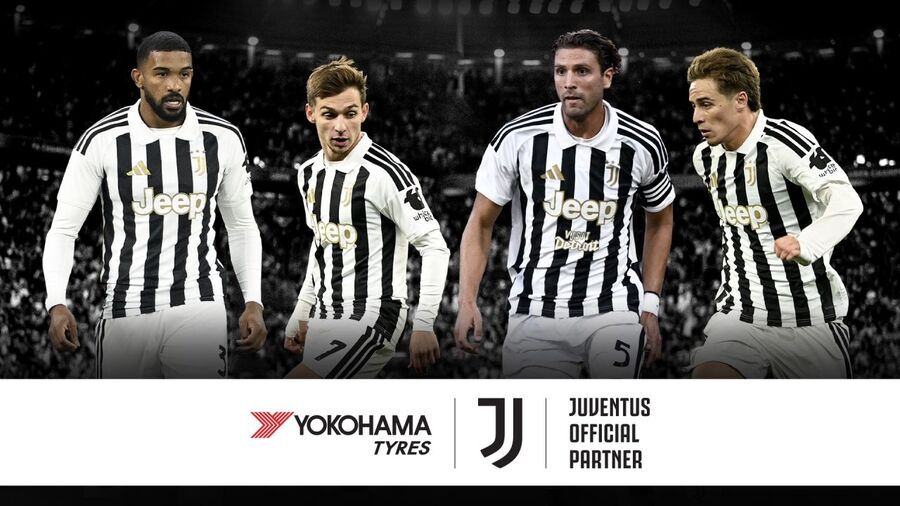

Yokohama Tyres has returned to a prominent European football sponsorship through a multi-year partnership with Juventus FC, becoming an Official Partner of the Italian club. The deal is more significant for the tyre industry when viewed alongside Yokohama Rubber's wider strategy: increasing high-value-added tyre sales while responding to intensifying competition from lower-cost manufacturers.
Juventus confirmed the partnership on 17 August, describing Yokohama Tyres as its new Official Partner under a multi-year agreement. Yokohama Europe has positioned the relationship as a strategic investment intended to strengthen brand awareness and premium positioning across Europe.
The partnership includes LED perimeter visibility, in-stadium advertising, digital activity, fan engagement and hospitality initiatives. The commercial terms have not been disclosed, making it impossible to assess the scale of Yokohama's investment or its expected financial return.
The strategic context, however, is unusually clear. Yokohama Rubber has identified one of the central competitive pressures facing established tyre manufacturers: the expansion and growing market share of low-cost, low-priced tyres from emerging manufacturers.
Under Yokohama Transformation 2026, or YX2026, the company's response includes maximising the proportion of high-value-added products in its consumer tyre sales, promoting premium-vehicle OE fitments and using global motorsport to enhance brand value. ADVAN, GEOLANDAR, winter tyres and 18-inch-and-larger tyres are among the high-value-added categories Yokohama highlights.
Seen in that context, Juventus is less interesting as a sports sponsorship than as another component of Yokohama's premiumisation strategy.
Premiumisation presents tyre manufacturers with a particular commercial challenge. Investment in compounds, construction, vehicle-specific engineering and OE approvals can create genuine product differentiation, but those advantages do not automatically translate into a consumer's willingness to pay more in the replacement market.
That becomes more important as buyers are presented with a widening selection of brands across different price bands. Manufacturers seeking to maintain a premium therefore need both demonstrable product performance and sufficient brand strength to make that differentiation commercially valuable when a motorist reaches the point of purchase.
Yokohama's YX2026 strategy addresses both sides of that equation. Premium OE activity and motorsport can support technical credibility and brand value, while a partnership with Juventus potentially extends Yokohama's reach beyond consumers who actively follow tyres, cars or motorsport.
The strategy is also being pursued alongside record group sales and business profit, rather than against a backdrop of declining group performance. Yokohama Rubber reported sales revenue of ¥1.235 trillion for 2025, up 12.8%, while business profit increased 24% to ¥166.6 billion.
Yokohama said consumer tyre demand remained strong, with continued growth in ADVAN, GEOLANDAR, winter and larger-inch tyres contributing to the performance of its tyre business. Those results do not establish that sports sponsorship will increase European replacement sales, but they show that the high-value-added categories identified as strategically important are contributing to the company's tyre performance.
Yokohama has considerable experience of using European football as a consumer-marketing platform. Its five-year Chelsea shirt sponsorship began in 2015, before the relationship continued from 2020 as an Official Global Tyre Partnership.
More importantly, Yokohama has previously reported what it considered the relationship had achieved. In its 2020 annual reporting, the company said Yokohama Tyres brand awareness in Europe increased from 49% in 2015 to 58% in 2019. Awareness rose from 74% to 87% in Southeast Asia and from 69% to 76% globally over the same period.
Those are company-reported measures and do not establish that the Chelsea sponsorship alone caused the increase. Brand awareness can be influenced by numerous factors over a five-year period. Nevertheless, the figures provide useful context for Juventus because they show Yokohama has previously measured increased awareness during a major European football sponsorship and regarded the relationship as commercially useful.
When the Chelsea relationship moved beyond shirt sponsorship in 2020, Yokohama and the club also said the partnership had increased brand and product awareness and supported efforts to engage consumers and increase sales in strategically important markets.
The question now is what Yokohama expects Juventus to achieve in a different competitive environment.
The European tyre market of 2026 is not the market in which the Chelsea shirt agreement began in 2015. Yokohama's current management strategy explicitly identifies growing market share for lower-cost emerging manufacturers as a competitive challenge, while simultaneously seeking to increase the proportion of high-value-added tyres in its own sales mix.
That puts a more commercially significant question behind the Juventus partnership: can increased consumer recognition help turn product differentiation into pricing power?
For European wholesalers and retailers, the most important measure will not be football audience reach in isolation. It will be whether increased consumer recognition creates useful demand when motorists are choosing replacement tyres.
A manufacturer can secure premium OE fitments, invest in motorsport and place its brand alongside a major football club, but the commercial value ultimately depends on whether those activities make the product easier to sell while supporting the price differential over lower-cost alternatives.
This is where the Juventus programme will be worth watching. Yokohama has outlined the broad activation rights attached to the partnership, but it has not publicly detailed how the programme will be deployed across individual European replacement markets, what role distributors and retailers will play, or which commercial measures will determine its return.
Dealer activation could therefore prove as important as audience exposure. If the sponsorship is integrated with replacement-market campaigns, product launches and retailer activity, Juventus could become a mechanism for turning broad consumer recognition into tyre enquiries and sell-out. Without that connection, visibility alone tells wholesalers and retailers relatively little about the commercial return.
There is a broader industry issue behind the deal. Established manufacturers increasingly face competitors offering products at lower price points. Technical differentiation remains fundamental, but where several tyres satisfy a buyer's requirements, brand strength can influence the additional value consumers attach to one sidewall name over another.
Yokohama's strategy suggests it regards that relationship as commercially important. YX2026 combines efforts to improve cost competitiveness with a deliberate push towards high-value-added products, premium OE fitments, motorsport and stronger brand value. Juventus adds another large-scale consumer platform to that mix.
The partnership should therefore ultimately be judged not by the prominence of Yokohama branding around Juventus, but by whether it contributes to the economics of premiumisation in Europe.
Chelsea provides a useful historical benchmark. Juventus now provides another test of whether football can help Yokohama translate consumer recognition into commercially useful demand in a European tyre market where established brands face intensifying pressure to justify their premium.
Tags: Yokohama Juventus, Yokohama Tyres, Juventus sponsorship, Yokohama Europe, premium tyres, European tyre market, YX2026, ADVAN, GEOLANDAR, tyre retail, tyre pricing
Editorial Standards & Disclaimer
Tyre News Media is an independent industry publication. Our reporting is based on information available at the time of publication, including company announcements, regulatory filings, official data, research and other sources considered reliable.
Articles may include independent analysis and editorial interpretation. Where appropriate, company statements and third-party claims are attributed to their source. Analysis, estimates and forward-looking observations should not be read as statements of established fact.
Tyre News Media takes reasonable steps to ensure accuracy but welcomes corrections, clarifications and responses from organisations or individuals covered in our reporting. If you believe information is inaccurate or requires clarification, please contact info@tyrenews.co.uk. Material errors will be corrected as appropriate.
Commercial relationships, advertising and sponsorship do not determine Tyre News Media's editorial coverage or conclusions.
















%20(1).jpeg)