
A commercial tyre has a purchase price, but its cost to a fleet extends across mileage, fuel consumption, maintenance and vehicle downtime. As Kirkby Tyres introduces fleet support alongside its Sailun truck and bus tyre range, the development raises a wider procurement question: how accurately can UK operators calculate the true cost of their tyres?
Commercial tyre suppliers increasingly compete on more than the initial cost of the tyre. Mileage, rolling resistance, durability, retreadability, monitoring and service support can all influence what a fleet ultimately spends keeping vehicles operational, making tyre total cost of ownership a broader calculation than a comparison of purchase prices.
That shift was evident at Road Transport Expo 2026, where Tyre News Media's coverage of truck tyre technology found manufacturers and suppliers increasingly connecting tyre performance with fuel efficiency, digital management, casing utilisation and whole-life operating cost.
Kirkby Tyres provides a recent example. The company used RTX to introduce Kirkby Tyres Assist, a fleet service which it says offers nationwide support 24 hours a day, 365 days a year, including emergency roadside assistance and tailored tyre management. The service sits alongside Kirkby's UK distribution of Sailun truck and bus radial tyres.
Products in that range include the Ecomax Pro Series, which Kirkby says uses Sailun's EcoPoint3 compound technology. Kirkby positions Ecomax Pro for highway fleets seeking fuel efficiency, while presenting the Terra Pro Series as suited to mixed-service applications. These remain supplier descriptions rather than independently verified fleet-performance findings, but bringing tyre supply and service support into the same proposition illustrates a commercially important question for operators: what should actually be included in tyre TCO?
Acquisition cost is comparatively easy to establish. Fleets can compare the price of two tyres, record achieved mileage and calculate cost-per-kilometre. Fuel consumption can potentially be incorporated, while planned maintenance, regrooving and casing or retread value add further layers to the calculation.
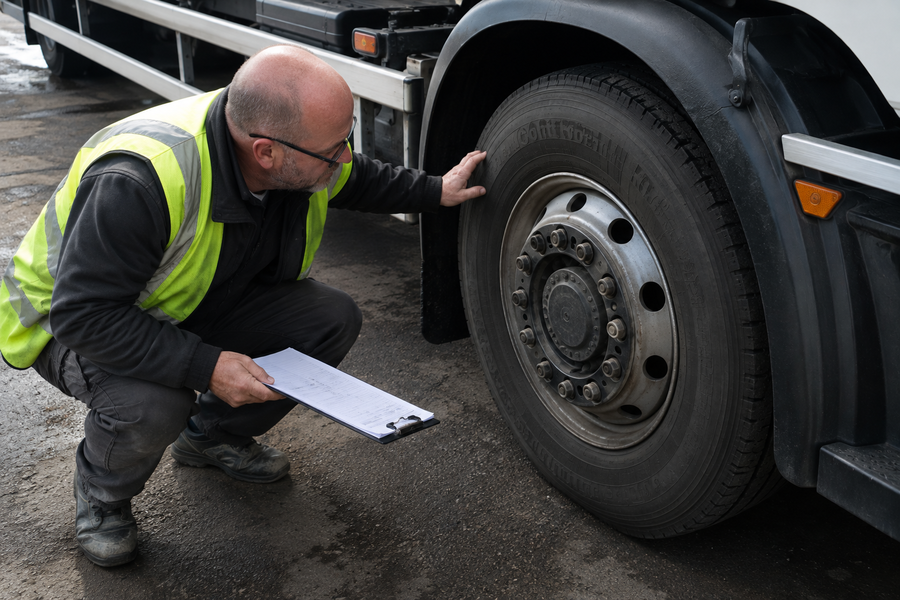
Downtime is more difficult. An unexpected tyre-related stop can involve a roadside call-out, replacement tyre and labour, but the commercial consequences do not necessarily end there. Driver time continues to accumulate, schedules can be disrupted and vehicle utilisation falls while the truck is stationary. Depending on the operation, missed delivery windows, replacement capacity and customer commitments may also carry a cost.
Those consequences are unlikely to be identical between fleets. A vehicle in general haulage may have enough scheduling flexibility to absorb a delay relatively cheaply, while a supermarket distribution or parcel-delivery vehicle approaching a fixed delivery window could experience greater disruption. The physical tyre incident may be similar, but its financial effect can be very different.
That makes a universal hourly HGV downtime figure attractive but potentially misleading. A more useful calculation for an individual fleet may be based on how often tyre-related immobilisation occurs, how long incidents typically last and what each incident costs within that particular operation.
The difficulty is that publicly available UK evidence does not provide that complete calculation.
Government data establish that tyre condition remains a measurable HGV roadworthiness issue, although the figures require careful interpretation.
DVSA's top-ten HGV annual-test failure data for April to June 2025 recorded "Condition of Tyres" as a failure item for 3.77% of HGVs tested. Brake Systems and Components, at 6.02%, was the only higher-listed item in the quarter's table.
The distinction between that figure and an in-service tyre-failure rate is important. The DVSA measure relates to vehicles presented for annual testing where tyre condition was recorded as a reason for failure, and a vehicle can fail on more than one testable item. It therefore does not mean that 3.77% of Britain's operating HGVs experience tyre failures, nor does it measure the frequency of tyre-related roadside breakdowns.
Tyre condition was recorded for 3.93% of HGVs tested in Q1 2024/25, followed by 3.48% in Q2, 3.59% in Q3 and 3.34% in Q4. The subsequent 3.77% figure for April to June 2025 reinforces tyre condition's continuing presence among leading annual-test failure items, but should not on its own be treated as evidence of a change in national in-service tyre-failure performance.
DVSA roadside-enforcement data provide a separate compliance measure. In April to June 2025, "Condition of Tyres" was the largest listed prohibition-defect category in the agency's HGV roadside and operator-premises inspection table, recorded for 7.97% of vehicles inspected.
Again, the denominator matters. Roadside and premises inspections involve a different population from annual tests and should not be treated as representative of the entire operating HGV fleet. A prohibition defect is also not synonymous with an unexpected tyre breakdown. What the two datasets show is narrower but still commercially relevant: tyre condition continues to feature materially in HGV roadworthiness and enforcement activity.
Annual-test failures, enforcement prohibitions, roadside tyre incidents and unexpected tyre-related immobilisation therefore measure different things. None provides, on its own, the financial number required for a complete tyre TCO calculation.
The public evidence becomes thinner when the question shifts from roadworthiness to economics. Tyre News Media has not identified a standard, publicly available UK benchmark establishing what an hour of tyre-related HGV downtime costs an operator. The public DVSA and DfT datasets reviewed also do not establish whether fleets incorporate downtime into tyre procurement, how they value roadside-response performance or the financial return obtained from preventive tyre technologies.
That does not mean fleets are failing to make those calculations. Individual operators, tyre-management providers and breakdown networks may hold substantially more detailed internal information. The gap is a lack of transparent, industry-wide evidence showing how downtime is valued and incorporated into tyre TCO, making competing whole-life propositions difficult to compare consistently.
This matters because the proposition being sold to fleets is becoming broader. As Tyre News Media identified in its wider RTX 2026 analysis, manufacturers and suppliers are increasingly connecting tyres with fleet efficiency, uptime, monitoring and lifecycle management.
A tyre delivering additional mileage, lower fuel consumption or fewer interventions could potentially justify a higher acquisition price. Faster roadside response could similarly reduce the consequences of an incident that cannot be prevented. Demonstrating either proposition, however, requires operational evidence rather than product positioning alone.
For fleets comparing suppliers, a more complete calculation could therefore include acquisition and fitting costs, achieved mileage, fuel effect, planned maintenance, regrooving, casing or retread value and the expected financial consequence of unplanned tyre incidents. The importance assigned to each variable will depend heavily on duty cycle.
Service support adds another variable. Kirkby's proposition is that nationwide service infrastructure complements the Sailun range by supporting fleets when tyre intervention is required. Whether that combination produces a lower total operating cost for an individual fleet would require evidence covering incident frequency, response times, vehicle-off-road duration and the financial consequences of those incidents. The launch itself cannot establish that outcome.
Commercial tyre procurement therefore presents a measurement problem. The industry has increasingly sophisticated ways of discussing mileage, rolling resistance, casing utilisation and tyre monitoring, while service networks are commonly positioned as a way to limit one important consequence of tyre incidents: unplanned vehicle downtime.
Yet the cost of immobilising a truck is inherently operational. The same tyre incident could have limited consequences for one vehicle and substantial commercial implications for another depending on its load, route, replacement capacity, customer commitments and time sensitivity.
For operators, the more useful question may therefore be not "what does HGV downtime cost?" but "what does tyre-related downtime cost our operation, how frequently does it happen, and does that figure influence which tyres and services we buy?"
Answering that requires information annual-test statistics and tyre labels cannot provide. It also points towards the next stage of the investigation.
Tyre News Media is seeking fleet operators willing to share anonymised information about tyre-related roadside incidents, response times, vehicle-off-road duration and how downtime is treated within tyre procurement and total-cost calculations. Such evidence could help establish whether the industry's increasingly broad discussion of tyre TCO is matched by the data fleets use to make purchasing decisions.
Purchase price can be measured. Mileage can be recorded. Fuel consumption can be monitored and service response can be timed. The harder question is what happens financially when the wheels stop turning.
Tags: HGV tyre TCO, truck tyre costs, tyre-related downtime, fleet tyre management, HGV downtime, commercial vehicle tyres, Kirkby Tyres, Sailun truck tyres, tyre total cost of ownership, fleet operating costs
Editorial Standards & Disclaimer
Tyre News Media is an independent industry publication. Our reporting is based on information available at the time of publication, including company announcements, regulatory filings, official data, research and other sources considered reliable.
Articles may include independent analysis and editorial interpretation. Where appropriate, company statements and third-party claims are attributed to their source. Analysis, estimates and forward-looking observations should not be read as statements of established fact.
Tyre News Media takes reasonable steps to ensure accuracy but welcomes corrections, clarifications and responses from organisations or individuals covered in our reporting. If you believe information is inaccurate or requires clarification, please contact info@tyrenews.co.uk. Material errors will be corrected as appropriate.
Commercial relationships, advertising and sponsorship do not determine Tyre News Media's editorial coverage or conclusions.

















.jpg)



%20(1).jpeg)