.jpg)

Mercedes-Benz has started large-scale production of axial-flux electric motors at its Berlin-Marienfelde plant. The technology, based on work by Oxfordshire engineering company YASA, will make its production-vehicle debut in the electric Mercedes-AMG GT 4-Door Coupé. The milestone demonstrates how a compact but complex motor architecture can be manufactured at automotive scale.
Production began on 9 June 2026 at Mercedes-Benz’s oldest operating manufacturing site. The company has allocated around 30,000 square metres across three halls and seven production lines.
The manufacturing system comprises 98 process steps. Mercedes-Benz says 65 are new to the company and 35 have not previously been used in industrial production. The development work has generated more than 30 patent applications.
Those figures indicate the engineering challenge behind axial-flux technology. Its disc-shaped construction supports high power and torque density within a compact package. However, the design places demanding tolerances on coil forming, rotor positioning and final assembly.
.jpg)
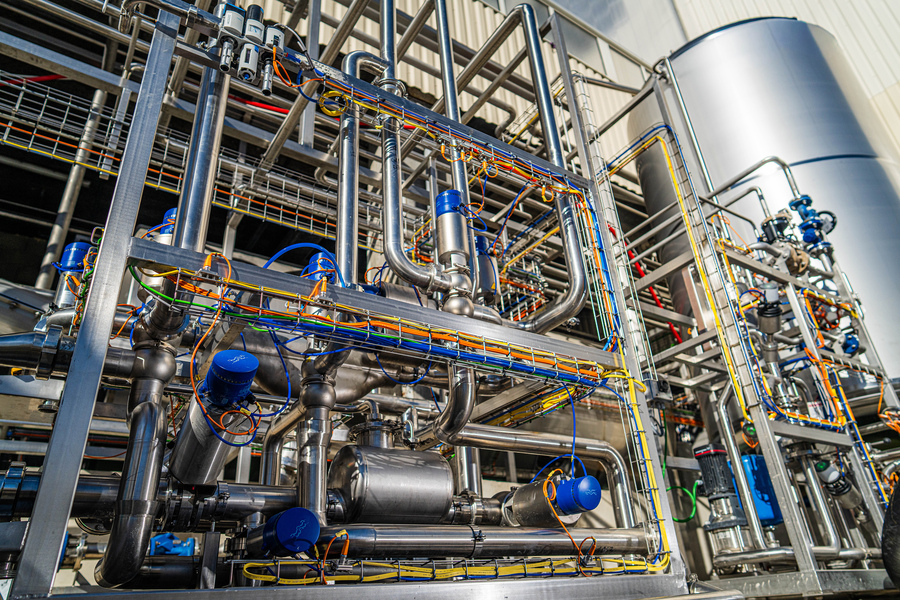
Mercedes-Benz has combined automated manufacturing, laser processing, intelligent control systems and artificial intelligence-based quality inspection. These systems are intended to provide the precision and repeatability required for large-scale vehicle production.
Michael Schiebe, Mercedes-Benz board member responsible for production, quality and supply chain management, said the programme had brought axial-flux technology into “industrial reality”.
The industrialisation process is significant because the barriers to axial-flux adoption extend beyond motor output. Manufacturers must also meet durability, cycle-time and quality requirements across repeated production runs.
The new Mercedes-AMG GT 4-Door Coupé uses one axial-flux motor at the front and two at the rear. Each axle combines the motors with a compact planetary gearbox inside a high-performance electric drive unit.
Mercedes-Benz says the front motor is less than nine centimetres wide. Each rear motor measures around eight centimetres. The layout creates more freedom for drivetrain packaging than many conventional radial-flux designs.
The production car can accelerate from 0–100km/h in a claimed 2.1 seconds. Its specified top speed reaches 300km/h with the Driver’s Package.
These figures show how compact electric motors can support high-output vehicle platforms. They also highlight the loads that associated chassis, braking and tyre systems must manage.

YASA developed the prototype architecture on which the Mercedes-Benz production motor is based. The German manufacturer acquired the Oxfordshire company in 2021 and has since developed both the product and its manufacturing processes.
YASA opened an upgraded 60,000 sq ft facility at Yarnton in May 2025 following a £12 million investment. The site increased annual capacity beyond 25,000 motors and brought coil production, winding, assembly and quality control together.
The company is also developing a 90,000 sq ft headquarters at Bicester Motion. The building is intended to consolidate engineering, development, prototyping and business operations in Oxfordshire.
YASA chief executive Joerg Miska said Mercedes-Benz ownership had allowed the business to accelerate development while retaining its established engineering culture.
“We have retained the spirit, agility and engineering curiosity that have always defined YASA,” he said, adding that the company had gained Mercedes-Benz’s scale and industrial support.
YASA has used separate prototype programmes to explore the longer-term potential of its motor architecture.
In October 2025, the company reported a short-term peak output of 750kW from a 12.7kg prototype. That equated to an unofficial power-density figure of 59kW per kilogram.
The test followed an earlier result of 550kW from a 13.1kg version. YASA estimates that the newer prototype could provide continuous output of between 350kW and 400kW, although extended validation remains under way.
Peak prototype figures cannot be compared directly with production-vehicle output. They do, however, indicate the potential for lighter drive units in high-performance electric vehicles.
Smaller motors could affect vehicle packaging, cooling systems, axle design and weight distribution. They may also help manufacturers increase performance without relying solely on larger batteries and heavier drivetrains.
Higher-output electric platforms create demands beyond the powertrain. Immediate torque delivery, vehicle mass and sustained high-speed operation affect tyre construction, thermal management and wear.
A three-motor layout can also provide more precise control over torque distribution. Tyres must convert those commands into predictable grip while coping with repeated acceleration, braking and cornering loads.
Tyre News has previously examined EV tyre development through Nexen Tire’s original equipment supply agreement for the Kia EV5. The fitment reflects the growing demand for tyres designed around electric vehicle weight, efficiency and torque characteristics.
Coverage of ENSO’s EV-specific ultra-high-performance tyre range also shows how manufacturers are balancing grip, efficiency, durability and wet performance for premium electric vehicles.
For tyre developers, the AMG platform provides further evidence that EV-specific engineering will extend beyond rolling resistance and cabin noise. High-performance electric cars require stable behaviour across repeated thermal cycles and demanding torque inputs.
Replacement data has also raised wider questions about EV tyre use. Tyre News reported that Tesla models led tyre replacement rankings across several UK areas, although mileage and vehicle-age factors limited direct conclusions about comparative wear rates.
YASA’s ownership anniversary is therefore not the central development. The important change is that its axial-flux technology has progressed from specialist engineering into a large-scale production component.
Tagged with: YASA, Mercedes-Benz, Mercedes-AMG, axial-flux motors, electric powertrains, EV tyres, automotive manufacturing, high-performance electric vehicles, torque management, tyre wear, UK automotive engineering, electric vehicle technology
Editorial Standards & Disclaimer
Tyre News Media is an independent industry publication. Our reporting is based on information available at the time of publication, including company announcements, regulatory filings, official data, research and other sources considered reliable.
Articles may include independent analysis and editorial interpretation. Where appropriate, company statements and third-party claims are attributed to their source. Analysis, estimates and forward-looking observations should not be read as statements of established fact.
Tyre News Media takes reasonable steps to ensure accuracy but welcomes corrections, clarifications and responses from organisations or individuals covered in our reporting. If you believe information is inaccurate or requires clarification, please contact info@tyrenews.co.uk. Material errors will be corrected as appropriate.
Commercial relationships, advertising and sponsorship do not determine Tyre News Media's editorial coverage or conclusions.















.png)