


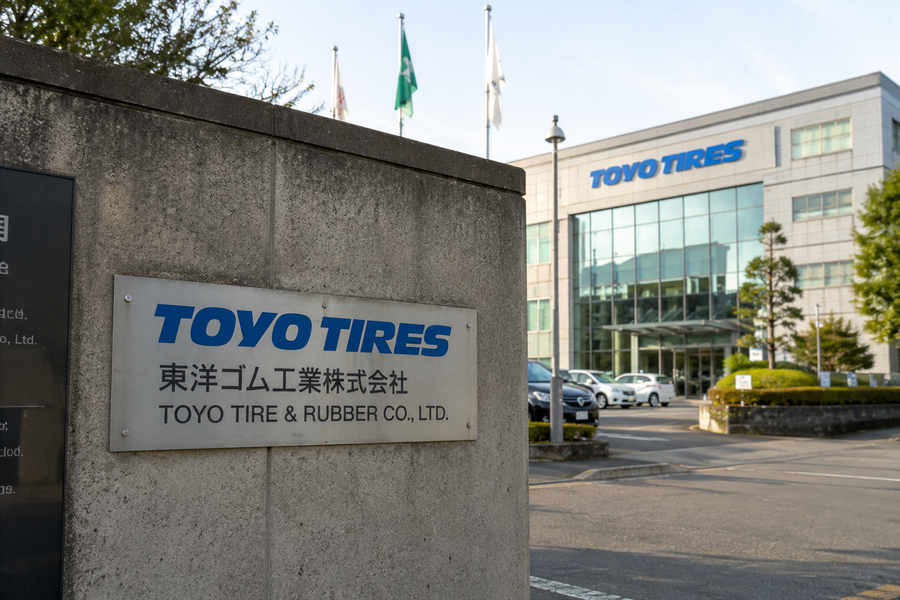

Toyo Tire has ended its eight-year capital and business alliance with Mitsubishi Corporation through a planned share buyback worth up to ¥115 billion. The Japanese tyre maker says the partnership has achieved its objectives. More significantly, the transaction returns greater control over Toyo’s capital and strategy at a time when global tyre competition is becoming less predictable.
The formal explanation for the end of Toyo Tire’s relationship with Mitsubishi Corporation is straightforward. The companies believe the alliance they established in 2018 has done what it was intended to do.
Mitsubishi supported Toyo through personnel secondments and became its largest shareholder after participating in a third-party allotment. The capital raised helped Toyo expand production capacity, while the wider partnership was intended to strengthen sales, technology and corporate resources.
Eight years later, Toyo says it has established a management structure capable of pursuing “autonomous and sustainable growth”. That wording is arguably more important than the termination itself.
The transaction gives Toyo greater strategic independence just as tyre manufacturers are having to make faster decisions about production geography, market exposure, pricing and capital expenditure.
Toyo plans to acquire up to 32 million of its own shares for a maximum company-stated ¥115 billion through an off-auction ToSTNeT-3 transaction.
Mitsubishi holds just over 30 million Toyo shares, representing 20.01% of issued shares excluding treasury stock. Selling that position will take its holding below the threshold specified by the alliance agreement and formally bring the arrangement to an end.
The scale matters. This is not simply an administrative tidying-up exercise between two Japanese companies.
Toyo is deploying substantial capital to alter its ownership structure. In doing so, it is effectively deciding that the strategic flexibility associated with independence is worth committing significant balance-sheet capacity to obtain.
That creates a different question for investors and the tyre industry: what does Toyo intend to do with that freedom?
There is no evidence that the company is preparing an immediate acquisition or major new European investment as a direct consequence of ending the Mitsubishi relationship. The more defensible conclusion is that Toyo now has greater optionality over those decisions.
In the current tyre market, that optionality has become increasingly valuable.
The competitive environment is considerably different from the one in which the alliance was created in 2018.
Raw-material and manufacturing costs remain under pressure. Higher input costs have squeezed manufacturer margins even where revenue and volumes remain comparatively strong, forcing tyre companies to balance pricing, product mix and continued capital expenditure.
Trade patterns are shifting at the same time.
Passenger car and light truck tyre imports into the EU27 and UK fell sharply in early 2026, with Chinese volumes particularly affected as European trade measures disrupted established supply routes.
The European Commission imposed definitive anti-dumping duties ranging from 30% to 52% on Chinese passenger car and light-lorry tyres in July 2026, following its investigation. Hankook, the Korean manufacturer included separately in the proceeding, was assessed at a substantially lower rate of around 3.4%.
The distinction matters. These are no longer provisional measures around which manufacturers can simply plan for different possible outcomes. Definitive duties provide greater clarity over the competitive conditions facing Chinese suppliers and their European rivals, even as manufacturers continue to adjust sourcing, production and pricing strategies.
That does not automatically create an opportunity for Toyo. Chinese manufacturers have been diversifying production internationally, while other Asian tyre makers are expanding their overseas manufacturing and commercial footprints.
But it does make the competitive map less settled and potentially increases the value of being able to make capital and market decisions quickly.
Indian manufacturers are becoming increasingly relevant to that picture.
Indian tyre exports reached a record ₹273.12 billion in FY2025-26, up 9% year on year. The US remained the industry’s largest single export market, while Germany, Italy and France were among its leading European destinations.
The figures underline an important change in the competitive landscape. India’s tyre industry is no longer significant to Europe simply as a source of lower-cost capacity. Its manufacturers are increasingly building brands, distribution networks and more permanent commercial positions in developed markets.
That expansion adds another layer of competition for manufacturers such as Toyo, particularly in replacement markets where positioning between global premium brands and lower-cost producers is becoming increasingly contested.
This matters because Toyo occupies a strategically demanding part of the global tyre market.
It does not possess the scale of Bridgestone or Michelin, but neither is it competing purely on price. Its position depends on brand, specialist product strength, OE relationships and profitable replacement-market niches.
That makes capital allocation particularly important.
For manufacturers in this tier, attempting to compete everywhere risks spreading investment too thinly. The alternative is to concentrate capital and management attention on markets and product categories where brand strength can support margins.
Removing a 20% strategic shareholder does not determine which route Toyo will choose. It does, however, give management greater freedom to choose it.
The wider significance may therefore extend beyond Toyo.
Japanese corporate alliances have historically provided patient capital, commercial relationships and stability. Mitsubishi’s involvement appears to have delivered tangible benefits during Toyo’s development, including capital for production expansion and access to personnel and corporate resources.
There is no indication that the relationship failed. Quite the opposite: both sides describe its objectives as accomplished.
That distinction is important.
Toyo is not escaping a distressed partnership. It is deciding that a structure which was useful during one phase of its development is no longer necessary for the next.
For mid-sized tyre manufacturers, that calculation deserves attention. Strategic shareholders can provide financial strength, commercial connections and stability, but concentrated ownership can also influence capital allocation, transactions and changes in strategic direction.
When raw-material prices, tariffs and manufacturing locations can alter competitive economics within months, management flexibility carries a higher value.
The Mitsubishi exit therefore deserves to be viewed alongside the industry’s wider restructuring rather than simply as the conclusion of an eight-year agreement.
It also raises a broader question for the sector: whether other mid-tier Japanese and Korean tyre manufacturers will increasingly favour strategic autonomy over long-standing capital relationships as competitive conditions become harder to predict.
One transaction is not enough to establish a trend. But Toyo provides a useful case study of how the calculation may be changing.
There is another side to the argument.
Strategic autonomy is attractive, but it is not free.
A buyback with a company-stated maximum of ¥115 billion represents substantial capital that cannot simultaneously be deployed into factories, technology, acquisitions, distribution or other investments.
That makes the transaction as much a test of capital discipline as it is a statement of independence.
The relevant measure of success will not simply be whether Toyo operates more independently after Mitsubishi’s departure. It will be whether that independence produces returns that justify the capital committed to achieving it.
For a mid-sized tyre manufacturer competing against groups with substantially larger research, manufacturing and marketing budgets, that is an important distinction.
Toyo is effectively exchanging one form of strategic resource, a major corporate shareholder and its associated capital relationship for greater control over its own direction.
The commercial outcome will depend on how effectively management uses that control.
Attention now shifts from the Mitsubishi relationship to Toyo’s investment priorities.
Investors and competitors should watch where the company prioritises capacity, which replacement-market categories receive investment, how aggressively it pursues OE programmes and whether its regional strategy changes as European and North American trade barriers redraw global tyre supply routes.
The transaction may ultimately prove to be exactly what the companies say it is: the orderly conclusion of an alliance that achieved its purpose.
But the timing gives it wider relevance.
The tyre industry is entering a period in which manufacturing location, access to capital and speed of decision-making are becoming competitive assets in their own right. Chinese producers are adapting to trade barriers, Indian manufacturers are expanding internationally, and established manufacturers are being forced to make increasingly selective investment decisions.
Toyo has chosen to enter that environment with greater control over its strategy.
The alliance helped build the platform. The more important test now is what Toyo does without it.
Tagged: Toyo Tire Mitsubishi alliance, Toyo Tire share buyback, Mitsubishi Corporation Toyo Tire, Japanese tyre manufacturers, tyre industry investment, tyre market strategy, tyre manufacturing strategy, European tyre market, EU tyre anti-dumping duties, Indian tyre exports, Asian tyre manufacturers, tyre industry capital allocation
Editorial Standards & Disclaimer
Tyre News Media is an independent industry publication. Our reporting is based on information available at the time of publication, including company announcements, regulatory filings, official data, research and other sources considered reliable.
Articles may include independent analysis and editorial interpretation. Where appropriate, company statements and third-party claims are attributed to their source. Analysis, estimates and forward-looking observations should not be read as statements of established fact.
Tyre News Media takes reasonable steps to ensure accuracy but welcomes corrections, clarifications and responses from organisations or individuals covered in our reporting. If you believe information is inaccurate or requires clarification, please contact info@tyrenews.co.uk. Material errors will be corrected as appropriate.
Commercial relationships, advertising and sponsorship do not determine Tyre News Media's editorial coverage or conclusions.
















%20(1).jpeg)