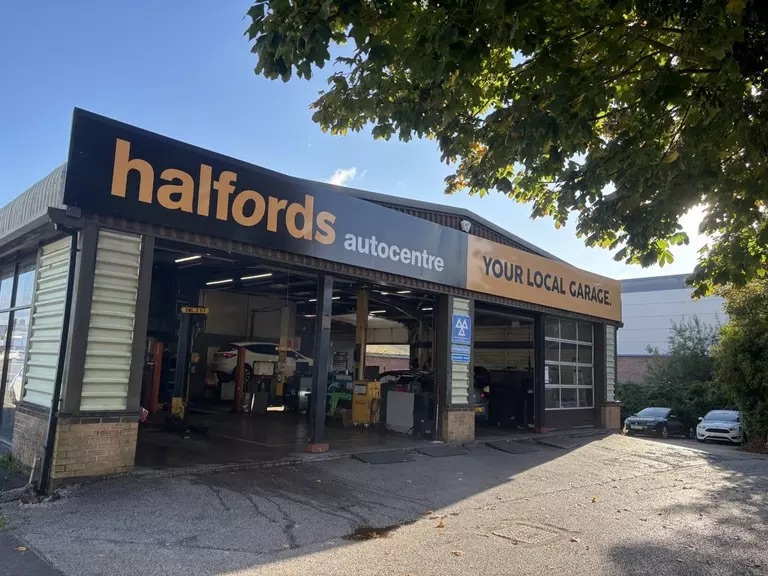

Halfords has lifted Autocentres gross margin sharply and increased underlying operating profit despite continued weakness in UK replacement tyres. Its FY26 results point to a broader change in the economics of the business: tyres remain important, but servicing, maintenance and repair, alignment, workshop utilisation and a lower-cost supply chain are increasingly determining how much value Halfords captures from each vehicle.
The most revealing number in Halfords’ FY26 results is not the Group’s return to statutory profit. It is the widening margin inside Autocentres while one of the division’s core markets remained difficult.
On a comparable ex-Avayler basis, Autocentres gross margin reached 55.6% in FY26, against approximately 52.5% in FY25 and 49.3% in FY24. Across two years that represents an improvement of roughly 630 basis points. Underlying operating profit, meanwhile, rose from £15.1m in FY24 to £18.3m in FY25 and £22.3m in FY26, an increase of about 48% in two years. FY26 Autocentres like-for-like sales grew 5.8%, with consumer garages growing at around 8%.
That progression is striking because Halfords has continued to describe the consumer tyre market as weak. In FY25, growth in service, maintenance and repair, or SMR, more than compensated for weakness in consumer tyres. FY26 brought signs of tyre-market stabilisation towards the end of the year, but the main driver of consumer-garage growth remained SMR.
The implication is not that Halfords has discovered a way to make tyre-market conditions irrelevant. Rather, it has become less dependent on the economics of the tyre itself. Better Buying, pricing discipline and purchasing improvements have raised gross margin, while a greater mix of SMR and higher attachment of services to tyre transactions have changed what an Autocentre visit can be worth.
That distinction matters. Halfords’ results suggest the commercial unit it is increasingly trying to optimise is not simply the tyre sale, but the vehicle visit.
That also offers a different perspective on Halfords’ £62m acquisition of Axle Group, including National Tyres, in December 2021. At the time, the transaction was readily understood as a major expansion in tyres. National operated 239 tyre and SMR garages and 60 mobile fitting vans, fitted around 1.3 million tyres annually and generated more than 80% of its sales mix from tyres.
Five years later, the strategic value of that footprint looks broader.
The acquisition did not simply add tyre volume and purchasing power. It added hundreds of physical locations, technicians and customer relationships through which Halfords could potentially sell servicing, MOTs, repairs, alignment and other work over the life of a vehicle. In that sense, there is an important difference between buying tyre capacity and buying a national automotive service network.
Halfords’ own subsequent decisions reinforce that interpretation. It has retained the garages and customer-facing service capacity while restructuring parts of the tyre infrastructure that came with the acquisition. The assets closest to the customer appear to have become more strategically important than owning every stage behind them.
This is consistent with the wider services-led direction that Tyre News Media has tracked through Halfords’ recent strategy and leadership changes and its continuing investment in technician training capacity. The common thread is workshop capability: having enough locations, skills and capacity to convert motoring demand into productive labour hours.
Tyres still have a central role in this model, but their economic function may be changing.
Halfords said FY26 Autocentres gross-margin expansion reflected both a shift towards SMR and higher attachment rates for add-on services around tyres. The logic is straightforward. A customer arriving for replacement tyres is also bringing a vehicle into a workshop, creating an opportunity to identify and perform legitimate additional work, from wheel alignment and inspection through to servicing, MOT and repair.
Wheel alignment is particularly relevant because it sits naturally alongside tyre replacement. It can increase the value of an existing workshop visit without requiring Halfords to acquire another customer, while potentially helping the motorist protect the replacement tyres they have just purchased. The wider aftermarket is increasingly connecting alignment technology with digital vehicle-health workflows, an area Tyre News Media has examined through the integration of Hunter alignment equipment with digital vehicle inspections.
The commercial question is therefore more nuanced than whether Halfords wants to sell more tyres. It clearly does. Management says it continues to target share in the fragmented tyre market. But its margin progression indicates that tyre volume alone is not the objective. What matters increasingly is the total gross profit and productive workshop activity generated by the customer relationship.
For tyre retailers, that raises a useful question rather than providing a universal prescription. Where fitting capacity and technician skills already exist, should the performance of a tyre transaction be judged only on tyre gross margin, or also on the additional services and future visits it creates?
Halfords’ Fusion programme makes that logic more visible. Fusion brings its retail and Autocentre propositions together locally so that customers can move between products and workshop services more easily. Early trials in Halifax and Colchester demonstrated how retail activity could feed garage demand, with Halfords reporting that referrals from its Halifax retail operation were generating a meaningful share of garage sales.
By FY26, 103 Fusion locations were trading. Halfords says mature sites approximately double contribution on average, and it plans around another 35 sites before applying selected elements of the model more widely at lower investment per garage. Crucially, the company uses the term contribution, not profit, so the two should not be treated as interchangeable.
Earlier Fusion trials indicated why management has been willing to invest. Halifax and Colchester generated more than 100% revenue growth and approximately doubled site-level EBITDA, while subsequent rollout economics pointed to investment of roughly £200,000 per location and an approximately two-year payback.
The economic idea behind Fusion is more significant than store refurbishment. Halfords already pays to attract customers, operates physical locations and employs technicians. If a retail interaction can create a garage booking, or a tyre customer can subsequently buy SMR work, the group can spread customer-acquisition and property costs across more revenue opportunities.
The model is therefore less “shop plus garage” than one customer, one vehicle and several possible transactions. Whether independent tyre retailers can reproduce that model is another matter. Halfords has unusual scale, brand recognition, digital traffic and a mixed retail-and-services estate. But the underlying question about increasing revenue per customer is relevant well beyond Halfords.
Perhaps the clearest evidence of where Halfords now sees strategic value is found further back in the tyre supply chain.
In FY24 the group closed the Viking and BDL tyre wholesale and distribution operations acquired with Axle Group and transferred responsibility for Autocentres tyre warehousing, stock management and distribution to Bond International. Halfords expected the arrangement to save approximately £5m annually while improving garage stock availability, reducing inventory requirements and improving working-capital efficiency.
The decision is more interesting than a conventional outsourcing story. Halfords said the arrangement allowed it to retain the margin benefits of direct tyre sourcing while avoiding much of the cost of operating the physical distribution infrastructure itself. It also enabled a same-day tyre proposition across Halfords and National garages that management said would have required considerable additional scale and capital investment under the former Viking and BDL structure. By the first half of FY25, Halfords said the new arrangement had already produced £2.1m of savings and improved tyre availability.
This does not establish that outsourced distribution is economically superior to vertical integration. For wholesalers with dense distribution networks, logistics expertise and third-party volume, ownership of that infrastructure may be precisely where competitive advantage lies.
Halfords made a different calculation. Its decisions suggest it places greater strategic value on controlling the customer relationship, digital journey, workshop, technicians and service proposition than on owning the warehouses and distribution network supplying every tyre to those workshops.
That is an important distinction for the tyre industry. It asks where in the value chain an operator has genuine differentiation, and where capital is merely supporting an activity another specialist may be able to perform more efficiently.
The next stage of Halfords’ Autocentres economics depends increasingly on labour.
FY26 underlying operating margin for Autocentres excluding Avayler was 3.1%, up 50 basis points year on year but still below Halfords’ medium-term ambition of 5% to 6%. Closing that gap will require more than gross-margin gains. It means extracting more revenue and gross profit from an expensive fixed network while controlling the labour required to deliver it.
Halfords has therefore made technician utilisation a central operating priority. During FY26 it redeployed colleague hours from lower-utilisation to higher-utilisation garages, reduced reliance on more expensive agency labour and focused on sales per colleague hour. By the fourth quarter, labour cost as a percentage of sales had improved year on year despite higher wages and National Insurance costs. The group is also investing in garage equipment, workflow systems and technician capability.
This is where Fusion, SMR mix, digital booking and labour management intersect. More customer demand has limited economic value if the workshop cannot schedule it efficiently. Equally, a garage full of technicians becomes expensive if bays and labour hours are underused. Higher-value work, better attachment, improved digital conversion and smarter labour deployment all feed the same objective: increasing gross profit generated per available workshop hour.
There is a structural tailwind behind that effort. Halfords estimates that the average age of the UK car parc increased from about 7.5 years in 2019 to 10.1 years in 2024. Older vehicles generally require more maintenance and repair and are more likely to sit outside manufacturer servicing packages, increasing the addressable opportunity for independent garages and national aftermarket networks.
The opportunity is clear, but so is the execution challenge. Moving from a 3.1% operating margin towards 5% to 6% requires Halfords to turn theoretical demand into booked, efficiently delivered workshop work without allowing labour inflation, property costs or customer-acquisition spending to absorb the gain.
At Group level, FY26 provides evidence that these changes are beginning to translate into stronger economics. Comparable 52-week revenue reached £1.7645bn and gross margin 52.8%, while ROCE rose to 14.2%. Reported statutory PBT for the 53-week year was £43.6m, compared with a £30.0m loss in FY25. That comparison requires care: FY25 was heavily affected by £49.1m of impairment charges, predominantly relating to goodwill, together with £14.9m of closure costs, and was not representative of underlying trading performance.
There is also an accounting comparability issue. Halfords changed its treatment of acquired intangible amortisation in FY26 and retrospectively restated FY25 underlying PBT to £43.6m. Excluding that change in policy, FY26 underlying PBT was £41.5m against the previously reported £38.4m in FY25. The more useful evidence for tyre-sector readers is therefore not the headline swing in statutory PBT, but the sustained improvement in Autocentres gross margin and operating profit.
Halfords should not be treated as a blueprint for every tyre retailer. Its scale, national estate, retail stores, digital reach and purchasing power make its economics different from those of an independent fast-fit operator or regional tyre chain. Nor does its experience show that tyre retail itself is becoming unattractive.
What it does show is where one of Britain’s largest aftermarket operators is choosing to put capital, management attention and operating effort. Halfords is keeping tyres close to the customer proposition while combining them with SMR and alignment, pushing harder on technician productivity and digital conversion, joining retail and garage demand through Fusion, and removing capital and cost from parts of tyre distribution it no longer believes it needs to operate itself.
That changes the question from how many tyres a network can sell to how much economic value it can generate when a vehicle enters its orbit.
If replacement tyre margins and volumes remain under pressure, the competitive battle may increasingly be decided not simply by who sells the most tyres, but by who captures the greatest value from every vehicle that comes through the workshop.
Tags: Halfords Autocentres, National Tyres, UK tyre retail, replacement tyre market, tyre retail margins, automotive aftermarket, SMR, wheel alignment, Fusion, Bond International, workshop productivity, tyre distribution
Editorial Standards & Disclaimer
Tyre News Media is an independent industry publication. Our reporting is based on information available at the time of publication, including company announcements, regulatory filings, official data, research and other sources considered reliable.
Articles may include independent analysis and editorial interpretation. Where appropriate, company statements and third-party claims are attributed to their source. Analysis, estimates and forward-looking observations should not be read as statements of established fact.
Tyre News Media takes reasonable steps to ensure accuracy but welcomes corrections, clarifications and responses from organisations or individuals covered in our reporting. If you believe information is inaccurate or requires clarification, please contact info@tyrenews.co.uk. Material errors will be corrected as appropriate.
Commercial relationships, advertising and sponsorship do not determine Tyre News Media's editorial coverage or conclusions.













%20(1).png)