
Dunlop Tyre Europe has urged UK motorists to inspect their tyres ahead of the August travel peak, as high temperatures combine with heavily loaded vehicles and long motorway journeys. The immediate message is familiar, but the wider significance for retailers and fleets is more important: tyre condition can deteriorate substantially between formal vehicle inspections.
Extreme summer conditions create a useful reminder of how tyre failures develop.
Heat alone should not be presented as an automatic cause of tyre failure. Modern tyres are engineered to operate across demanding temperature ranges. The greater concern is what happens when high ambient and road temperatures are combined with underinflation, overloading, existing damage, excessive wear or sustained high-speed operation.
Those conditions reduce the margin available when something is already wrong.
Pressure is particularly important. As a tyre warms during operation, its internal pressure rises, meaning a reading taken immediately after a long journey cannot simply be compared with the vehicle manufacturer’s cold-pressure recommendation. Reducing the pressure of a hot tyre to that cold figure can leave it underinflated once it cools.
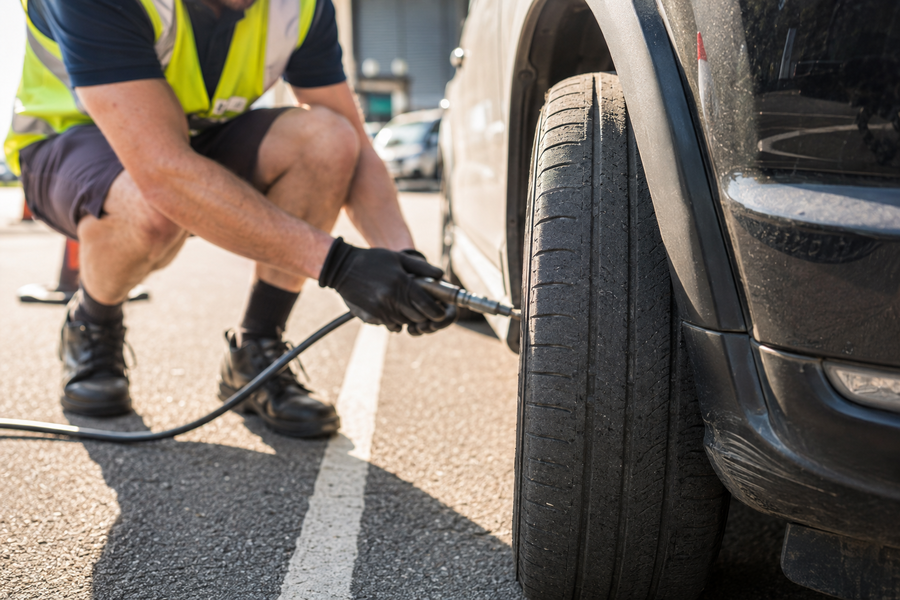
For motorists, the practical response remains straightforward: check pressures when the tyres are cold, use the vehicle manufacturer’s specified settings and account for additional passengers and luggage where a higher loaded pressure is specified.
For the tyre industry, however, the more interesting question concerns what happens before the holiday journey begins.
A long motorway journey does not create every tyre problem. It can expose one that has been developing unnoticed for weeks or months.
A vehicle may pass an MOT, receive a service or visit a workshop long before its summer journey. Since then, its tyres may have covered thousands of miles, suffered a pothole or kerb impact, developed irregular wear or gradually lost pressure.
This creates an inspection gap between the occasions when a vehicle is formally examined and the continuous deterioration taking place on the road.
Evidence from the UK market suggests that gap is significant. Tyre News Media’s reporting on TyreCheck 2025 found that 7.69% of vehicles inspected had illegal tyres below the 1.6mm tread threshold, while a further 31.79% were in the 1.6–2.0mm range.
The significance is not simply that some tyres had already crossed a legal threshold. A much larger group was approaching the point where intervention would soon be required.
Separate MOT data reported by Tyre News Media illustrates the same issue from another direction. More than nine million tyre-related advisory notices were recorded during a 13-month period covered by government data obtained for Point S Tyre & Autocare. Advisories represent precisely the point at which the aftermarket has an opportunity to move from identifying deterioration to managing what happens next.
That is where Dunlop’s seasonal warning becomes commercially relevant.
Traditional tyre retail is often built around a binary outcome: the tyre requires replacement or it does not.
In practice, tyre condition develops along a curve.
A tyre measuring comfortably above the legal tread threshold may not need replacing today, but its remaining tread, mileage, wear pattern and operating environment can indicate when another inspection would be sensible. Likewise, gradual pressure loss or uneven shoulder wear may justify investigation before either becomes an immediate safety problem.
Earlier identification changes the relationship between retailer and customer.
Instead of discovering an unexpected replacement requirement immediately before a holiday — or following a roadside incident — the driver can be shown the condition of the tyre, told what to monitor and given an indication of when another inspection should take place.
That gives motorists time to budget and gives retailers an opportunity to retain the maintenance relationship rather than compete for an emergency purchase.
The commercial significance lies less in selling tyres earlier than necessary and more in identifying the correct point for the next intervention.
This is also where digital tyre inspection starts to become more strategically useful.
Tyre News Media has previously examined the growth of digital inspection technology, including Anyline surpassing 100 million tyre inspections worldwide in 2025. The important development is not simply replacing a manual tread gauge with a camera or digital measuring device.
It is the ability to retain the measurement.
A tread-depth reading taken in isolation provides a snapshot. Connect that measurement to a vehicle, mileage and previous inspection, and it becomes part of a maintenance history.
The workshop can begin to see how quickly a tyre is wearing, whether deterioration is consistent across an axle and whether an unusual wear pattern warrants further investigation. Most importantly, the business has information that can support a future maintenance decision rather than disappearing when the vehicle leaves the workshop.
That distinction could become increasingly important as tyre retailers compete not only on replacement price but on their ability to manage tyre condition throughout its service life.
For commercial fleets, the economics of earlier intervention are more immediate.
Vehicles operating at high mileage, carrying substantial loads or spending prolonged periods at motorway speeds can accumulate tyre wear rapidly between workshop visits. A developing problem therefore carries a cost beyond the replacement tyre itself.
Roadside recovery, vehicle downtime, missed deliveries, disrupted schedules and administrative intervention can all turn a relatively routine maintenance issue into a more expensive operating event.
Digital tyre management is already moving in this direction. Recent Tyre News Media analysis of Continental’s fleet strategy highlighted how pressure and temperature monitoring can give operators earlier visibility of conditions developing between manual inspections.
Summer heat reinforces rather than creates that business case.
A fleet that knows the condition of its tyres before a period of intensive operation is better positioned to forecast replacement requirements and intervene before an asset becomes unavailable. The same principle applies to a retail customer heading for a heavily loaded motorway journey: the most valuable inspection is often the one conducted before a defect becomes urgent.
There is a risk, however, that summer tyre campaigns overstate the role of temperature.
Warnings suggesting that ordinary hot weather will simply cause correctly maintained tyres to fail can obscure the more useful maintenance message. Drivers need to understand that heat, load and distance can increase the consequences of underinflation, damage and deterioration rather than assume that temperature alone determines tyre safety.
That makes specific advice more valuable than alarmist language.
Drivers should check pressures cold against the vehicle manufacturer’s recommended figures, including loaded settings where appropriate. Tread, shoulders and sidewalls should be inspected for unusual wear, cuts, cracking, bulges or embedded objects, while any spare tyre should also be checked where one is fitted.
Persistent pressure loss, impact damage or visible deterioration should prompt a professional inspection rather than simply another inflation.
For retailers, the objective should be equally clear. A tyre inspection should not automatically become a replacement conversation. Where immediate replacement is unnecessary, recording the condition and establishing when the tyre should next be checked can create greater value for both the customer and the business.
Dunlop’s August warning is therefore useful for reasons extending beyond summer travel.
The industry already has the equipment and expertise required to measure pressure, tread depth and visible condition. The larger opportunity is to make those observations more regular, consistent and connected over time.
For retailers, that could turn an occasional tyre check into an ongoing maintenance relationship. For fleets, it can improve replacement forecasting and reduce exposure to unplanned downtime. For drivers, it increases the likelihood that deterioration is discovered in a workshop rather than at the roadside.
The heat is the immediate trigger, but the inspection gap is the more important issue.
Tyre safety increasingly depends not simply on finding tyres that have already reached the point of replacement, but on recognising deterioration early enough to decide what should happen next.
Tagged: Dunlop tyre warning, summer tyre safety, tyre inspection, tyre pressure, UK tyre safety, digital tyre inspection, fleet tyre maintenance, tyre retailers, tyre tread depth, preventative tyre maintenance, summer driving, tyre condition
Editorial Standards & Disclaimer
Tyre News Media is an independent industry publication. Our reporting is based on information available at the time of publication, including company announcements, regulatory filings, official data, research and other sources considered reliable.
Articles may include independent analysis and editorial interpretation. Where appropriate, company statements and third-party claims are attributed to their source. Analysis, estimates and forward-looking observations should not be read as statements of established fact.
Tyre News Media takes reasonable steps to ensure accuracy but welcomes corrections, clarifications and responses from organisations or individuals covered in our reporting. If you believe information is inaccurate or requires clarification, please contact info@tyrenews.co.uk. Material errors will be corrected as appropriate.
Commercial relationships, advertising and sponsorship do not determine Tyre News Media's editorial coverage or conclusions.




















%20(1).jpeg)