


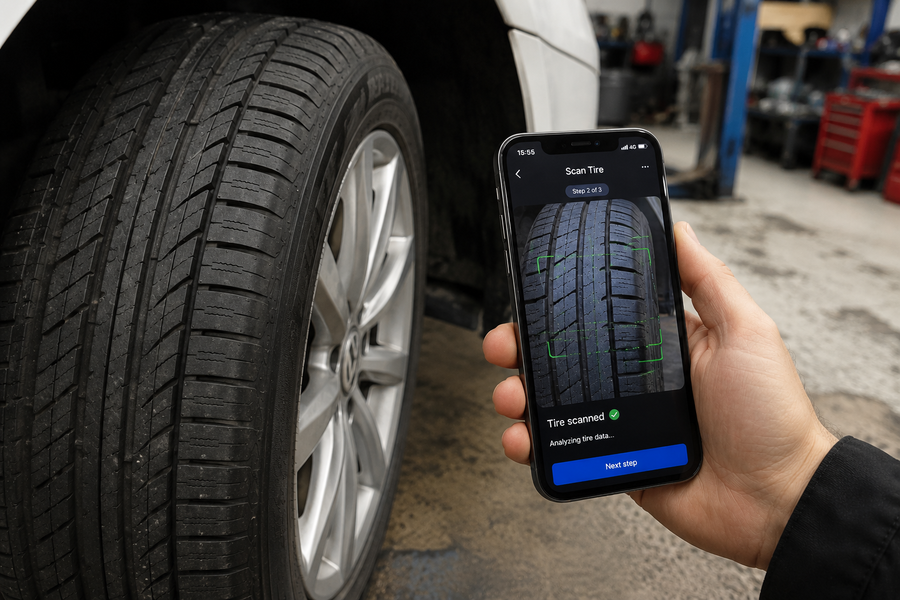

Anyline's latest US tyre inspection data has highlighted the number of vehicles reaching workshops with tyres already well into the later stages of their tread life. With 15% of tyres inspected through TireBuddy during National Tire Safety Week measuring below 3/32in, the findings raise a wider question for the aftermarket: how much replacement demand is currently going unidentified between routine workshop visits?
The headline finding from Anyline is straightforward. During National Tire Safety Week, 15% of tyres processed by professional customers using its TireBuddy inspection platform measured below 3/32in of remaining tread, or approximately 2.38mm. Anyline regards that as an important safety threshold, particularly because of the deterioration in wet-weather performance associated with declining tread depth.
There is an important distinction between that figure and the conventional US replacement threshold. The US Tire Manufacturers Association advises that passenger and light-truck tyres should be replaced when they reach 2/32in, approximately 1.6mm. Anyline's findings therefore should not be interpreted as showing that 15% of US tyres had passed the minimum replacement point. The company's published data is also drawn from tyres inspected through its professional customer network during the campaign period rather than a representative survey of the entire US vehicle parc.
Yet concentrating solely on that distinction risks missing the more interesting finding for the tyre trade. The space between a tyre reaching 3/32in and eventually reaching 2/32in represents a period in which wear can be identified, explained to the driver and monitored. In an aftermarket where replacement is still frequently triggered by a puncture, inspection failure or an immediate workshop recommendation, identifying tyres earlier creates an opportunity to move the transaction from an unexpected purchase towards planned maintenance.
That is where Anyline's figures become commercially significant. If 15% of the tyres being measured within a professional inspection environment are already below 3/32in, there is clearly a sizeable pool of vehicles reaching the later stages of tyre life. The question for retailers is whether those vehicles disappear after the inspection or whether the tyre's condition becomes the beginning of an ongoing customer conversation.
Tyre dealers have measured tread depth for decades, so the measurement itself is hardly an innovation. What is changing is what happens to the information afterwards.
A manual tread gauge provides an accurate reading at a particular moment, but unless that information is recorded and connected to a customer and vehicle, much of its future value disappears when the vehicle leaves the workshop. Digital inspection systems make it possible to retain that measurement, compare it with subsequent inspections and potentially build a picture of how quickly a tyre is wearing.
Anyline is already operating at considerable scale. The company said in 2025 that its technology had passed 100 million tyre inspections worldwide, a milestone previously covered by Tyre News Media in our report on Anyline's growth in digital tyre inspection. TireBuddy uses smartphone-based computer vision, allowing professional users to digitise tyre inspections without installing dedicated inspection infrastructure.
Other parts of the market are approaching the same problem differently. TireCheck's INSCAN commercial tyre inspection system, for example, uses drive-over technology to automate tyre condition checks in commercial vehicle operations. The technologies are different, as are their intended applications, but both reflect a wider shift: tyre inspection is becoming easier to repeat and the resulting information easier to retain.
That matters because the value of a tread-depth measurement increases considerably when it becomes part of a history. Knowing that a tyre has 3.5mm remaining today is useful; knowing how quickly it moved from 5mm to 3.5mm, how much mileage was covered in between and whether the wear is consistent across the axle begins to support a much more informed maintenance decision.
For fleets, that can mean predicting replacement requirements before they disrupt vehicle availability. For retailers, it could mean identifying when a customer is likely to return and making contact at an appropriate point rather than waiting for the next puncture, service or annual inspection to bring the vehicle back through the door.
Anyline's findings also highlight a longstanding weakness in tyre maintenance: tyre wear is continuous, while professional inspections are intermittent.
The problem is visible in other markets. Tyre News Media has previously reported on concerns around UK tyre tread-depth compliance, where industry research has repeatedly raised questions about the number of vehicles reaching the point of replacement before motorists take action. The UK and US datasets cannot be compared directly because the measurement thresholds, inspection regimes and samples are different, but the underlying issue is much the same.
A tyre can cover thousands of miles between workshop visits. Its condition can change substantially during that period, particularly on high-mileage vehicles, and an annual inspection provides little protection against deterioration occurring several months later. Increasing the frequency of tyre checks is therefore as important as improving the accuracy of an individual measurement.
This is where the simplicity of smartphone-based inspection could prove important. Dedicated automated inspection equipment has obvious attractions for high-throughput fleet and workshop environments, but putting measurement capability into equipment technicians already carry reduces the barrier to checking tyres more frequently. If digital inspections can be incorporated into routine workshop processes without materially adding time, tyre condition becomes something that can be recorded whenever a vehicle enters the business rather than only when a customer specifically requests a tyre check.
There is a commercial consequence to that change, but it should not simply be interpreted as an opportunity to sell tyres earlier. Retailers need to distinguish between identifying wear and recommending immediate replacement. A customer shown a recorded tread measurement, an explanation of what it means and an indication of when another check should take place is likely to have a very different experience from one presented with an unexpected replacement recommendation.
Used properly, digital inspection could therefore improve the credibility of the tyre conversation as much as its timing. It provides evidence, creates a record and gives the retailer an opportunity to demonstrate deterioration rather than merely describe it.
The longer-term significance of systems such as TireBuddy may ultimately lie beyond the workshop.
Once tyre measurements are captured digitally in sufficient numbers, they begin to create datasets capable of showing more than the condition of an individual vehicle. Connected with mileage, vehicle type, operating environment and inspection history, tyre data could eventually reveal patterns in wear rates and replacement cycles that have traditionally been difficult for the aftermarket to observe at scale.
Anyline's latest figures offer an early illustration of that potential, although they are best viewed as a snapshot of tyres moving through its professional inspection network rather than a measure of the condition of the entire US vehicle population. The company has not published a detailed breakdown of the number of tyres included in the National Tire Safety Week analysis, their geographic distribution or vehicle mix, which limits the conclusions that can reasonably be drawn about the wider US parc.
That is not unusual for operational data of this kind, but it will become increasingly relevant as inspection technology companies accumulate larger datasets. The more the tyre industry looks to these systems for market intelligence, the more useful information about sample composition, vehicle type and operating conditions will become.
The opportunity is considerable. Large-scale inspection data could help retailers understand replacement demand, enable fleets to forecast tyre requirements and potentially give manufacturers a clearer picture of how products are performing in real-world use. The businesses able to turn individual measurements into reliable patterns will be creating something more valuable than a digital version of the tread-depth gauge.
Anyline's 15% figure should be considered in that context. It does not establish that one in seven tyres across America is below an accepted replacement limit, nor does it need to in order to be significant. It shows that when tyres are inspected systematically, a substantial number can be identified at a point where intervention, monitoring and customer education become increasingly relevant.
The next development in tyre inspection is therefore unlikely to be about measuring another fraction of a millimetre more accurately. It will be about making better use of the measurement once it has been taken.
For an aftermarket that has historically waited for the vehicle to return before discovering what happened to its tyres, knowing what is likely to happen next could be considerably more valuable.
Tagged: Anyline tyre inspection, US tyre safety, digital tyre inspection, tyre tread depth, TireBuddy, tyre replacement, tyre retailers, tyre condition data, predictive tyre maintenance, AI tyre inspection, tyre safety
Editorial Standards & Disclaimer
Tyre News Media is an independent industry publication. Our reporting is based on information available at the time of publication, including company announcements, regulatory filings, official data, research and other sources considered reliable.
Articles may include independent analysis and editorial interpretation. Where appropriate, company statements and third-party claims are attributed to their source. Analysis, estimates and forward-looking observations should not be read as statements of established fact.
Tyre News Media takes reasonable steps to ensure accuracy but welcomes corrections, clarifications and responses from organisations or individuals covered in our reporting. If you believe information is inaccurate or requires clarification, please contact info@tyrenews.co.uk. Material errors will be corrected as appropriate.
Commercial relationships, advertising and sponsorship do not determine Tyre News Media's editorial coverage or conclusions.

_0%20(1).png)

















.png)
%20(1).jpg)
%20(1).jpeg)