Financial results from 18 major tyre manufacturers reveal contrasting profitability trends across Europe, Asia and North America.
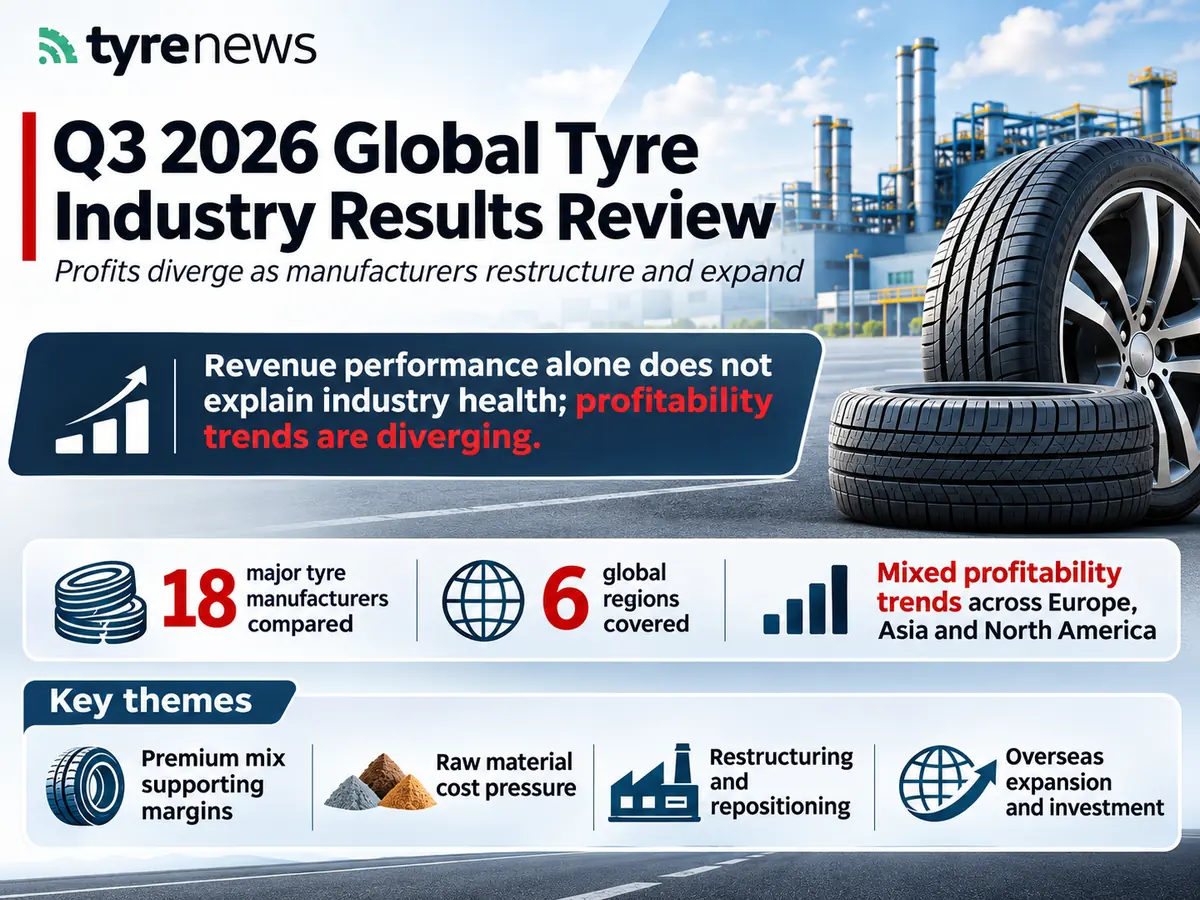

Financial results from 18 major tyre manufacturers reveal contrasting profitability trends across Europe, Asia and North America. Tyre News Media examines the figures alongside manufacturing investment, restructuring, product strategies and the outlook for 2027.
Third-quarter financial results from major global tyre manufacturers reveal a widening difference between sales performance and profitability, with stronger revenue failing to guarantee higher earnings as producers contend with raw-material costs, regional demand pressures and changing product strategies.
Continental increased adjusted operating profit by 6.7% and improved its quarterly margin to 14.9%, while Bridgestone achieved an adjusted operating margin of 13.3%. Nokian Tyres also recorded a substantial recovery in operating profit.
Elsewhere, the picture was less favourable. Goodyear's segment operating income declined by 39.4%, while Hankook reported record quarterly tyre revenue despite lower operating profit. Chinese manufacturers Sailun, Linglong and Triangle experienced particularly sharp earnings pressure.
The contrasts illustrate why turnover alone provides an incomplete measure of tyre industry performance. Sales can increase through pricing, product mix, acquisitions or currency movements without an equivalent improvement in earnings.
Tyre News Media has examined the financial performance of 18 major manufacturers across six geographic groups, alongside the investment and restructuring announcements that provide context for their future operations.
The results reveal substantial differences in the relationship between revenue growth and earnings.
Among European manufacturers, Continental's adjusted EBIT increased despite declining organic sales, while Pirelli reported higher revenue and operating profit but a slightly weaker profit margin.
Bridgestone and Yokohama delivered stronger profitability in Japan, although Yokohama's headline figures represent the first nine months rather than the standalone third quarter.
In South Korea, Kumho increased operating profit, while Hankook and Nexen reported earnings pressure despite higher sales.
China presented some of the sharpest contrasts, with Sailun, Linglong and Triangle all recording weaker attributable earnings.
Indian manufacturers delivered significant revenue growth, but the differences between BKT's sales and profit increases and MRF's falling net profit demonstrate the importance of cost management.
The results cannot be ranked purely by profit growth or margin because manufacturers use different reporting measures, including operating profit, adjusted EBIT, business profit, segment income and attributable net profit.
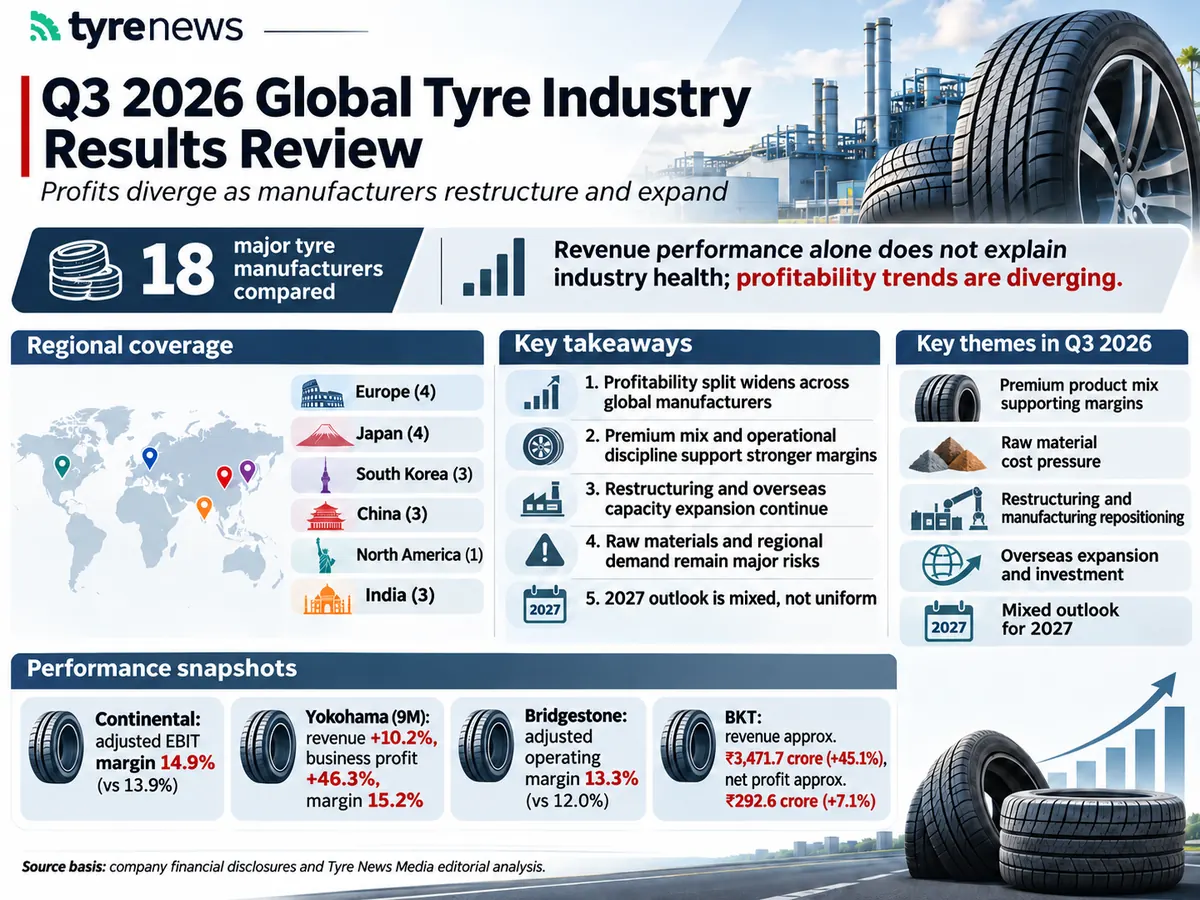
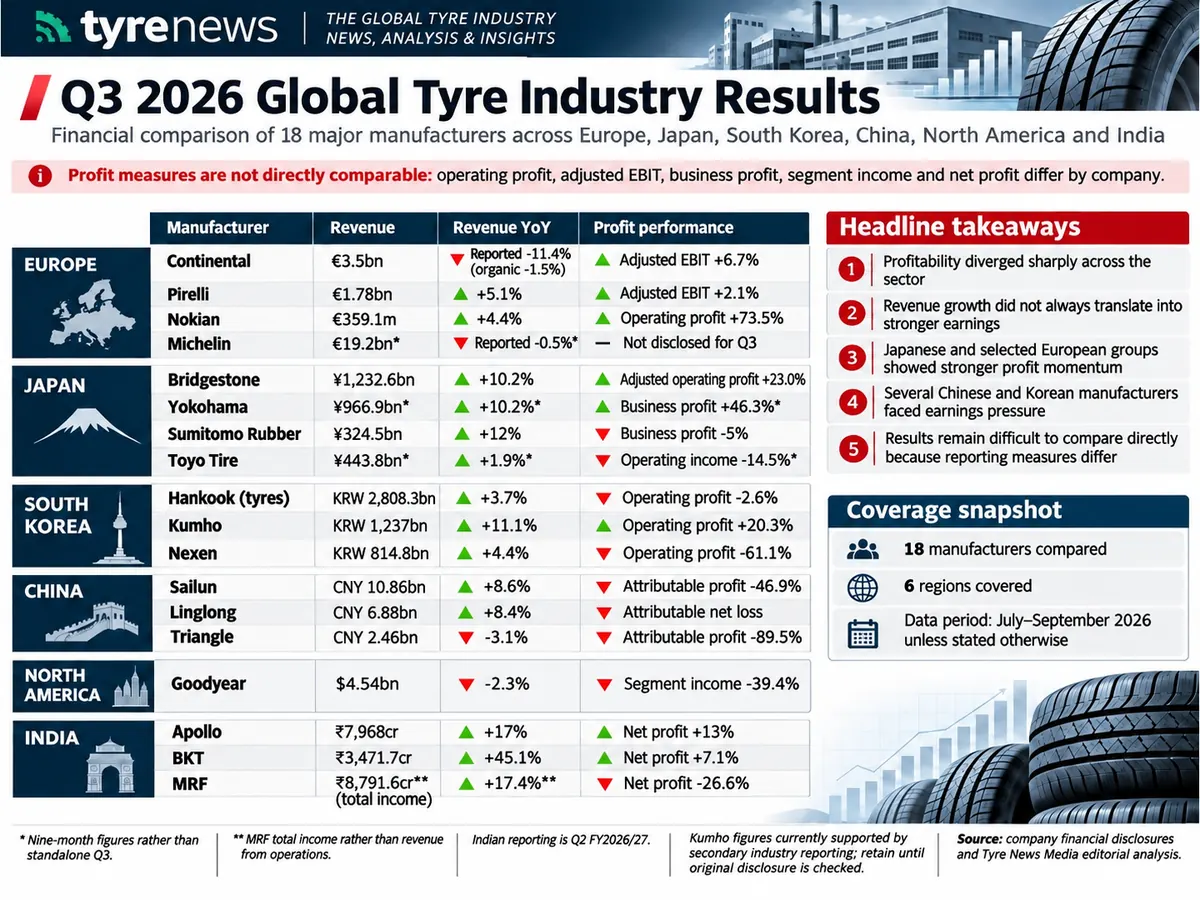
Continental's third-quarter sales were approximately €3.5 billion, down 11.4% on a reported basis and 1.5% organically.
Despite the revenue decline, adjusted EBIT increased 6.7% to €514 million, while its adjusted EBIT margin improved from 13.9% to 14.9%.
Continental identified its higher-value tyre portfolio, including products measuring 18 inches and above, alongside commercial measures and regional performance, as contributors to profitability.
The manufacturer also raised its full-year adjusted EBIT margin outlook to approximately 13.4% to 14.0%, although management warned of increasing raw-material cost pressure during the final quarter.
The results demonstrate how product mix and operating performance can support earnings even when sales decline.
Pirelli reported third-quarter revenue of €1.78 billion, up 5.1%, while adjusted EBIT increased 2.1% to €283 million.
However, its adjusted EBIT margin declined from 16.3% to 15.9%, partly reflecting higher raw-material costs.
Price and mix contributed a positive 4.6%, while total tyre volumes declined 1.6%.
The figures reflect Pirelli's emphasis on higher-value products and reduced exposure to lower-margin standard tyres.
Although the manufacturer increased earnings in absolute terms, profitability relative to revenue weakened slightly, demonstrating that premium positioning does not entirely remove input-cost pressure.
Nokian Tyres reported third-quarter sales of €359.1 million, an increase of 4.4%, while reported operating profit rose from €21.8 million to €37.9 million.
Its reported operating margin consequently improved from 6.3% to 10.5%.
On the company's segment reporting basis, operating profit increased from €32.4 million to €47.0 million.
The improvement reflected operational efficiency, pricing and product mix, with lower manufacturing and material costs also supporting profitability.
Nokian continues to develop its European manufacturing operations, including the ramp-up of its Romanian factory.
However, the Romanian investment should be considered part of the company's longer-term manufacturing strategy rather than the sole explanation for its latest profit improvement.
Michelin reported group revenue of approximately €19.2 billion for the first nine months of 2026, down 0.5% on a reported basis.
At constant exchange rates, revenue increased 1.0%, while growth was 0.1% after adjusting for both currency and changes in business scope.
Tyre volumes declined 0.8%, principally reflecting weaker original equipment demand.
Replacement sales proved more resilient, with MICHELIN-brand volumes increasing 4% over the nine-month period.
The group also benefited from a favourable product mix, including larger-diameter tyres and higher-value products.
Michelin's update did not provide a standalone third-quarter operating profit figure directly comparable with the other manufacturers.
Its figures nevertheless provide important context for a market in which branded replacement performance and original equipment demand are moving in different directions.
Goodyear reported third-quarter net sales of $4.54 billion, down 2.3%, while tyre unit volumes declined 3.3% to 38.6 million.
Segment operating income fell from $287 million to $174 million, a decline of 39.4%.
The company recorded a reported net loss of $238 million. On an adjusted basis, its net loss was $31 million, compared with adjusted net income of $82 million a year earlier.
The Americas accounted for a substantial proportion of the earnings deterioration, with segment operating income declining from $206 million to $96 million.
Manufacturing utilisation and cost absorption were important contributors to the regional decline.
In Europe, the Middle East and Africa, replacement tyre volumes fell 11.3%, while reported regional segment operating income decreased from $30 million to $12 million.
However, the comparison was affected by the disposal of the Dunlop brand. Excluding the transaction's impact, Goodyear reported a $5 million improvement in EMEA segment operating income.
The distinction is important because the reported regional decline does not fully reflect the performance of the continuing business.
Goodyear also continued its shift towards higher-value consumer products. Tyres measuring 18 inches and above accounted for 44% of consumer sales volumes, compared with 39% a year earlier.
Despite that improvement in product mix, wider operating pressures continued to affect profitability.
Following the reporting period, Goodyear announced the departure of chief executive Mark Stewart and the appointment of Roger Wood as interim chief executive, while its board continued a strategic review.
These developments provide context for the company's future direction, but should not be presented as direct consequences of the quarterly results.
Bridgestone reported third-quarter revenue of ¥1,232.6 billion, compared with ¥1,118.5 billion a year earlier.
Adjusted operating profit increased from ¥133.7 billion to ¥164.4 billion, while its adjusted operating margin improved from 12.0% to 13.3%.
Specialty tyres were a particularly strong area of performance.
The category achieved an adjusted operating margin of 27.4% during the third quarter, compared with 19.4% a year earlier.
For the January-to-September period, the specialty margin was 24.4%, illustrating the importance of distinguishing quarterly and cumulative results.
Bridgestone subsequently experienced a fire at its Tosu factory in Japan during November, resulting in a temporary production interruption.
The incident occurred after the quarter ended and therefore does not affect the published third-quarter financial results.
Yokohama Rubber reported record sales and profits for the first nine months of 2026.
Revenue increased 10.2% to ¥966.9 billion, while business profit rose 46.3% to ¥147.4 billion.
Its business profit margin reached 15.2%, representing a substantial improvement in profitability relative to sales.
The manufacturer maintained its full-year forecasts, including revenue of ¥1,320 billion and business profit of ¥192.5 billion.
These figures cover January to September rather than the standalone third quarter, but demonstrate strong cumulative earnings momentum.
Sumitomo Rubber Industries reported third-quarter consolidated revenue of ¥324.5 billion, up approximately 12%.
Business profit declined around 5% to ¥19.2 billion.
Within its tyre operations, revenue increased approximately 12% to ¥280.9 billion, while business profit fell 29% to ¥13.3 billion.
Higher raw-material costs were an important contributor to the decline in tyre profitability.
Toyo Tire also recorded a divergence between sales and earnings over the first nine months.
Cumulative revenue increased 1.9% to ¥443.8 billion, while operating income declined 14.5% to ¥61.6 billion.
However, standalone third-quarter operating income was broadly stable, increasing slightly to approximately ¥24.1 billion.
Toyo has revised its full-year operating income forecast down to ¥82 billion, reflecting pressure on expected annual profitability.
The Japanese results therefore demonstrate different performance patterns, from Bridgestone and Yokohama's stronger margins to continuing cost and earnings challenges elsewhere.
Hankook Tire & Technology reported record third-quarter revenue for its tyre business, but operating earnings moved in the opposite direction.
Tyre sales increased 3.7% to KRW 2.81 trillion, while tyre-division operating profit declined 2.6% to KRW 505.9 billion.
Hankook attributed the earnings pressure partly to higher raw-material and logistics costs.
The figures relate specifically to the tyre business rather than the wider consolidated group, which also includes thermal management specialist Hanon Systems.
Nexen Tire experienced a sharper deterioration in profitability.
Revenue increased 4.4% to KRW 814.8 billion, while operating profit declined 61.1% to KRW 18.1 billion.
Europe remained an important market for the manufacturer, supported by demand for winter, all-weather and larger-diameter tyres.
However, raw-material costs and other operating expenses outweighed the benefits of higher sales.
Kumho Tire delivered a contrasting result.
Third-quarter revenue increased 11.1% to approximately KRW 1.24 trillion, while operating profit rose 20.3% to KRW 130.5 billion.
The differences between Hankook, Kumho and Nexen demonstrate why manufacturers within the same national market should not be assumed to share identical earnings trends.
Product positioning, regional exposure and individual operating costs remain significant factors.
Chinese tyre manufacturers reported some of the most substantial differences between revenue growth and profitability.
Sailun Group recorded third-quarter revenue of approximately CNY 10.86 billion, an increase of 8.6%.
However, attributable net profit declined 46.9% to CNY 552.3 million.
Raw-material costs and foreign-exchange movements contributed to the earnings pressure.
Shandong Linglong Tire reported revenue growth of 8.4% to CNY 6.88 billion, but recorded a quarterly net loss attributable to shareholders of approximately CNY 37.4 million.
Triangle Tyre reported revenue of CNY 2.46 billion, down 3.1%, while attributable net profit fell approximately 89.5% to CNY 30 million.
Excluding non-recurring items, Triangle recorded a quarterly loss.
The three companies have different product portfolios and international operations, but their financial results illustrate the extent of pressure on profitability within parts of China's tyre manufacturing industry.
The findings have implications for the international supply chain, although weaker manufacturer earnings do not automatically translate into higher wholesale or retail tyre prices.
Future pricing will depend on individual commercial decisions, exchange rates, competition and applicable trade measures.
Apollo Tyres reported consolidated quarterly revenue of ₹7,968 crore, an increase of 17% compared with the same period in 2025.
Operating profit reached approximately ₹855 crore, while net profit increased 13% to ₹292 crore.
The results cover Apollo's second financial quarter of 2026/27, corresponding to July to September 2026.
Indian operations supported growth, including contributions from commercial vehicle products and domestic market expansion.
Apollo also identified higher input costs and supply chain disruption associated with geopolitical tensions in West Asia.
Separately, the manufacturer is restructuring its European production arrangements.
Its strategy includes greater sourcing of smaller tyre sizes from India and a stronger emphasis on higher-value production at its Hungarian facility.
These changes are intended to improve longer-term competitiveness, although their full financial effects remain to be established.
Balkrishna Industries, known as BKT, reported consolidated quarterly revenue of ₹3,471.7 crore, up 45.1%.
Net profit increased by a much smaller 7.1% to ₹292.6 crore.
Although revenue grew strongly, the difference between sales and profit movements highlights the importance of examining costs and margins rather than relying solely on turnover growth.
BKT is also pursuing a significant expansion beyond its established off-highway tyre business.
The manufacturer is preparing to enter the Indian passenger car replacement tyre market under its own brand, with a January 2027 launch target.
Separately, it has entered a manufacturing agreement with Pirelli covering premium passenger car tyres in India.
Under the initial arrangement, BKT is expected to produce up to 800,000 Pirelli-branded tyres annually by 2030.
The companies have also outlined the possibility of a future 50:50 manufacturing joint venture, subject to specified conditions.
The partnership represents an important diversification opportunity for BKT, but future passenger car production should not be treated as a contributor to third-quarter earnings.
MRF reported consolidated total income of ₹8,791.6 crore for the quarter, up 17.4% from ₹7,489 crore a year earlier.
Revenue from operations was ₹8,660.2 crore.
Despite the stronger income performance, net profit fell 26.6% to approximately ₹387 million? No, ₹387 crore, compared with ₹527.4 crore in the corresponding period of 2025.
MRF attributed the deterioration primarily to significantly higher raw-material costs, partially offset by pricing and cost-saving measures.
The manufacturer also warned that commodity and logistics costs could remain elevated.
MRF's experience reinforces the broader finding that stronger demand and revenue do not necessarily translate into improved profitability.
Financial results provide an indication of manufacturers' current operating performance. Recent investment and restructuring announcements offer a separate view of their priorities beyond 2026.
BKT's expansion into passenger car tyres represents a significant diversification from its established agricultural, construction and off-highway markets.
Its agreement with Pirelli could establish an additional Indian production route for premium tyres, while offering BKT access to a different market segment.
Apollo is pursuing another approach, adjusting the relationship between its Indian and European manufacturing operations to improve competitiveness and product positioning.
Sailun is expanding its international production network.
Its Egyptian factory produced its first tyre on 4 November, marking the transition into trial production.
The first phase is planned to provide annual capacity of approximately three million passenger car tyres and 600,000 truck and bus tyres.
These figures represent planned future capacity rather than commercial production achieved during the reporting period.
Nokian continues to develop its Romanian manufacturing operations as part of its European production strategy.
Goodyear, meanwhile, is undertaking a strategic review following weaker financial performance and changes in leadership.
These developments should not be interpreted as identical responses to a common problem.
Some manufacturers are expanding into new product categories or geographic markets, while others are adjusting production costs, improving factory utilisation or concentrating on higher-value tyres.
Three developments stand out from the latest financial disclosures.
First, raw-material costs and pricing remain important determinants of profitability.
Several manufacturers reported higher revenue without corresponding profit growth. This was particularly visible among Chinese and Indian producers, although the extent of cost pressure varied significantly between companies.
Second, premium and specialised tyres remain important sources of differentiation.
Continental, Pirelli and Bridgestone demonstrate how higher-value products and product mix can support profitability.
However, Hankook and Nexen show that an improving premium mix cannot necessarily offset wider cost pressures.
Third, manufacturing location and capacity decisions are increasingly important to future competitiveness.
Apollo, BKT, Sailun, Nokian and Goodyear are pursuing different operational strategies that could influence their positions beyond 2026.
The industry also faces uncertainty around replacement demand, original equipment production, currency movements and international trade policy.
For tyre distributors, wholesalers and retailers, the results provide an indication of potential pressures across the supply chain, but manufacturer earnings alone cannot establish future tyre pricing or product availability.
The third-quarter figures do not show a uniform decline in global tyre industry profitability.
Instead, they reveal a differentiated market in which product mix, operating efficiency, regional exposure and cost management are producing sharply contrasting outcomes.
For 2027, the central question will be which manufacturers can translate sales performance and planned operational changes into sustainable earnings growth.
Tags: Q3 2026 tyre results, tyre manufacturers, tyre industry profits, global tyre industry, tyre market analysis, tyre manufacturing, operating margins, raw material costs, tyre industry investment, financial results, premium tyres, manufacturing strategy
Editorial Standards & Disclaimer
Tyre News Media is an independent industry publication. Our reporting is based on information available at the time of publication, including company announcements, regulatory filings, official data, research and other sources considered reliable.
Articles may include independent analysis and editorial interpretation. Where appropriate, company statements and third-party claims are attributed to their source. Analysis, estimates and forward-looking observations should not be read as statements of established fact.
Tyre News Media takes reasonable steps to ensure accuracy but welcomes corrections, clarifications and responses from organisations or individuals covered in our reporting. If you believe information is inaccurate or requires clarification, please contact info@tyrenews.co.uk. Material errors will be corrected as appropriate.
Commercial relationships, advertising and sponsorship do not determine Tyre News Media's editorial coverage or conclusions.

Tyre Industry Business Directory
Search manufacturers, suppliers, wholesalers, service providers and industry partners across the tyre sector.

Commercial Relationships
TNM works with sponsors and advertisers across the tyre industry. These relationships help fund open-access journalism while editorial decisions remain independent.

TNM Sponsor
Kumho Tyre (UK) Ltd

Banner Advertiser
Davanti Tyres

Banner Advertiser
Linglong Tyre Co., Ltd
TNM Sponsor
Point S UK Ltd

TNM Sponsor
TyreSafe

TNM Sponsor
Oak Tyres

TNM Sponsor
ENVOY Tyres
Work with TNM
Explore advertising, sponsorship and supporter opportunities across Tyre News Media.
Commercial relationships do not determine TNM editorial coverage or conclusions.