
Natural rubber traceability requires more than a map of supplier plantations. Recent announcements involving Apollo Tyres and Dunlop Aircraft Tyres illustrate how manufacturers are bringing origin information, risk assessments and operational records together ahead of the EU Deforestation Regulation’s application. Both accounts are published by technology suppliers.
According to an Emertech case study, Apollo’s system connects supplier submissions, geolocation validation, satellite assessment, production records and due diligence statement filing.
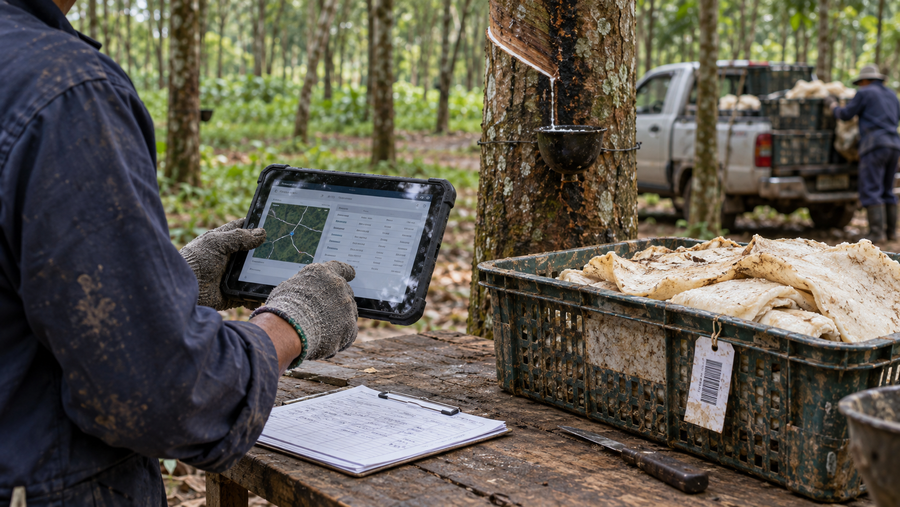
Suppliers upload plot boundaries and supporting information. The platform checks coordinates, geometry and mandatory fields, identifying incomplete records, duplicate plots and potential overlaps. Satellite analysis then assesses deforestation risk, with flagged plots held for review.
Emertech says integration with Apollo’s enterprise resource planning system links sourcing evidence to purchase orders, incoming consignments, material batches, production transactions, finished products and export shipments. Filing status and reference numbers return from the EU Information System to Apollo’s portal.
The case study includes a statement attributed to Shibu George, Apollo’s Group Head of Advanced Manufacturing and Enterprise Application, describing stronger visibility from source to finished product. It remains a supplier account of the implementation, rather than an independent assessment of compliance.
Dunlop Aircraft Tyres provides a second example, although at a different stage of reported development.
In its 5 October announcement, osapiens says the manufacturer has selected its HUB platform for natural rubber due diligence. It describes plot-level deforestation and legality assessments, documented decisions and automated handling of exceptions, including incomplete upstream data.
The announcement includes an attributed comment from purchasing manager Andy Wells about improved supply-chain visibility. It does not provide quantified implementation results or explain how unresolved cases ultimately receive approval. Platform selection therefore cannot be treated as evidence of a fully validated supply chain.
The European Commission’s current timetable sets application for large and medium operators at 30 December 2026, and most micro and small operators at 30 June 2027. Responsibilities depend on the business’s role in the supply chain.
New pneumatic tyres containing relevant natural rubber remain within the regulation’s product scope. The amended list excludes retreaded tyres, while retaining relevant tyre treads, making product classification an essential starting point.
Under the Commission’s due diligence guidance, upstream operators must establish that relevant products are legally produced and that their commodities did not originate on land deforested after 31 December 2020.
Where rubber comes from several plots, the required origin information must cover those plots. Risk assessment also considers possible mixing with material of unknown origin. If required information cannot be collected, the operator must not place the relevant product on the EU market or export it.
These requirements explain why links between supplier evidence and factory records matter. A satellite assessment addresses land-use risk, but does not establish every aspect of legality or material traceability. A submitted statement records the operator’s declaration, rather than independently proving compliance.
For manufacturers evaluating these systems, the practical questions are how missing records are resolved, how mixed inputs remain traceable and who authorises material to proceed. Neither announcement fully answers those questions.
Tags: natural rubber, rubber traceability, EUDR, Apollo Tyres, Dunlop Aircraft Tyres, Emertech, osapiens, tyre manufacturing, deforestation, supply chain due diligence
Editorial Standards & Disclaimer
Tyre News Media is an independent industry publication. Our reporting is based on information available at the time of publication, including company announcements, regulatory filings, official data, research and other sources considered reliable.
Articles may include independent analysis and editorial interpretation. Where appropriate, company statements and third-party claims are attributed to their source. Analysis, estimates and forward-looking observations should not be read as statements of established fact.
Tyre News Media takes reasonable steps to ensure accuracy but welcomes corrections, clarifications and responses from organisations or individuals covered in our reporting. If you believe information is inaccurate or requires clarification, please contact info@tyrenews.co.uk. Material errors will be corrected as appropriate.
Commercial relationships, advertising and sponsorship do not determine Tyre News Media's editorial coverage or conclusions.


















%20(1).jpeg)