DIGITAL-ONLY · OPEN ACCESS · TYRE INDUSTRY NEWS



The role of connected tyres could extend well beyond vehicle safety, with tyre sensors and artificial intelligence increasingly being used to help road authorities identify infrastructure damage before it develops into more expensive problems.
Jonathan Selbie, CEO of Swedish technology company Univrses, has renewed calls for British road authorities to adopt preventative maintenance strategies supported by AI. His comments come seven months after Pirelli acquired a 30% stake in the company, bringing together two technologies with potential applications across road infrastructure, fleet management and future mobility.
With the British government encouraging highway authorities to move towards preventative maintenance, deployments in Sweden and Italy offer examples of how everyday vehicles could become part of a wider road monitoring network.
On 29 April 2026, Pirelli announced its investment in Univrses, acquiring a 30% stake with the option to obtain majority ownership.
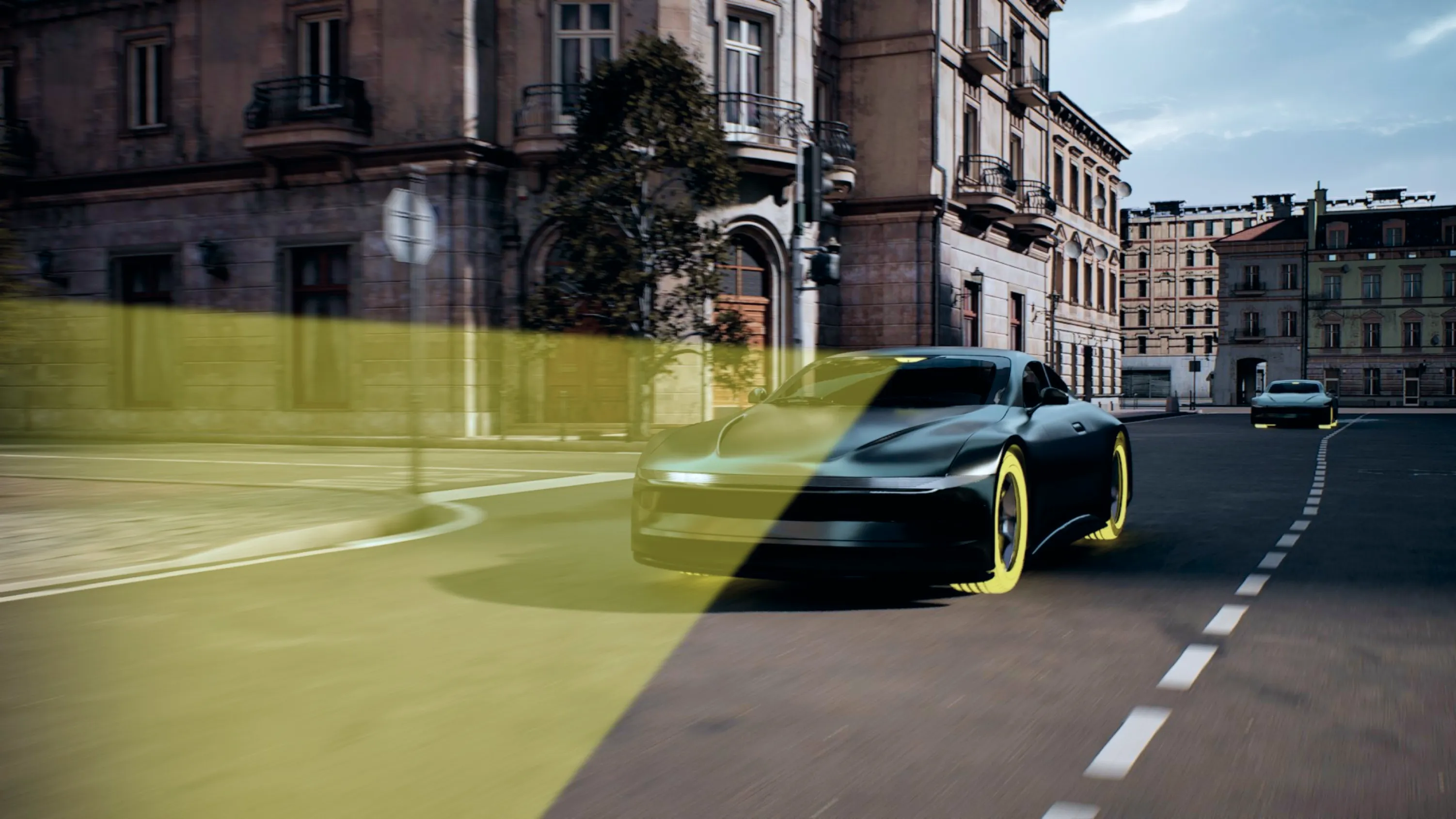
The agreement provides for the integration of Univrses’ AI-based computer vision technology into Pirelli’s Cyber Tyre platform, supporting applications in road monitoring, advanced driver assistance systems and autonomous driving.
Andrea Casaluci, CEO of Pirelli, said at the time:
“The agreement with Univrses further enhances our Cyber Tyre™ platform, thanks to advanced AI‑based artificial vision technologies. The collaboration between Pirelli and Univrses will make a significant contribution to the ongoing transformation of cars into true software‑defined vehicles.”
While much of the development surrounding connected tyres has focused on vehicle performance and safety, the partnership also raises an important question for the tyre industry. Could information collected at the point of contact between a vehicle and the road become a valuable resource for infrastructure management?
Pirelli’s Cyber Tyre system uses sensors integrated within tyres to collect information that can be processed and communicated to vehicle electronics and cloud-based systems.
Univrses’ 3DAI technology adds another dimension through computer vision, analysing images captured by cameras fitted to vehicles to identify road defects, signage and other infrastructure assets.
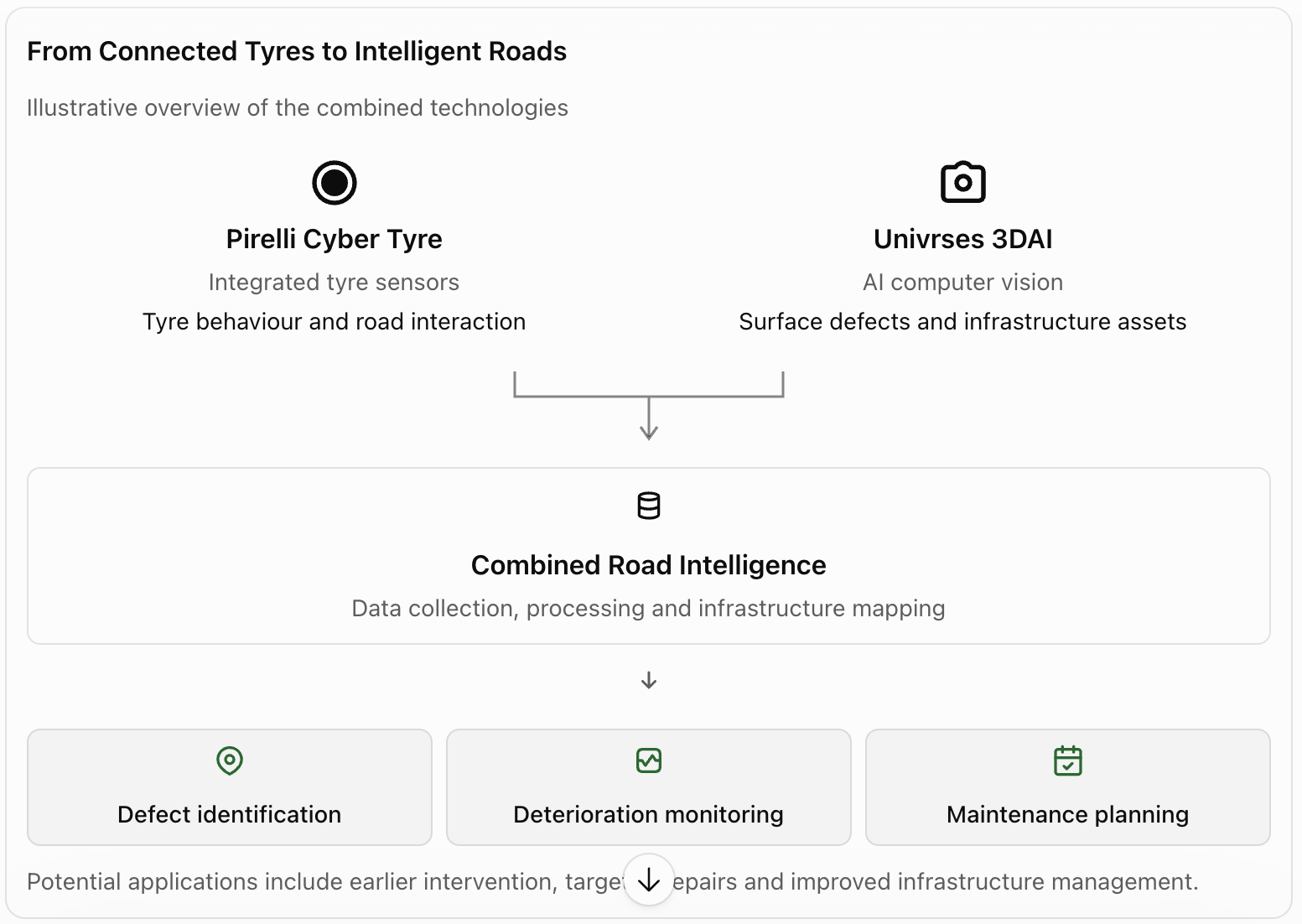
The technologies offer complementary sources of information. Tyre sensors provide data associated with the physical interaction between vehicle and road, while computer vision provides information about visible surface conditions and surrounding infrastructure.
Collecting this information during everyday journeys could allow authorities to monitor changes more frequently without relying exclusively on dedicated inspection vehicles.
The relationship between Pirelli and Univrses predates the April investment.
In 2025, the Apulia regional government and Pirelli launched a pilot project in southern Italy to explore the use of connected tyre technology and computer vision for infrastructure monitoring.
The initiative was followed in September 2026 by an agreement to test the technology on five Alfa Romeo Tonale vehicles operated by the Carabinieri in Rome.
As previously reported by Tyre News Media, the police vehicles are intended to collect information during normal operational duties, combining tyre sensor data with camera imagery to identify road surface and signage problems.
The significance of these projects lies in their use of vehicles already operating across the road network, rather than relying solely on separate inspection journeys.
One of the more established examples of AI-supported infrastructure monitoring comes from Helsingborg in Sweden.
The municipality worked with Univrses and regional waste management company NSR to install camera-based monitoring equipment on refuse collection vehicles.
Information collected during existing collection routes allowed maintenance teams to identify defects, monitor changes and prioritise repairs.
According to Univrses’ published case study, the number of recorded potholes fell from 3,000 in April 2022 to 900 in September 2022.

The City of Helsingborg has separately confirmed the benefits of the deployment, including more frequently updated road condition information, lower inspection costs and the ability to intervene earlier.
The Swedish project used Univrses’ computer vision technology rather than the combined Pirelli Cyber Tyre system. Nevertheless, it demonstrates how data collected by existing vehicle fleets can support changes in municipal maintenance practices.
The potential application of these technologies comes at a relevant time for British road authorities.
In October 2026, the Department for Transport reported that 94% of English highway authorities were planning preventative road maintenance during the current financial year, compared with 76% in the previous year.
The government has committed £7.3 billion to local highway maintenance in England between 2026/27 and 2029/30.

Speaking about preventative road monitoring in November, Jonathan Selbie, CEO of Univrses, said:
“Road authorities know where potholes are, the more valuable question is where they’re going to develop. Addressing early surface deterioration costs less than repairing a pothole once the road has failed, and advancements in predictive road monitoring technology mean that this is now possible.”
For the tyre industry, the issue has direct relevance. Poor road surfaces can cause punctures, sidewall damage and premature tyre replacement, alongside damage to wheels and suspension components.
Research published by TyreSafe in January 2026 put the estimated cost of pothole-related vehicle damage in the UK at £589 million during 2025.
Commercial fleets could also benefit from improved road conditions through reduced vehicle downtime and fewer unplanned maintenance requirements.
However, identifying deteriorating roads is only one part of the challenge. Authorities must also have sufficient funding, maintenance capacity and processes to act on the information collected.
Pirelli’s investment raises a wider commercial question about the future role of tyre manufacturers.
Traditionally, the tyre has been manufactured, distributed, fitted and eventually replaced. Connected tyre technology introduces the possibility of delivering additional value throughout its operating life through software, monitoring and data services.
Jonathan Selbie said when the Pirelli investment was announced:
“Continuous monitoring and data are becoming the new foundation for infrastructure asset management, and Univrses technology is able to provide powerful analytical capabilities based on reliable and frequently updated data. In this context, we are pleased to welcome Pirelli as an investor and to take our partnership to the next level: we will join forces to deliver increasingly advanced services and products.”
Highway authorities, infrastructure contractors, commercial fleets and smart city technology providers could become users of information generated through connected tyre systems.
Whether these applications develop into significant commercial revenue streams will depend on deployment costs, data accuracy, interoperability, ownership of information and the measurable benefits delivered to infrastructure operators.
Pirelli’s investment in Univrses illustrates how tyre technology is beginning to address challenges beyond the vehicle itself.
The Swedish experience provides evidence of the practical value of continuous road monitoring, while the Italian projects offer an opportunity to assess what integrated tyre sensors and computer vision can deliver together.
For Britain, where preventative road maintenance is becoming a greater policy priority, the next step could involve evaluating similar technologies across existing municipal and commercial fleets.
The future value of a connected tyre may increasingly lie not only in what it tells a vehicle about the road, but also in what it tells road authorities about their infrastructure.
Tags: Pirelli, Univrses, Cyber Tyre, Connected Tyres, Artificial Intelligence, Computer Vision, Road Maintenance, Pothole Prevention, Smart Infrastructure, Predictive Maintenance, Future Tyre Industry, Road Monitoring
Editorial Standards & Disclaimer
Tyre News Media is an independent industry publication. Our reporting is based on information available at the time of publication, including company announcements, regulatory filings, official data, research and other sources considered reliable.
Articles may include independent analysis and editorial interpretation. Where appropriate, company statements and third-party claims are attributed to their source. Analysis, estimates and forward-looking observations should not be read as statements of established fact.
Tyre News Media takes reasonable steps to ensure accuracy but welcomes corrections, clarifications and responses from organisations or individuals covered in our reporting. If you believe information is inaccurate or requires clarification, please contact info@tyrenews.co.uk. Material errors will be corrected as appropriate.
Commercial relationships, advertising and sponsorship do not determine Tyre News Media's editorial coverage or conclusions.








Tyre Industry Business Directory
Search manufacturers, suppliers, wholesalers, service providers and industry partners across the tyre sector.
Commercial Relationships
TNM works with sponsors and advertisers across the tyre industry. These relationships help fund open-access journalism while editorial decisions remain independent.

TNM Sponsor
Kumho Tyre (UK) Ltd

Banner Advertiser
Davanti Tyres

Banner Advertiser
Linglong Tyre Co., Ltd

TNM Sponsor
Point S UK Ltd

TNM Sponsor
TyreSafe

TNM Sponsor
Oak Tyres

TNM Sponsor
ENVOY Tyres
Work with TNM
Explore advertising, sponsorship and supporter opportunities across Tyre News Media.
Commercial relationships do not determine TNM editorial coverage or conclusions.