
A $1.9 million US study into battery-free smart-tyre sensors is testing whether commercial truck tyres can warn fleets about developing problems before failure. Auburn University's research is one part of a wider shift in tyre R&D, where the challenge is moving beyond identification and pressure monitoring towards something potentially more valuable: usable intelligence about tyre condition.
For fleets, the important question about the next generation of smart tyres is not how much data they can produce. It is whether that data changes a maintenance decision.
That distinction is becoming increasingly important as tyre digitalisation advances beyond familiar pressure and temperature monitoring. RFID can already give an individual tyre a persistent digital identity, while connected systems can feed operating information into fleet-management platforms. Research is now pushing further, towards extracting information about physical condition, degradation and potentially impending failure.
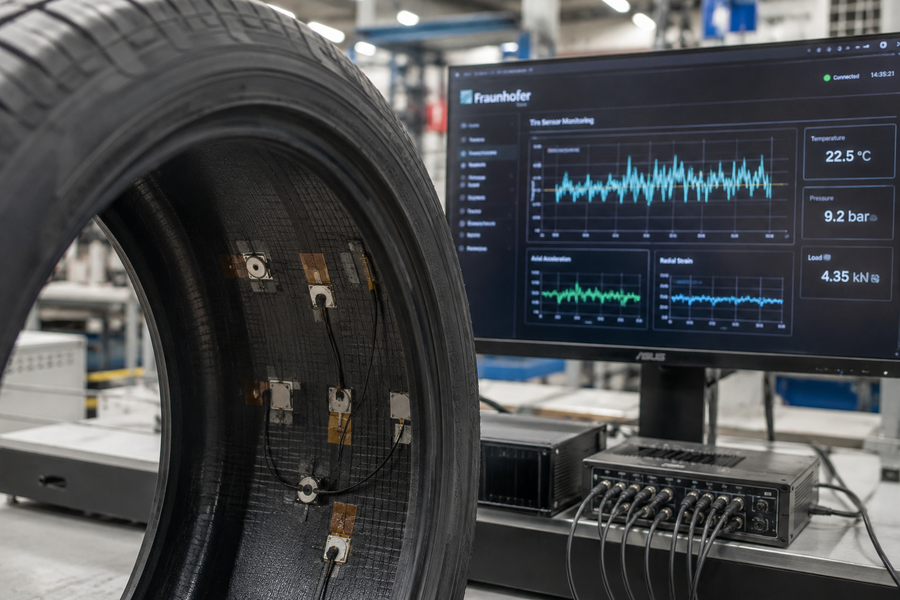
Auburn University's Transportation Research Institute (AUTRI) offers a particularly practical example. It has received $1.9 million from the US Federal Motor Carrier Safety Administration for a two-year study into battery-free, RFID-enabled sensors embedded in commercial truck tyres.
The objective is not simply to prove that another parameter can be measured. Researchers are investigating whether the technology can detect unsafe conditions sufficiently reliably and early enough to help prevent tyre failures.
Auburn will test the technology in three operating scenarios that closely resemble existing commercial vehicle inspection and maintenance processes.
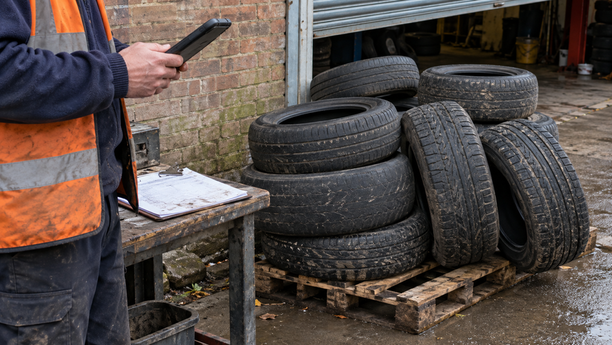
Drivers or enforcement officers could use handheld equipment to interrogate tyres while a vehicle is parked during pre-trip, post-trip or roadside inspections. Fixed readers will also be tested to determine whether information can be captured as trucks pass equipment at fleet facilities, ramps or inspection stations, including at highway speeds.
The third application is potentially the most consequential. Continuous on-vehicle monitoring will investigate whether changes over time, including gradual pressure loss or abnormal strain, can provide an early warning while the truck is operating.
Testing will take place in Auburn laboratories and on instrumented commercial vehicles at the National Center for Asphalt Technology Test Track. The researchers will also examine signal reliability in noisy real-world environments, an important distinction between demonstrating sensor capability under controlled conditions and establishing whether the information can support safety-critical decisions in service.
Auburn's project therefore represents more than another iteration of TPMS. Its significance lies in the attempt to infer something about the tyre's developing condition rather than simply report a threshold breach.
There is already evidence of connected tyre technology moving deeper into commercial products. Continental's Sensor Ready commercial tyres, introduced on the Conti Coach HA3 line, incorporate a moulded pocket for a sensor feeding pressure, temperature and mileage information into the ContiConnect ecosystem.
That development tackles one of the practical barriers to connected tyres by simplifying sensor installation. Auburn is addressing a different barrier: establishing whether richer tyre information can be made sufficiently reliable and useful to influence what fleets and inspectors actually do.
For commercial fleets, that is where smart-tyre technology will ultimately succeed or fail.
A sensor that generates technically impressive information but requires expensive infrastructure, produces frequent false warnings or cannot survive the tyre's operating environment has limited commercial value. Conversely, relatively modest information could be valuable if it consistently identifies a developing problem before it creates roadside downtime.
The business case will therefore depend on outcomes rather than data volume. Avoided failures, reduced inspection labour, better tyre utilisation, fewer unplanned maintenance events and protection of casing value can all potentially contribute to the return, but only if the system is sufficiently reliable and inexpensive to influence normal fleet operations.
Auburn's three test scenarios are particularly interesting in that context because they imply different economics.
Handheld interrogation could enhance existing inspections without requiring continuous connectivity. Drive-by readers could automate parts of tyre checking at depots or enforcement points. On-vehicle monitoring offers the richest information, but also introduces greater demands around integration, communications and how warnings are presented to drivers or fleet-management systems.
There may consequently be several commercial routes to a more intelligent tyre rather than one universal architecture.
A separate research programme in Germany demonstrates how the same movement towards tyre data is appearing on the development side of the industry.
Fraunhofer's TERIS programme is not an intelligent-tyre project. Instead, four Fraunhofer institutes are developing a technology platform intended to generate, analyse and predict tyre wear under standardised laboratory conditions.
The consortium reported a significant milestone in July, with work covering reference abrasion and particle analysis, tribological models, AI-supported surface analysis, a test-bench concept and methods for accelerated ageing and detection of volatile organic compounds.
The objective is to make tyre wear more reproducible and quantifiable in the laboratory, supporting emissions assessment and the development of new rubber compounds. The methods have so far been validated using substitute materials, with application to real rubber samples forming part of the next phase.
That distinction matters. Auburn is attempting to extract condition information from a tyre operating on a vehicle. TERIS is trying to turn tyre degradation into a standardised and predictive dataset in the laboratory.
Yet both developments point towards a broader change in how the industry treats tyre condition. Properties that were traditionally discovered through physical inspection, testing or eventual failure are increasingly becoming measurable variables that can be analysed and modelled.
For manufacturers, that could accelerate material development and become increasingly important as Euro 7 introduces tyre abrasion requirements. For fleets, the equivalent prize is earlier and more precise intervention during the tyre's service life.
The implications become particularly interesting when condition monitoring is combined with persistent tyre identification.
RFID is already establishing the infrastructure through which an individual tyre can carry a digital identity. Toyo Tire's participation in the Global Data Service Organisation illustrates the parallel development of standardised tyre identification and lifecycle data exchange, including the potential for information to follow a casing through manufacture, service, retreading and end-of-life processing.
Identification and condition monitoring are not the same thing. Bringing them together, however, raises an important downstream question for the commercial tyre industry.
What happens when a casing arrives at a retreader with a usable digital history?
Casing assessment today necessarily relies heavily on the physical condition of the tyre presented for retreading and the inspection technologies available at the plant. In a future system capable of retaining reliable operating information, a retreader could potentially know more about what happened to that casing before it arrived.
Mileage, inflation history, load information or recorded abnormal events could theoretically add another layer to casing assessment if future systems capture those parameters accurately and the data remains available through subsequent ownership and service stages.
That is not an objective claimed by Auburn's researchers, and current smart-tyre research should not be presented as having already created such a system. It is, however, a logical commercial question raised by combining increasingly persistent tyre identification with richer condition information.
It also exposes an issue that sensor development alone cannot resolve.
If a tyre generates valuable information during its operating life, who controls it?
The manufacturer may have an interest in product-performance information. A fleet needs data to manage maintenance and safety. A tyre service provider may need access to diagnose problems. A retreader could eventually benefit from elements of the casing's operating history.
The value of smart tyres could therefore depend partly on interoperability and access rather than sensing capability alone. Proprietary systems that cannot exchange useful information across manufacturers, vehicles, fleet platforms and subsequent tyre users could limit the lifecycle value of the data they generate.
That makes the progression of tyre digitalisation increasingly important. The industry has moved from a tyre that was periodically inspected, to pressure monitoring, connected sensors and persistent digital identification. Research is now investigating whether much more of the tyre's physical condition can be converted into useful information.
Prediction is the next and considerably harder step.
Auburn's research may help establish how far battery-free sensing can move commercial vehicle tyres along that path. Fraunhofer's work is separately demonstrating how wear and degradation can become more structured and predictive during product development.
Neither programme proves that every tyre will become an intelligent, predictive component. They do show why the commercial question is changing.
The challenge is no longer simply whether more information can be extracted from a tyre. It is whether that information is trustworthy and inexpensive enough to improve a decision, whether the relevant businesses can access it, and who ultimately captures the value when tyre condition becomes data.
Tags: smart tyres, intelligent tyres, tyre sensors, tyre condition monitoring, RFID tyres, predictive maintenance, fleet tyre management, Auburn AUTRI, tyre data, connected tyres, tyre retreading, TERIS
Editorial Standards & Disclaimer
Tyre News Media is an independent industry publication. Our reporting is based on information available at the time of publication, including company announcements, regulatory filings, official data, research and other sources considered reliable.
Articles may include independent analysis and editorial interpretation. Where appropriate, company statements and third-party claims are attributed to their source. Analysis, estimates and forward-looking observations should not be read as statements of established fact.
Tyre News Media takes reasonable steps to ensure accuracy but welcomes corrections, clarifications and responses from organisations or individuals covered in our reporting. If you believe information is inaccurate or requires clarification, please contact info@tyrenews.co.uk. Material errors will be corrected as appropriate.
Commercial relationships, advertising and sponsorship do not determine Tyre News Media's editorial coverage or conclusions.





















%20(1).jpeg)